
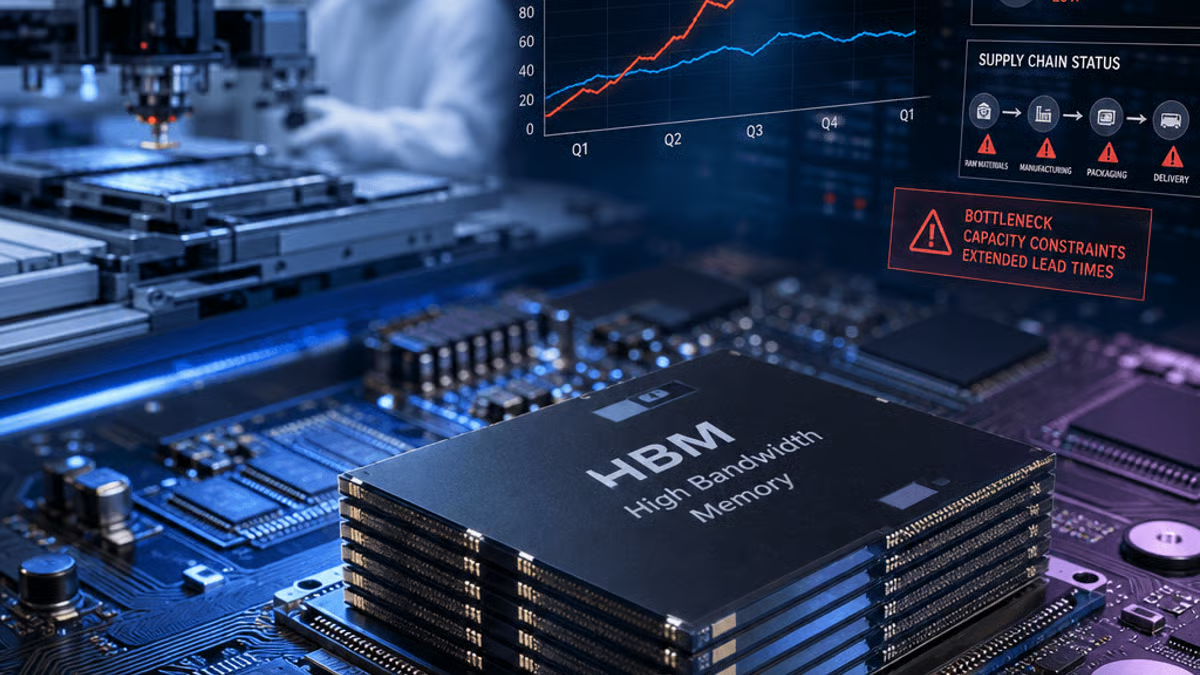
Micron Technology CEO Sanjay Mehrotra just dropped a truth bomb about why the memory chip industry can’t keep up with AI demand. Years of customers squeezing suppliers on price left chipmakers chronically underinvested in new capacity, he revealed in remarks to CNBC. The admission comes as memory prices surge and tech giants scramble for high-bandwidth memory chips essential for AI data centers.
Micron Technology CEO Sanjay Mehrotra isn’t mincing words about how the memory chip industry ended up in a supply crunch just as AI exploded demand. Speaking with CNBC, Mehrotra pointed directly at years of brutal pricing pressure from customers that left chipmakers unable to justify major capacity investments.
The dynamic Mehrotra describes is a classic commodities trap. When memory prices were falling through the mid-2020s, hyperscalers like Amazon, Microsoft, and Google leveraged their massive purchasing power to drive down costs. It made sense for their bottom lines, but it starved suppliers of the capital needed to build new fabs that take years to come online and cost billions of dollars.
Now that AI workloads require specialized high-bandwidth memory (HBM) chips, the industry’s running into hard capacity constraints. Micron, Samsung, and SK Hynix are all sold out of HBM production through much of 2027. The irony isn’t lost on anyone – the same customers who pushed for rock-bottom pricing are now begging for allocation.
Mehrotra’s comments offer rare public acknowledgment of the tension between chipmakers and their hyperscale customers. Memory suppliers have historically been reluctant to call out pricing dynamics, fearful of antagonizing their biggest buyers. But with Micron’s stock up sharply this year and the company holding pricing power for the first time in years, the CEO appears more willing to speak candidly about market dynamics.
The memory chip business has always been notoriously cyclical, swinging between gluts and shortages. But the current situation is different because it’s driven by a fundamental technology shift rather than typical inventory cycles. AI training and inference require memory bandwidth that traditional DRAM chips simply can’t deliver, creating structural demand for advanced packaging technologies that command premium pricing.
Industry analysts are watching whether this marks a sustainable shift in memory economics or just another peak before the next downturn. What’s clear is that chipmakers are using this moment to rebuild profit margins after years of compression. Micron reported its most profitable quarter in years recently, and competitors are seeing similar dynamics.
The underinvestment Mehrotra references has broader implications for the AI infrastructure buildout that Microsoft, Google, Meta, and others are racing to complete. Memory chips are a critical bottleneck for AI data centers, and no amount of Nvidia GPUs can compensate if the memory components aren’t available. Some AI projects are reportedly being delayed specifically due to HBM shortages.
Chipmakers are responding with aggressive capacity expansion plans, but memory fabs take 18-24 months to ramp to volume production. Micron is investing heavily in its Idaho facilities and new plants in upstate New York, backed by CHIPS Act funding. Samsung and SK Hynix are making similar moves, but the supply-demand imbalance will persist well into 2027.
What’s emerging is a recalibration of power dynamics in the semiconductor supply chain. The era of hyperscalers dictating terms to component suppliers appears to be ending, at least temporarily. Memory chipmakers are insisting on longer-term contracts with more stable pricing, and customers have little choice but to agree if they want guaranteed supply for their AI ambitions.
Mehrotra’s willingness to publicly discuss pricing pressure also signals confidence that Micron won’t face retaliation from customers who need the company’s chips. That’s a notable shift from previous cycles when suppliers feared being cut out of future designs if they pushed back too hard on pricing demands.
Mehrotra’s comments reveal how short-term pricing optimization created long-term supply constraints at exactly the wrong moment for the AI boom. The memory industry’s underinvestment during lean years means chipmakers can’t quickly scale to meet exploding demand from AI data centers. For tech giants racing to build AI infrastructure, the message is clear: the days of dictating terms to semiconductor suppliers are over, at least until the next downturn. The bigger question is whether this cycle will finally break the boom-bust pattern that’s defined memory markets for decades, or if we’re just witnessing another swing of the pendulum before gravity reasserts itself.










Leave a Reply