
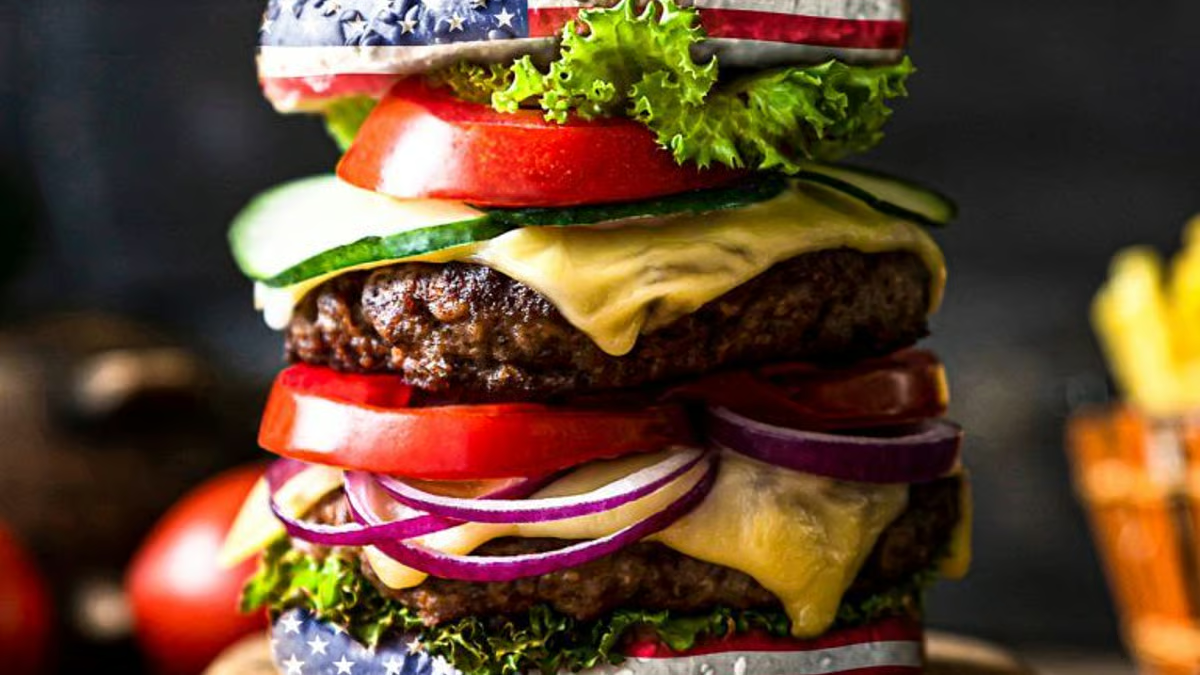
Somewhere between the drought maps and the grocery store aisle, America ran out of cows. Not completely. But enough that the beef industry now needs Wall Street’s help to make sense of itself. This week, CME Group launched a brand new futures contract for beef trim, the fatty scraps that get ground into hamburgers and meatballs. Think of it as a stock ticker, but for the meat in your burger. That is not a small thing. Futures markets exist to manage risk when prices get too wild to predict on gut feeling alone. And right now, beef prices are about as wild as it gets.
Ground beef averaged $6.73 a pound through May, according to the Federal Reserve Bank of St. Louis. Some regional reports put fresh beef even higher, near $9.60 a pound. Prices are up 19% year over year by one measure, and 22% since January 2025 by another. However you slice it, the math points the same direction: up, fast, and without much sign of slowing before the Fourth of July.
Where did all the cows go
The short answer is drought. The slightly longer answer involves decades of ranchers getting squeezed out of business, one bad year at a time. The US cattle herd now sits at 86.2 million head, the smallest it has been in 75 years. Since 1997, the country has lost more than 450,000 cattle ranches. That is not a typo. Entire towns that once ran on cattle money, feed stores, trucking routes, vet clinics, have quietly emptied out as the herds shrank around them.
About 75% of the national beef cow herd is currently sitting in drought conditions. Grass does not grow without rain, and cattle do not fatten up without grass. Ranchers have been paying more for feed, hay, water, and credit just to keep animals alive, let alone grow their herds. Live cattle prices climbed 37% between June 2024 and May 2026, which is actually faster than the retail price of beef itself, which rose 27% over the same stretch. That gap tells you something important: the pain is starting on the ranch, long before it ever reaches your grill.
Then there is the screwworm. This is not a metaphor. New World Screwworm is a real, flesh-eating pest that has forced the US to halt live cattle imports from Mexico, one of the country’s key sources of replacement cattle. Fifteen confirmed cases have already shown up on US soil. It is a slow-moving problem with a fast-moving consequence: one more reason the cattle supply cannot rebuild itself anytime soon, even if ranchers wanted it to.
The imports paradox
Here is the part that should confuse anyone paying attention: US beef imports are up 86% since 2021, and beef prices are still up 56% over that same period. Bringing in more meat from overseas was supposed to ease the squeeze. It has not.
New Zealand has become the biggest beneficiary of this gap. NZ beef exports hit a record $1.56 billion, driven almost entirely by American demand for the lean beef used in burgers. New Zealand accounted for 46% of its beef export volume heading to the US in the first quarter alone, and roughly three quarters of what it sends over is the fattier trim American hamburger makers are desperate for. American cattle are typically raised for leaner cuts, so the country has never produced enough of the fatty trim that a proper burger actually needs. New Zealand fills that gap. Now that gap has turned into the biggest trade story in the entire cattle business.
Imports alone were never going to fix this. Rebuilding a domestic herd takes years, since a calf born today will not be ready for market for a couple more. Meanwhile, the US Department of Justice confirmed in May that it is investigating potential antitrust violations in the beef processing industry. Four companies control more than 85% of US beef processing capacity. When that few players control that much of the pipeline, it becomes hard to tell whether high prices are purely a supply problem or partly a market structure problem. Federal investigators are trying to figure that out right now.
Chicken quietly wins the summer
While beef has been setting records for all the wrong reasons, chicken has barely moved. The Consumer Price Index for poultry rose just 1.8% over the past year. Wholesale chicken prices are hovering around $1.19 to $1.20 a pound and have actually been ticking down slightly in recent weeks. Chicken production forecasts got a boost too, with strong hatchery numbers and healthy profit margins keeping supply high through the rest of 2026.
Pork tells a similar story. Retail pork prices are up a modest 2.3%, and farmers have offset a slight slowdown in hog slaughter by raising animals to heavier weights, which keeps the overall supply steady. Eggs, somewhat surprisingly, have gotten cheaper than they were a year ago, giving budget-conscious shoppers another easy substitute. Turkey is the one exception worth watching, with hatchery declines pointing toward tighter supply and higher prices heading into the fall.
The result is a very visible shift at the meat counter. Beef sales are up 8% in dollar terms, but the actual number of units sold is down 4%, meaning people are buying less beef even though they are spending more on it. Tyson Foods reported beef volumes falling as much as 13.1% in its most recent quarter, while its chicken volumes rose 1.7%. Skirt steak has become one of the fastest-growing beef cuts of the season, mostly because shoppers are trading down from ribeye and strip steak to something cheaper that still delivers real beef flavor.
Why any of this matters beyond the grill
A futures contract on hamburger meat sounds almost funny until you think about what it actually represents. Restaurants, food companies, and grocery chains all need a way to lock in prices months ahead of time so they are not blindsided by another price spike. CME’s new beef trim contract gives them that tool. It is the financial plumbing catching up to a supply crisis that has been building for years.
For a generation raised on food delivery apps and instant grocery pickup, this is also a lesson in something apps cannot fix. No algorithm can conjure more cattle out of a drought. No same-day delivery service can undo fifteen years of ranchers leaving the business. Supply chains for living animals move at the speed of biology, not software, and that mismatch is exactly why prices have gotten this disconnected from what shoppers expect.
The practical upshot for this weekend’s cookout is simple enough. Cheaper beef is not arriving in time for the Fourth of July, and probably not for next year’s either, since rebuilding a cattle herd takes real time. Chicken thighs, pork chops, a smaller pile of skirt steak, and a table crowded with side dishes are the new normal for the American backyard barbecue. The grill still gets fired up. What is on it just looks a little different now, and the reasons why stretch from a Texas drought all the way to a trading floor in Chicago.











Leave a Reply