
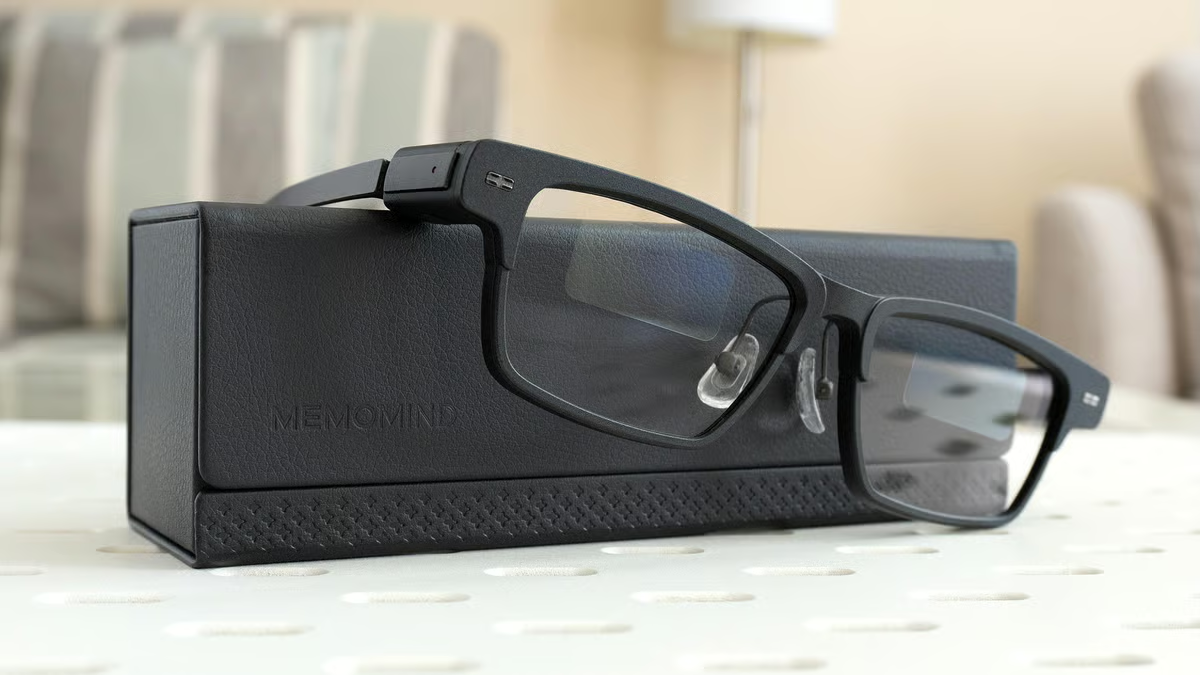
Xgimi is launching its MemoMind One smart glasses on Kickstarter today, bringing AI-powered features to your face without the privacy concerns of camera-equipped competitors. The Chinese projector company’s first wearable ditches cameras entirely for a lighter, more discreet design that uses micro-LED projectors to beam a bright green display only you can see. Starting at $399 for early backers (retail $599), the glasses ship in late July with voice AI, live translation, and heads-up navigation – but after a week of hands-on testing, they’re not quite ready to replace your smartwatch.
Xgimi, best known for its all-in-one smart projectors, is making a surprising pivot into wearables with the MemoMind One – AI-powered smart glasses that deliberately skip cameras to address privacy concerns that have plagued competitors like Meta and Snap. The company is launching a Kickstarter campaign today with early bird pricing at $399, a 33% discount from the planned $599 retail price.
The pitch is compelling: a lightweight, discreet pair of glasses that projects information directly into your field of vision while looking like ordinary eyewear. After testing a beta unit for a week, The Verge’s Andrew Liszewski found the concept delivers on some promises while falling short on others.
The MemoMind One uses the same micro-LED projector and waveguide prism technology as Meta’s $800 Ray-Ban Display glasses, but opts for a bright green monochrome display instead of full color. The choice isn’t just about cost – the high-contrast green makes the floating screen readable indoors even in bright conditions, though outdoor visibility suffers without dark backgrounds to create contrast.
At 47 grams, they’re noticeably heavier than regular reading glasses but still comfortable for extended wear. The oversized temple arms house impressive tech: batteries rated for 16 hours of use, Harman Kardon speakers, charging contacts, and the display hardware. Most people didn’t realize they had smart features until the wearer started playing audio – which points to a significant flaw.
The built-in speakers proved too loud even at minimum volume, making phone calls and music playback audible to anyone nearby. “Phone calls that were far from private,” Liszewski noted in his hands-on review. This undermines one of the product’s core use cases as an earbud alternative.
The AI assistant, activated by saying “hi, Memo” or holding the single button near the right hinge, responded to queries in about four to five seconds – fast enough that Liszewski found himself using it more frequently than Siri on his Apple Watch. Responses display as text with optional audio readback. But there’s a catch: you can’t discreetly whisper questions, defeating the “look smarter than you are” use case many would hope for.
Xgimi is betting heavily on practical productivity features. The customizable home screen shows time, date, weather, and battery level alongside four configurable sections for stocks, curated news headlines, calendar events, to-do lists, and notifications. A Quick Launch menu provides instant access to three functions: a teleprompter that matches your speaking pace, on-the-fly captions for videos, and a voice recorder with real-time transcription and AI-generated summaries.
The live translation feature holds particular promise. Liszewski, a Canadian with “abysmal French skills,” tested the Listen-in Mode that generates translated transcriptions on the display. Accuracy was solid when the microphone clearly picked up speech, but background noise easily confused it, and you can’t ask the AI to detect languages automatically – you have to manually select the translation pair in the mobile app first.
That dependency on the mobile app emerged as a recurring frustration. The mapping feature, which displays heads-up navigation directions, requires you to search for destinations in the app and currently only supports walking and cycling routes. “If I’m going to the trouble of pulling out my phone, I’ll just use it to complete a given task,” Liszewski concluded.
Notifications appear as condensed summaries, giving you the gist of messages but no way to read full content or respond – falling well short of smartwatch functionality. The glasses can detect head movements to wake the display, but navigation relies on that single physical button for cycling through interface sections.
One feature raised red flags: Moments, an optional $19.99/month premium service that continuously records audio to generate an AI summary of your day. Xgimi promotes the camera-free design as privacy-focused, but Moments undermines that positioning entirely. Liszewski found the auto-generated journal “frequently inaccurate” and prone to confusing events since it relies solely on audio without visual context. His recommendation: keep it turned off.
The Kickstarter offers three style options with customization available at higher price tiers. Standard pricing jumps to $879 with prescription lenses, discounted to $499 for backers. Color customization pushes retail to $699 ($449 for backers). Xgimi plans to ship units in late July, an ambitious timeline given the beta software and “buggy mobile app that’s missing features” Liszewski encountered.
The MemoMind One enters a crowded but still-nascent smart glasses market. Meta has been aggressive with its Ray-Ban partnership, recently adding display capabilities to complement camera and AI features. Snap continues iterating on its Spectacles AR glasses. But both companies face ongoing privacy concerns about cameras constantly pointed at the world.
By eliminating cameras entirely, Xgimi sidesteps the biggest consumer hesitation around smart glasses while keeping weight down and battery life up. The 16-hour rating significantly outpaces most camera-equipped alternatives. Whether that trade-off resonates with consumers depends on how much value they see in AI assistance, translation, and heads-up information versus photo/video capture.
The bigger question is whether smart glasses need to do everything a smartwatch does, or if they can succeed with a more focused feature set. The MemoMind One clearly isn’t a smartwatch replacement – it’s something different, positioned more as a heads-up display for information you’d otherwise check your phone for. But as Liszewski discovered, if you still need to pull out your phone for most tasks, the value proposition gets murky.
Xgimi’s projector expertise shows in the display quality and battery efficiency, but the software experience needs work before the July ship date. The company didn’t respond to requests for comment on whether the buggy app and missing features Liszewski encountered would be addressed in the final release.
Xgimi’s MemoMind One represents an intriguing middle ground in the smart glasses market – sacrificing cameras for better privacy, lighter weight, and longer battery life while delivering genuinely useful AI features through a heads-up display. But the execution isn’t quite there yet. The glasses shine when providing glanceable information and quick AI assistance, yet stumble on basics like private audio and seamless phone integration. At $399 for Kickstarter backers, they’re priced competitively against Meta’s offerings, but the missing features and mobile app dependency leave them feeling more like a promising prototype than a finished product. The real test comes in July when shipping units arrive – if Xgimi can polish the software and deliver on the features currently in beta, these could carve out a distinct niche for users who want AI assistance without surveillance cameras on their face.








Leave a Reply