

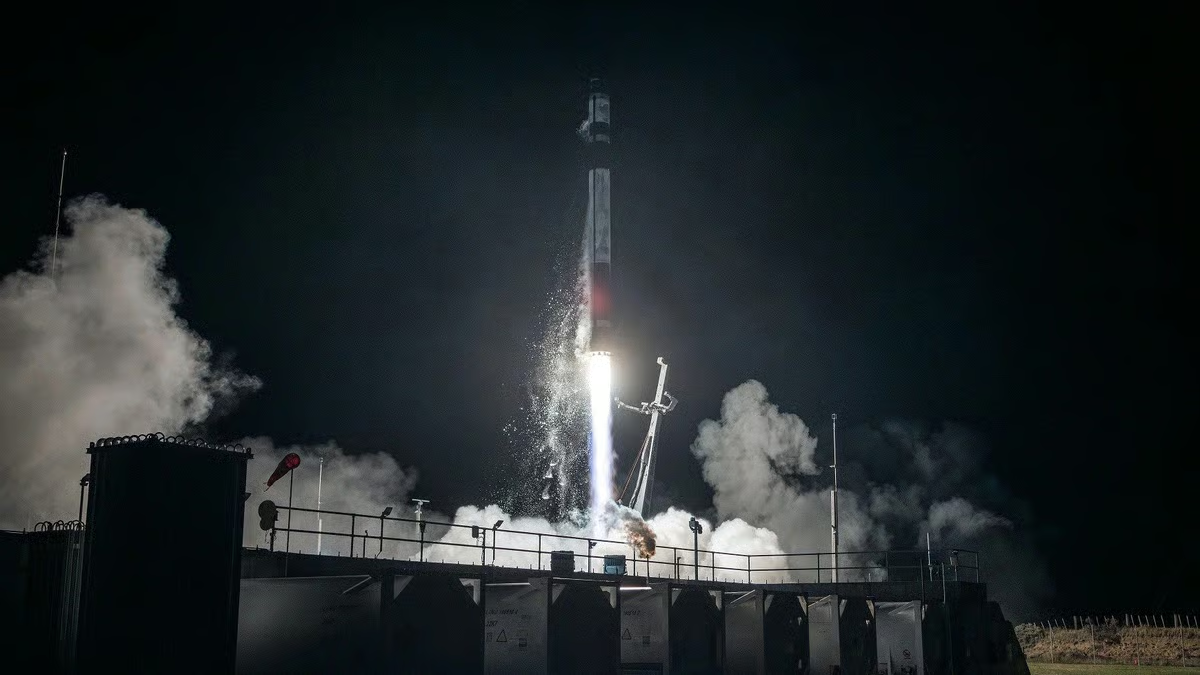
Space just got smarter. Firefly Aerospace has successfully operated NVIDIA’s Jetson AI computing platform in lunar orbit for the first time, marking a pivotal moment for autonomous space exploration. The deployment proves that commercial AI hardware can survive and function in the harsh radiation environment beyond Earth’s protective magnetosphere, opening new possibilities for intelligent spacecraft that can make split-second decisions without waiting for commands from ground control.
Firefly Aerospace just crossed a threshold that space engineers have been working toward for years. The company’s lunar mission successfully deployed and operated NVIDIA’s Jetson AI computing platform in orbit around the Moon, proving that commercial AI hardware can handle the brutal conditions of deep space.
The achievement matters because it fundamentally changes what spacecraft can do. Until now, missions beyond Earth orbit relied on radiation-hardened processors that were years behind consumer technology in computing power. That meant limited onboard intelligence and constant dependence on ground control. NVIDIA’s Jetson platform brings modern AI capabilities to space, enabling real-time image recognition, autonomous navigation, and instant decision-making without the 2.5-second communication delay between Earth and the Moon.
Firefly Aerospace didn’t just turn the system on and call it a success. The company put the Jetson through its paces in lunar orbit, demonstrating that it could process sensor data, run AI models, and maintain stable operation while being bombarded by cosmic radiation and exposed to temperature swings that would destroy most consumer electronics. The fact that a platform originally designed for terrestrial edge computing applications like autonomous vehicles and robotics could survive this environment represents a major validation for commercial space hardware.
The timing couldn’t be better. NASA’s Artemis program is racing to establish a permanent lunar presence, and the commercial space industry is planning everything from lunar bases to asteroid mining operations. All of these missions need intelligent systems that can operate independently when communication with Earth becomes impossible or impractical. According to industry analysts, the market for space-qualified AI computing could reach $2.8 billion by 2030 as autonomous capabilities become standard rather than optional.
NVIDIA’s Jetson platform wasn’t originally built for space, which makes this deployment even more significant. The company designed Jetson for edge AI applications on Earth – self-driving cars, industrial robots, smart cameras. But its combination of powerful GPU acceleration, energy efficiency, and compact form factor turned out to be exactly what space missions needed. Firefly Aerospace likely implemented additional radiation shielding and thermal management, but the core computing architecture proved robust enough to function in an environment that would fry most electronics.
The implications ripple across the entire space industry. SpaceX, Blue Origin, and other commercial space companies have been developing their own approaches to autonomous spacecraft systems, but NVIDIA’s proven platform could become the standard. The company’s CUDA software ecosystem and extensive AI libraries mean that developers can build space applications using familiar tools instead of learning proprietary systems from scratch.
What’s particularly interesting is what this means for lunar surface operations. A spacecraft equipped with Jetson-class AI can analyze terrain in real-time, identify hazards, select landing sites, and adjust trajectory without waiting for human approval. For lunar landers and rovers, that capability could mean the difference between mission success and cratering into an unexpected boulder field. The same technology enables scientific instruments to recognize interesting geological features and automatically adjust observation priorities.
The deployment also validates a broader trend in space technology – the shift from purpose-built space hardware to adapted commercial systems. Traditional aerospace suppliers spent decades developing radiation-hardened processors that cost millions and delivered performance equivalent to decade-old smartphones. Companies like Firefly Aerospace are proving that with proper engineering, commercial hardware can compete at a fraction of the cost and with vastly superior capabilities.
Industry watchers expect this success to accelerate adoption of AI computing across space missions. The European Space Agency, China’s space program, and commercial operators worldwide are all developing lunar and deep space missions that need autonomous capabilities. NVIDIA’s first-mover advantage in proven lunar operation could translate into a dominant position in what’s becoming a critical market for the company’s edge computing business.
Firefly Aerospace’s successful operation of NVIDIA’s Jetson platform in lunar orbit isn’t just a technical milestone – it’s a proof point that changes the economics and capabilities of space exploration. By demonstrating that commercial AI hardware can survive and thrive beyond Earth orbit, the mission opens the door for a new generation of intelligent spacecraft that can think for themselves. As the space industry accelerates toward permanent lunar presence and deeper solar system exploration, the ability to deploy powerful, affordable AI computing becomes essential rather than aspirational. The Moon just became the ultimate testing ground for the next wave of autonomous space technology.









Leave a Reply