
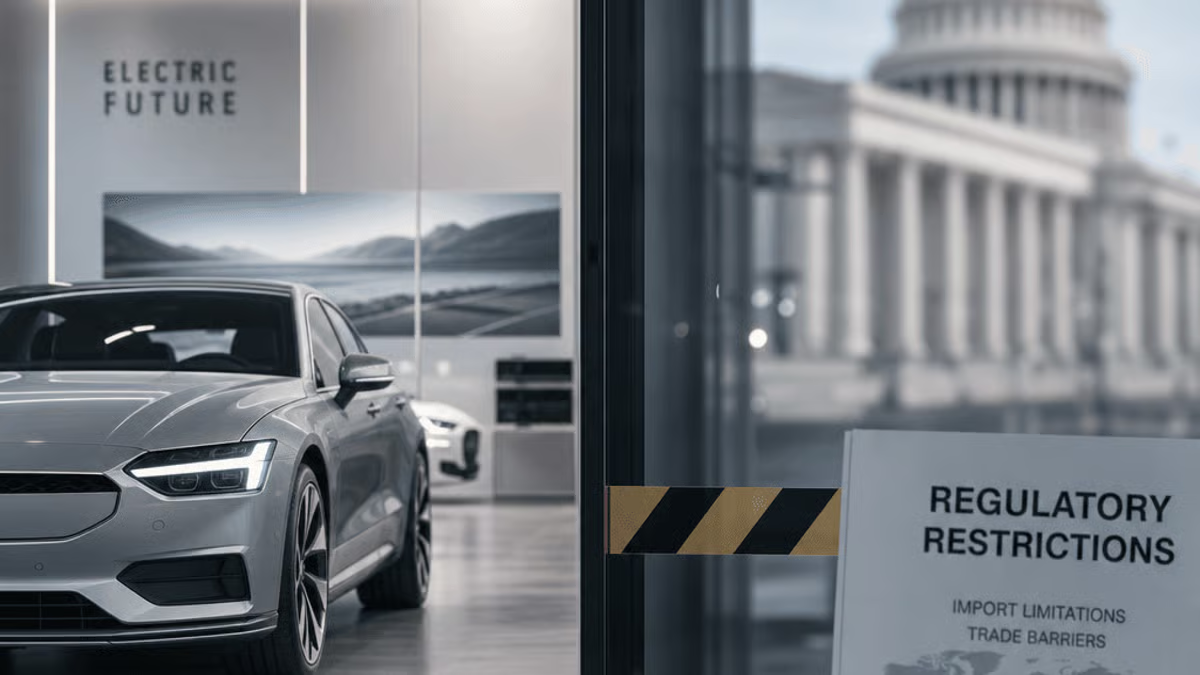
The Trump administration just slammed the door on Polestar’s US ambitions. The Department of Commerce denied the Chinese-owned electric vehicle maker special authorization to continue selling new models in the American market, marking one of the most aggressive moves yet in the escalating trade standoff between Washington and Beijing. The decision leaves thousands of prospective buyers in limbo and signals a hardening stance on Chinese automotive technology entering the US.
The Department of Commerce dropped a bombshell on the EV industry Thursday, refusing to grant Polestar the special authorization it needed to keep selling electric vehicles in the United States. The decision effectively bars the Swedish brand from the American market due to its ownership by Chinese automaker Geely, representing the most dramatic regulatory action yet against Chinese automotive interests.
The ruling comes as no surprise to industry watchers who’ve been tracking the Trump administration’s increasingly hostile posture toward Chinese technology companies. But the speed and decisiveness of the Commerce Department’s rejection caught many off guard. Polestar had been lobbying heavily for an exemption, arguing its vehicles are designed in Sweden and increasingly manufactured in South Carolina.
That argument clearly didn’t sway regulators. The denial appears rooted in concerns about Chinese control over connected vehicle data and automotive software systems – issues that have dominated Washington policy discussions for months. Polestar vehicles, like most modern EVs, collect vast amounts of driver and location data that flows back to company servers.
The immediate impact hits hardest for buyers who’ve placed deposits on upcoming Polestar models. The automaker’s sleek Polestar 2 sedan and Polestar 3 SUV have carved out a loyal following among EV enthusiasts seeking alternatives to Tesla. Now those customers face an uncertain path forward, with dealers unable to fulfill orders and the company scrambling to respond.
Existing Polestar owners can breathe slightly easier – the Commerce Department ruling doesn’t affect service and maintenance for vehicles already on US roads. But it creates a bizarre situation where current models become orphaned products, potentially hammering resale values as the brand loses its future in the American market.
The decision reverberates far beyond one automaker. Geely also owns Volvo Cars and holds significant stakes in other global automotive players. While the ruling specifically targets Polestar, it raises questions about how far the administration might extend restrictions on Chinese-linked automakers. Volvo hasn’t faced similar action yet, but the Swedish brand’s Chinese ownership now feels like a vulnerability rather than a strength.
Competitors are already positioning to capture Polestar’s market share. Tesla dominates the premium EV segment, while legacy automakers like Ford and GM have ramped up electric offerings. Korean manufacturers Hyundai and Kia also stand to benefit, having invested heavily in US manufacturing to avoid similar political headaches.
The timing couldn’t be worse for Polestar. The company went public through a SPAC merger in 2022 and has been burning cash while scaling production. Losing access to the crucial US market – the world’s second-largest EV market behind China – deals a devastating blow to growth projections and financial viability. The company’s stock price will likely face intense pressure when markets open.
Industry analysts see this as part of a broader decoupling between American and Chinese automotive ecosystems. The US has been steadily tightening restrictions on Chinese EV imports and technology, while China has responded with its own barriers to American automakers. What emerges looks increasingly like two separate, incompatible markets with distinct supply chains and technology standards.
The regulatory landscape keeps shifting under automakers’ feet. Earlier Commerce Department rules targeted specific Chinese components and software in connected vehicles. This Polestar decision takes a more sweeping approach, blocking an entire brand regardless of where specific components originate or vehicles are assembled. That precedent could have far-reaching implications for the global automotive industry’s complex web of partnerships and ownership structures.
Consumer choice takes a hit in the short term. Polestar offered distinctive Scandinavian design and competitive pricing in a market increasingly dominated by a few major players. The brand’s exit removes options for buyers seeking alternatives to the usual suspects, potentially slowing overall EV adoption as the industry tries to reach mainstream consumers.
The Commerce Department’s decision to bar Polestar from the US market marks a watershed moment in the intersection of trade policy and automotive technology. It’s not just about one Swedish-Chinese EV brand losing access to American buyers – it’s a signal that the US government will aggressively use regulatory power to keep Chinese-controlled automotive technology out of the country, regardless of where vehicles are designed or built. For the EV industry, already navigating complex supply chains and intense competition, this adds a new layer of geopolitical risk that could reshape which companies succeed in different markets. Buyers lose options, Polestar loses its second-biggest potential market, and the automotive world gets another reminder that the future of mobility will be shaped as much by Washington and Beijing as by engineers and designers.









Leave a Reply