
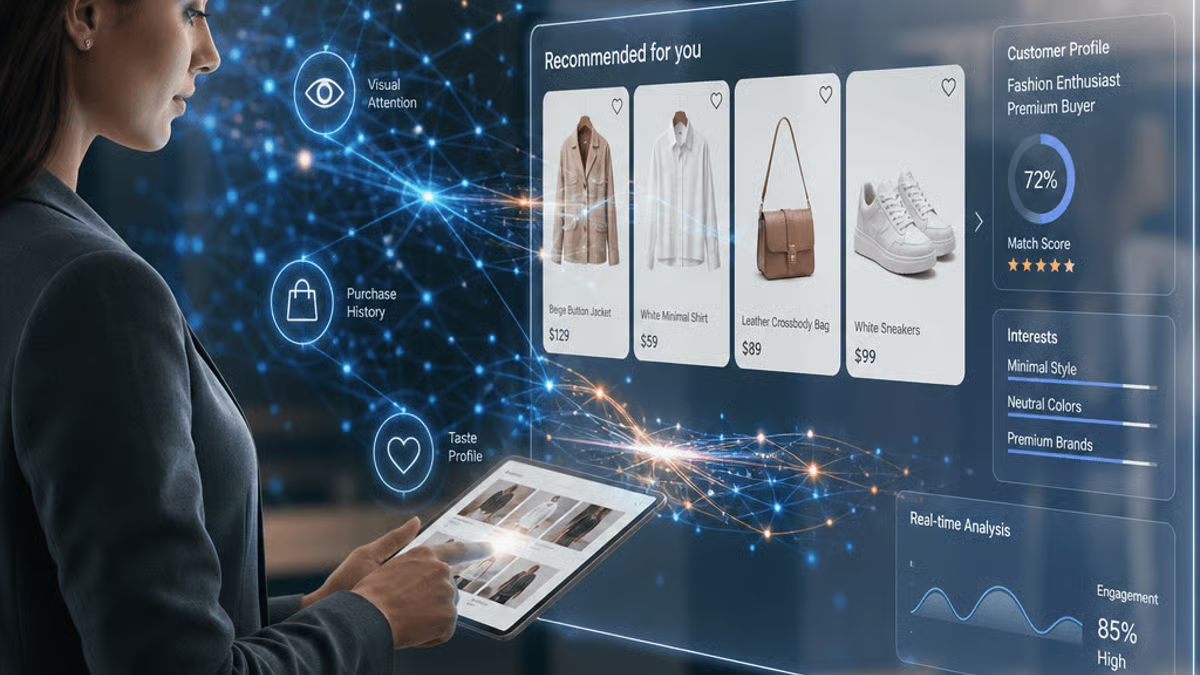
A team of former Spotify engineers just landed $10 million to solve one of online retail’s biggest headaches – helping shoppers find what they actually want to buy. The startup, backed by Bessemer Venture Partners and Gradient Ventures, is applying the same AI tech that keeps you hooked on Spotify’s Discover Weekly to the chaotic world of e-commerce. It’s a pitch that’s resonating with investors who’ve watched personalization transform streaming but largely fail in retail.
Spotify cracked the code on keeping listeners engaged for hours. Now a group of ex-employees thinks they can do the same thing for online shopping.
The unnamed startup, which emerged from stealth mode today, closed a $10 million Series A led by Bessemer Venture Partners and Gradient Ventures, Google’s AI-focused fund. The founding team includes former engineers who built core pieces of Spotify’s recommendation infrastructure – the same system that’s credited with driving over 30% of listening activity on the platform.
Their pitch is straightforward: e-commerce personalization is stuck in 2015. Most online retailers still rely on clunky rule-based engines that show you hiking boots because you once bought socks. Meanwhile, Spotify’s been predicting your next favorite song with scary accuracy for years. The gap between entertainment and commerce personalization has never been wider.
“We watched Netflix and Spotify completely transform how people discover content, but shopping still feels like wandering through a department store blindfolded,” one of the co-founders said in a statement. The platform they’ve built analyzes shopping behavior in real time – every click, hover, and scroll – to build what they call a “taste profile” for each visitor. It’s less about transaction history and more about understanding intent signals as they happen.
The technology continuously fine-tunes predictions based on micro-interactions. If someone lingers on product descriptions or zooms into fabric details, the system learns they’re detail-oriented. Rapid browsing without clicks? They’re probably in browse mode, not buy mode. The AI adjusts recommendations accordingly, shifting from discovery to conversion tactics on the fly.
Bessemer’s investment thesis hinges on timing. E-commerce conversion rates have flatlined around 2-3% industry-wide for the past few years, even as digital ad costs keep climbing. Retailers are desperate for tools that can squeeze more revenue from existing traffic without burning more cash on acquisition. Personalization engines that actually work represent one of the few levers left to pull.
The competitive landscape is crowded but messy. Legacy players like Monetate and Dynamic Yield dominate enterprise accounts but often require months-long implementations and dedicated data science teams. Newer entrants like Nosto and Clerk.io target mid-market retailers but still lean heavily on collaborative filtering – showing you what similar shoppers bought rather than what you specifically might want next.
What sets this Spotify-alumni approach apart is the real-time learning component. Traditional recommendation engines run batch updates overnight or weekly, meaning they’re always working with stale data. This platform processes behavioral signals continuously, adapting recommendations within seconds of user actions. It’s the difference between a playlist that updates daily versus one that responds to what you just skipped.
The technical architecture borrows heavily from streaming media playbooks. Instead of analyzing purchase history alone, the system treats every session as a listening session – tracking engagement depth, exploration patterns, and abandonment triggers. The AI looks for behavioral analogues: someone who samples dozens of products without buying might be treated like a Spotify user who skips through playlists looking for the right vibe.
Gradient Ventures brought more than capital to the deal. Google’s AI investment arm is providing access to advanced machine learning infrastructure and research partnerships. For a young startup trying to compete with Amazon’s recommendation juggernaut, that kind of backing matters. Amazon’s engine benefits from decades of purchase data across billions of transactions – an advantage that’s nearly impossible to replicate.
But the founders believe behavioral data beats transaction data in the early stages of discovery. Most shoppers don’t know what they want until they see it, which is where real-time intent signals become valuable. You can’t predict someone’s next purchase from their order history if they’ve only bought twice from your site. You can predict it from how they’re browsing right now.
The $10 million will fund initial customer pilots and engineering headcount. The company’s already testing with a handful of mid-size direct-to-consumer brands, though they’re not disclosing names yet. Early results suggest conversion rate lifts in the 15-25% range for visitors who interact with AI-generated recommendations versus standard merchandising.
Retail tech investors have been burned before by personalization promises that didn’t deliver. The sector’s littered with startups that raised big rounds, signed flashy logos, then disappeared when ROI didn’t materialize. What’s different this time is the maturity of underlying AI models and the proven track record of the team behind them. These aren’t academics theorizing about recommendation systems – they’re engineers who’ve already built them at scale for 500 million users.
The bigger question is whether shopping behavior is fundamentally different enough from listening behavior that the playbook won’t translate. Music discovery is low-stakes and habitual. You can skip a bad recommendation without consequence. E-commerce decisions involve money, research, and often anxiety. Getting a product recommendation wrong doesn’t just annoy a user – it can erode trust and tank conversion rates.
But that’s exactly why the founders think there’s opportunity. If they can bring even a fraction of Spotify’s recommendation magic to retail, the impact on conversion economics would be massive. A 20% lift in conversion rate for a mid-size retailer doing $50 million in annual online revenue translates to $10 million in incremental sales. The math works if the tech delivers.
The bet here isn’t just on AI or personalization – it’s on whether the principles that made Spotify addictive can make shopping less frustrating. If behavioral data can predict your next song with 80% accuracy, maybe it can predict your next purchase too. The $10 million gives this team runway to prove the thesis with real retailers and real revenue. Investors are clearly banking on the pedigree, but customers will judge them on conversion lifts. In e-commerce, nobody cares about your recommendation algorithm until it shows up in the revenue column.










Leave a Reply