
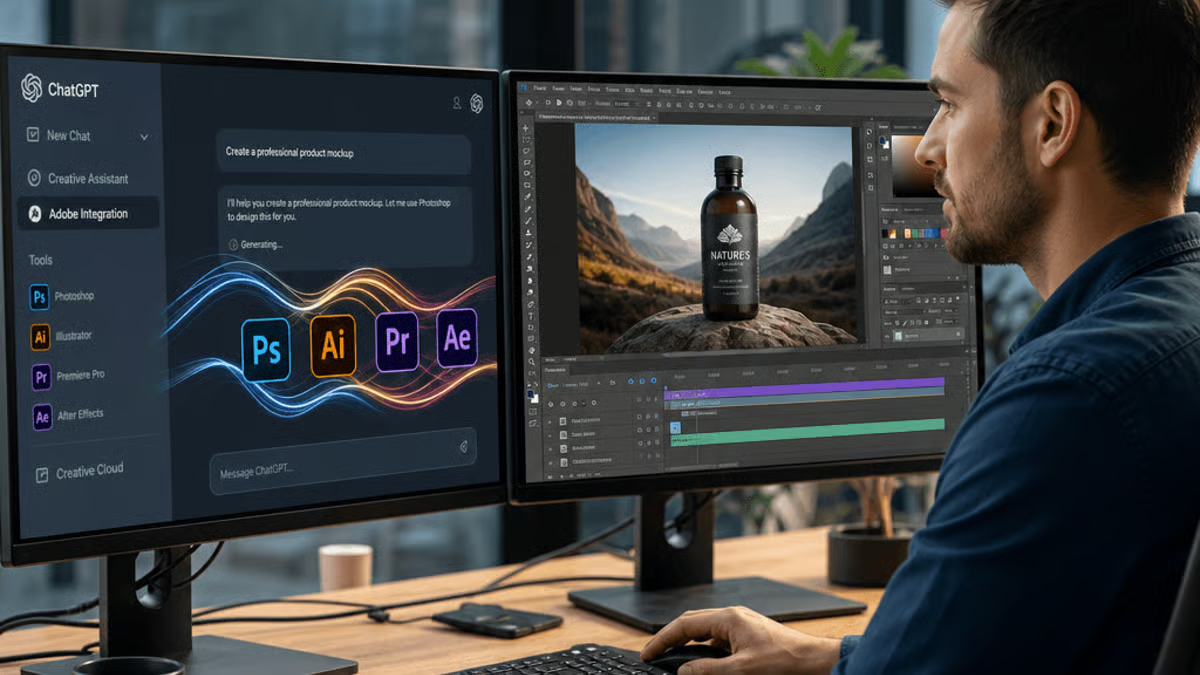
Adobe just made a bold move to meet creative professionals where they already work. The design software giant launched a new plugin that embeds over 70 Adobe tools directly into ChatGPT, letting users access everything from Photoshop to Premiere without ever leaving the AI chat interface. Available today across ChatGPT’s Work and Codex environments, the integration signals Adobe’s bet that the future of creative work happens inside AI assistants, not standalone apps.
Adobe is rewriting the rules for how creative professionals access design tools. The company announced today it’s launching a ChatGPT plugin that brings its entire Creative Suite ecosystem directly into OpenAI’s conversational interface. Users can now fire up Photoshop, Illustrator, Premiere Pro, and more than 70 other Adobe applications without toggling between windows or breaking their workflow.
The plugin works across ChatGPT’s Work and Codex offerings, targeting both enterprise teams and developers who’ve already embedded ChatGPT into their daily routines. According to Adobe’s announcement via ZDNet, the integration is live as of today, making it one of the most comprehensive third-party tool integrations ChatGPT has seen to date.
What makes this launch particularly notable is the scope. Rather than cherry-picking a handful of flagship products, Adobe went all-in, making its full creative arsenal available through natural language commands. A designer could theoretically ask ChatGPT to “create a logo in Illustrator, then animate it in After Effects” and execute both tasks without leaving the chat window. That level of integration fundamentally changes how creative work gets done, especially for teams already using ChatGPT for brainstorming and project planning.
The timing isn’t accidental. As AI assistants become the central hub for knowledge work, software companies face a choice: integrate or risk becoming irrelevant. Adobe clearly chose integration. By embedding its tools where users already spend their time, the company is betting on friction-free access over traditional desktop dominance. It’s a calculated pivot that acknowledges ChatGPT’s grip on the enterprise workspace.
For OpenAI, this partnership represents a major validation of its platform strategy. Landing Adobe, one of the creative industry’s most entrenched players, demonstrates that ChatGPT isn’t just a chatbot anymore. It’s becoming the operating system for AI-powered work. The more essential tools that plug into ChatGPT, the harder it becomes for competitors like Google’s Gemini or Microsoft’s Copilot to pry users away.
The plugin’s availability in both Work and Codex environments suggests Adobe is targeting two distinct user bases. Work users get seamless access to creative tools during team collaboration, while Codex users can potentially automate design tasks through code. That dual-channel approach maximizes Adobe’s reach across technical and non-technical audiences alike.
What remains unclear is how licensing works under this new model. Adobe’s subscription empire has always been tightly controlled, with per-seat pricing and complex enterprise agreements. Integrating those products into a third-party platform raises questions about authentication, usage limits, and whether ChatGPT users need existing Adobe subscriptions to access the tools. The company hasn’t publicly detailed those mechanics yet.
Still, the strategic implications are massive. If this integration proves successful, expect every major software vendor to follow Adobe’s playbook. The days of launching standalone apps and hoping users find them are fading fast. The new game is about embedding tools where attention already exists, and right now, that’s squarely inside AI assistants.
Competitors like Canva and Figma will be watching this launch closely. Adobe just made it exponentially easier for ChatGPT users to stay inside its ecosystem. If the plugin gains traction, it could lock in a new generation of creatives who never bother learning competing tools. That’s the kind of distribution advantage money can’t buy.
For now, the plugin represents Adobe’s clearest signal yet that it sees AI platforms as partners, not threats. Rather than building a competing AI assistant, Adobe is racing to become the default creative toolkit inside every AI workspace. It’s a smart hedge in a market where the interface layer is still up for grabs.
Adobe’s ChatGPT plugin isn’t just a feature launch – it’s a fundamental rethinking of how creative software gets distributed and accessed. By embedding 70+ tools directly into the AI workspace where millions already collaborate, Adobe is positioning itself as the essential creative layer in an AI-first world. The move forces competitors to either follow suit or risk obsolescence, while giving OpenAI another powerful reason for enterprises to stick with ChatGPT. As AI assistants evolve from helpful chatbots into full-fledged work platforms, integrations like this will define which legacy software companies survive the transition and which get left behind.




Leave a Reply