
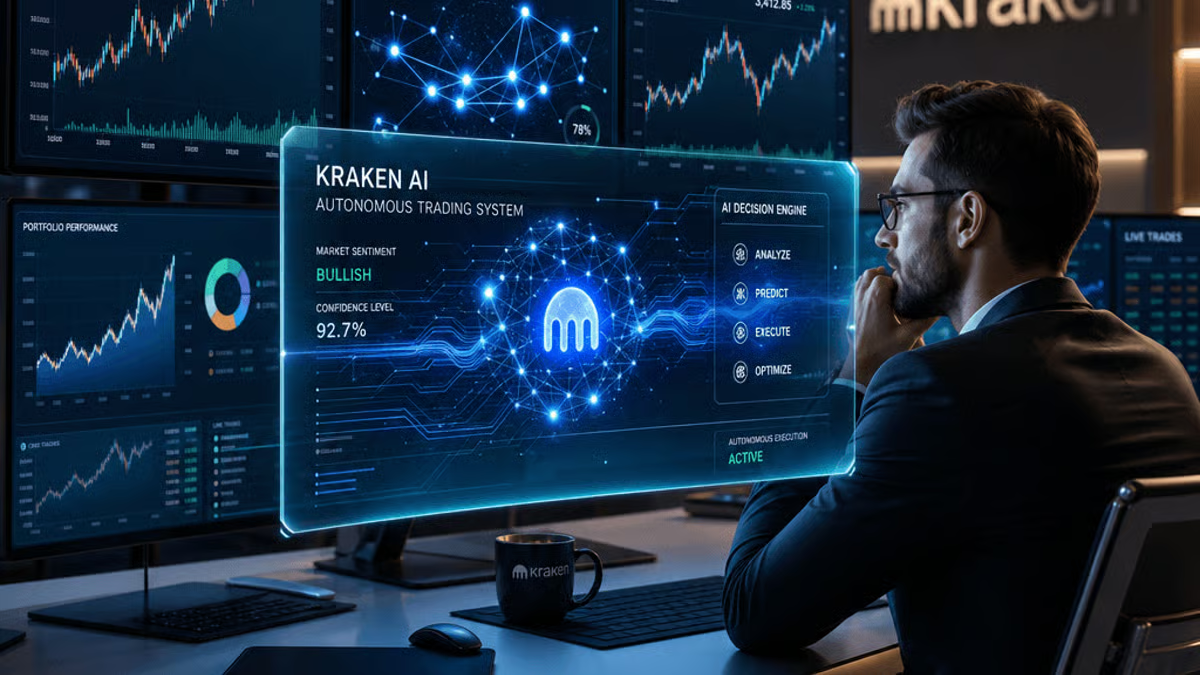
Kraken just became the first major crypto exchange to put AI agents at the center of its trading platform. The company told CNBC exclusively that it’s relaunching its entire app around agentic trading – autonomous AI systems that can execute complex trading strategies without constant human oversight. The move signals a fundamental shift in how crypto exchanges see themselves: less as simple buy-sell platforms, more as AI-powered financial operating systems that extend far beyond cryptocurrency.
Kraken is about to flip the script on what a crypto exchange can be. The San Francisco-based platform told CNBC it’s preparing to relaunch its entire app with agentic trading as the foundation – not a feature bolted on the side, but the core architecture around which everything else revolves.
Agentic trading represents a leap beyond the chatbots and alerts that have defined AI in finance until now. These are autonomous systems that can monitor market conditions across dozens of assets, recognize patterns, execute trades, rebalance portfolios, and adjust strategies in real-time based on changing conditions. Think of it as handing your trading strategy to a tireless analyst who never sleeps, never panics, and can process millions of data points per second.
The timing matters. While competitors like Coinbase and Binance have experimented with AI-powered analytics and trading signals, nobody’s rebuilt their entire platform around the assumption that AI agents will handle the bulk of trading decisions. Kraken is essentially betting that the future of crypto trading looks less like humans staring at charts and more like humans setting high-level goals while AI handles execution.
What makes this launch particularly significant is that it extends beyond crypto. The phrase “evolve beyond crypto” in Kraken’s positioning suggests the platform is preparing to let these AI agents trade across asset classes – potentially stocks, commodities, forex, and traditional securities alongside Bitcoin and Ethereum. That would transform Kraken from a crypto-native exchange into something closer to a universal AI trading platform that happens to include crypto.
The technology builds on recent breakthroughs in large language models and reinforcement learning that have made AI agents reliable enough to trust with real capital. These aren’t simple algorithmic trading bots following rigid if-then rules. Modern agentic systems can understand context, adapt to unprecedented market conditions, and even explain their reasoning in natural language. A trader could theoretically ask their AI agent why it sold a position, and get a coherent explanation referencing specific market signals and risk thresholds.
For Kraken, which has long positioned itself as the exchange for sophisticated traders, agentic trading is a natural evolution. The platform already offers advanced order types, margin trading, and futures contracts – tools that appeal to users who want fine-grained control over their strategies. AI agents take that control to its logical endpoint: perfect execution of complex strategies without the emotional baggage and reaction-time limitations that plague human traders.
The competitive implications are significant. Coinbase has focused on making crypto accessible to mainstream users through simplicity. Binance has competed on breadth – listing every token imaginable and offering products from spot trading to NFT marketplaces. Kraken is now carving out a third path: the exchange where serious capital deploys AI to manage sophisticated strategies across multiple assets.
There are obvious risks. Autonomous trading systems can amplify losses just as easily as gains. Flash crashes triggered by competing AI agents all reacting to the same signals represent a real systemic threat. Regulators are already scrambling to figure out how existing rules apply when an AI agent – not a human – makes trading decisions. And there’s the simple question of trust: will traders actually hand over control to algorithms, even very sophisticated ones?
But Kraken appears to be betting that the benefits outweigh the risks. In a market that trades 24/7 across global time zones, human traders are at a fundamental disadvantage. They need to sleep. They get emotional after losses. They miss opportunities while eating lunch. AI agents don’t have these limitations, and as the technology matures, the performance gap will only widen.
The app relaunch also signals that crypto exchanges see their future revenue beyond trading fees. If Kraken’s platform becomes the place where AI agents live and operate, the company can build an entire ecosystem of agent-related services: strategy marketplaces where traders can buy and sell proven AI approaches, premium compute for faster execution, risk management tools tailored to autonomous systems, and eventually, perhaps, licensing the underlying agent infrastructure to other financial institutions.
This fits a broader pattern we’re seeing across fintech. Goldman Sachs is experimenting with AI-powered trading desks. BlackRock has invested heavily in AI for portfolio management. Traditional finance is slowly waking up to the reality that human discretion in trading might become the exception rather than the rule. Kraken is just getting there first from the crypto side.
Kraken’s bet on agentic trading represents more than a product update – it’s a thesis about where financial markets are headed. If the company’s right that AI agents will become the primary interface between capital and markets, rebuilding the entire platform around that assumption gives them a significant head start. If they’re wrong, or if adoption happens more slowly than expected, they risk alienating users who want simpler tools. But given the trajectory of AI capabilities and the always-on nature of crypto markets, it’s hard to imagine a future where autonomous trading agents don’t play a central role. Kraken is just betting that future arrives sooner than most expect, and that being first matters more than being cautious.








Leave a Reply