
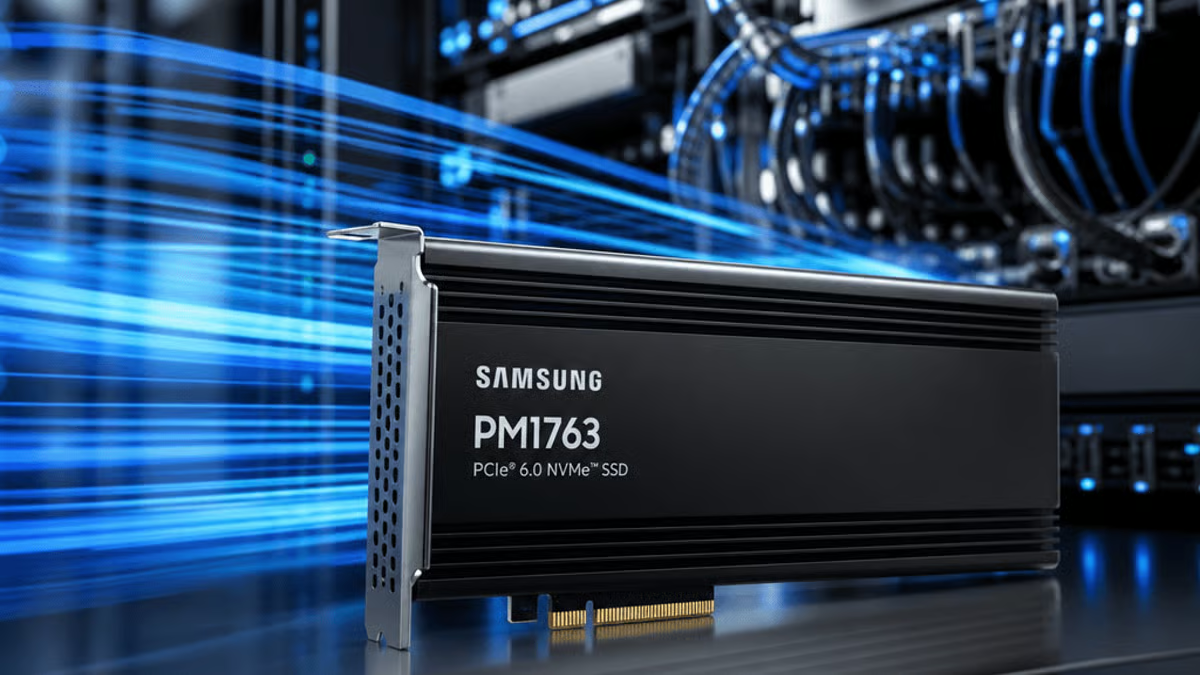
Samsung just started shipping the PM1763, its first PCIe 6.0 enterprise SSD designed specifically for AI infrastructure. The drive doubles the performance of its predecessor while adding post-quantum cryptography, addressing two critical pain points as AI workloads explode across data centers. With sequential read speeds hitting 28,400 MB/s, it can move a 40GB large language model in 1.4 seconds – a speed that matters when GPUs are sitting idle waiting for data.
Samsung Electronics is betting big on AI infrastructure with the PM1763, a PCIe 6.0 enterprise SSD that’s now shipping to data center customers. The company announced mass production today, marking a significant upgrade in storage technology as AI training and inference workloads continue to outpace existing hardware capabilities.
The timing couldn’t be better. As AI models balloon in size and complexity, storage has become a critical bottleneck. Companies are discovering that even the fastest GPUs can’t compensate for slow data transfer between storage and processors. Samsung’s answer delivers sequential read speeds of up to 28,400 MB/s and write speeds of 21,900 MB/s in the 16TB configuration – more than double what the PM1753 predecessor could manage.
“Built on industry-leading performance, PM1763 has successfully completed validation for next-generation AI platforms and is well positioned to support evolving AI infrastructure requirements,” Jangseok Choi, Vice President and Head of Memory Product Planning at Samsung Electronics, told reporters. “As AI models continue to grow in size and complexity, PM1763 will serve as a key solution that enables customers to efficiently scale memory capacity and optimize AI operations.”
The performance boost comes from Samsung’s 9th-generation V-NAND technology paired with a newly developed 4-nanometer controller. That combination doesn’t just push speeds higher – it also improves power efficiency by 1.8x compared to the previous generation. In massive data center deployments where every watt counts, that efficiency translates directly to lower operating costs.
Here’s where the real-world impact hits: the PM1763 can transfer a 40GB large language model in roughly 1.4 seconds. That’s the difference between AI accelerators waiting on data or running at full capacity. When you’re running inference at scale or training models that cost thousands of dollars per hour in compute time, those seconds add up fast.
Samsung is also addressing the cooling challenge that’s plaguing modern data centers. The PM1763 supports direct-to-chip cooling technology, optimized for liquid-cooled server environments that are becoming standard in high-performance AI deployments. This lets the drive maintain peak performance even under sustained intensive workloads – something air-cooled solutions struggle with.
But performance isn’t the only story here. Samsung has baked in security features that anticipate future threats. The drive supports post-quantum cryptography algorithms designed to withstand attacks from quantum computers that don’t even exist yet in practical form. It’s a hedge against a future where today’s encryption standards could be rendered obsolete.
The PM1763 also includes TEE Device Interface Security Protocol (TDISP), which secures data pathways in virtualized environments. As more AI workloads run in shared cloud infrastructure, these trusted execution environments become critical for protecting sensitive training data and model weights.
The drive ships in three capacities: 4TB, 8TB, and 16TB. Samsung hasn’t disclosed pricing, but enterprise SSDs at this performance tier typically command premium prices that reflect their role in multi-million dollar AI infrastructure deployments.
What makes this launch significant isn’t just the specs – it’s the validation process. Samsung says the PM1763 has already completed validation for next-generation AI platforms, meaning major hardware vendors have tested and approved it for their upcoming systems. That’s the kind of integration that takes months and signals real customer demand.
The enterprise SSD market is heating up as AI infrastructure spending accelerates. Companies building AI platforms need storage that can keep pace with increasingly powerful processors and accelerators. PCIe 6.0 adoption has been slower than some expected, but AI workloads are proving to be the killer application that drives migration from older standards.
Samsung’s move puts pressure on competitors like Micron, Western Digital, and Solidigm to match or exceed these performance benchmarks. The race for AI infrastructure dominance increasingly comes down to eliminating bottlenecks wherever they appear – and storage is one of the biggest remaining constraints.
Samsung’s PM1763 arrives as AI infrastructure spending reaches fever pitch and storage bottlenecks threaten to limit the capabilities of next-generation systems. The combination of doubled performance, improved power efficiency, and forward-looking security features positions it as a critical component for companies building or upgrading AI platforms. With validation already complete for major AI systems, expect to see these drives powering the large language models and training clusters launching over the next year. The real test will be whether the performance gains translate to measurable improvements in AI training times and inference costs – the metrics that ultimately determine whether data center operators will pay the premium these enterprise SSDs command.











Leave a Reply