
China just pulled off what looked impossible under US export controls. The country’s new LineShine supercomputer claimed the top spot in global rankings without using a single GPU – a direct technical workaround to Washington’s semiconductor restrictions. The achievement marks a turning point in the US-China tech competition, proving Beijing can innovate around supply chain barriers faster than many analysts predicted.
The global supercomputing landscape just got a major shakeup. China’s LineShine system claimed the number one ranking as the world’s fastest supercomputer, and it did so without relying on the graphics processing units that have become the standard backbone for high-performance computing. The development, first reported by Wired, represents a significant technical achievement and a strategic end-run around US export controls.
The timing couldn’t be more pointed. For years, Washington has tightened restrictions on advanced chip exports to China, particularly targeting GPUs from companies like Nvidia that power everything from AI training to scientific computing. The Biden administration’s October 2022 export controls specifically aimed to limit China’s access to cutting-edge computing hardware. LineShine’s emergence suggests those restrictions may have accelerated Chinese innovation rather than constrained it.
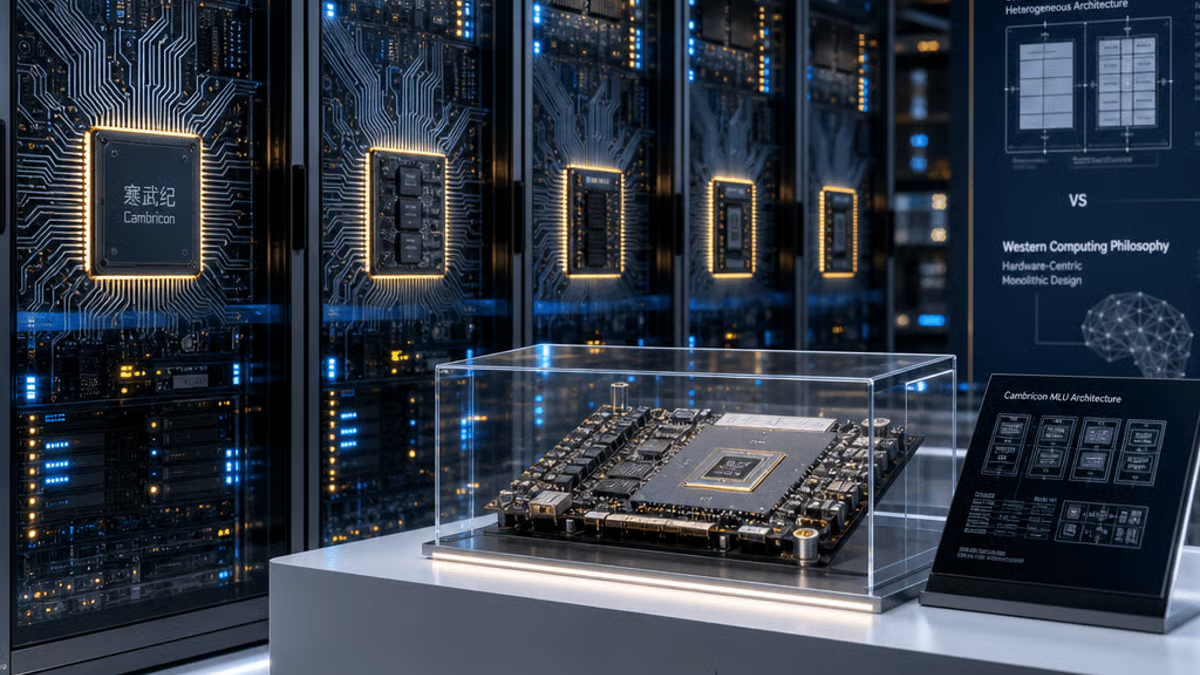
What makes LineShine particularly notable is its architectural approach. While Western supercomputers have converged on GPU-heavy designs – Nvidia’s H100 and upcoming B200 chips dominate the latest systems – China appears to have invested in alternative processor designs. The exact technical specifications of LineShine remain partly undisclosed, but the absence of GPUs points to custom silicon or novel computing architectures developed domestically.
This isn’t China’s first rodeo with homegrown supercomputing. The country previously developed the Sunway TaihuLight and Tianhe systems using domestic processors after being cut off from Intel chips in 2015. But those earlier systems predated the current AI boom and its insatiable appetite for parallel processing power. Building a GPU-free system that can top current rankings – when competitors are throwing thousands of cutting-edge GPUs at the problem – represents a more sophisticated engineering feat.
The implications ripple far beyond benchmark bragging rights. Supercomputers drive everything from weapons development to climate modeling to pharmaceutical research. They’re also increasingly critical for training large AI models, the same technology powering the current generative AI wave. If China can build competitive systems without access to Western GPU supply chains, it fundamentally changes the calculus around tech export controls.
For US chipmakers, the news lands as a strategic warning. Nvidia has seen its China revenue take repeated hits from export restrictions, with the company creating stripped-down chips like the H20 to comply with regulations while maintaining some market access. If Chinese customers can achieve comparable performance with domestic alternatives, that remaining market evaporates. AMD and Intel face similar pressures in a market that once represented billions in annual revenue.
The broader semiconductor industry has been watching this cat-and-mouse game with growing concern. Every restriction spurs Chinese investment in alternatives – not just in chip design but in manufacturing equipment, materials science, and software optimization. LineShine demonstrates that progress is accelerating, not stalling. Some industry observers have quietly questioned whether export controls might be creating the very technological independence they aim to prevent.
What remains unclear is how LineShine achieves its performance without GPUs. Possibilities include custom ASIC designs optimized for specific workloads, novel processor architectures that prioritize different performance metrics, or advances in interconnect technology that squeeze more capability from alternative chips. China’s supercomputing projects typically involve state-backed research institutes with access to significant resources and talent.
The announcement also raises questions about verification and benchmarking. Supercomputer rankings traditionally rely on standardized tests, but access to Chinese systems for independent validation has grown more limited amid rising geopolitical tensions. Still, China has a track record of producing legitimate supercomputing achievements, and outright fabrication would damage credibility more than it would gain strategic advantage.
LineShine’s emergence as the world’s fastest supercomputer without GPUs marks more than just a technical milestone – it’s a signal that export controls alone won’t maintain US technological dominance. China’s ability to innovate around supply chain barriers faster than expected forces a rethink of semiconductor policy and competitive strategy. For the AI industry, it hints at a future where multiple architectural approaches compete rather than GPU-centric designs monopolizing high-performance computing. The question isn’t whether China can build alternatives to restricted Western chips anymore. It’s how quickly those alternatives close the performance gap, and what that means for the next phase of global tech competition.









Leave a Reply