
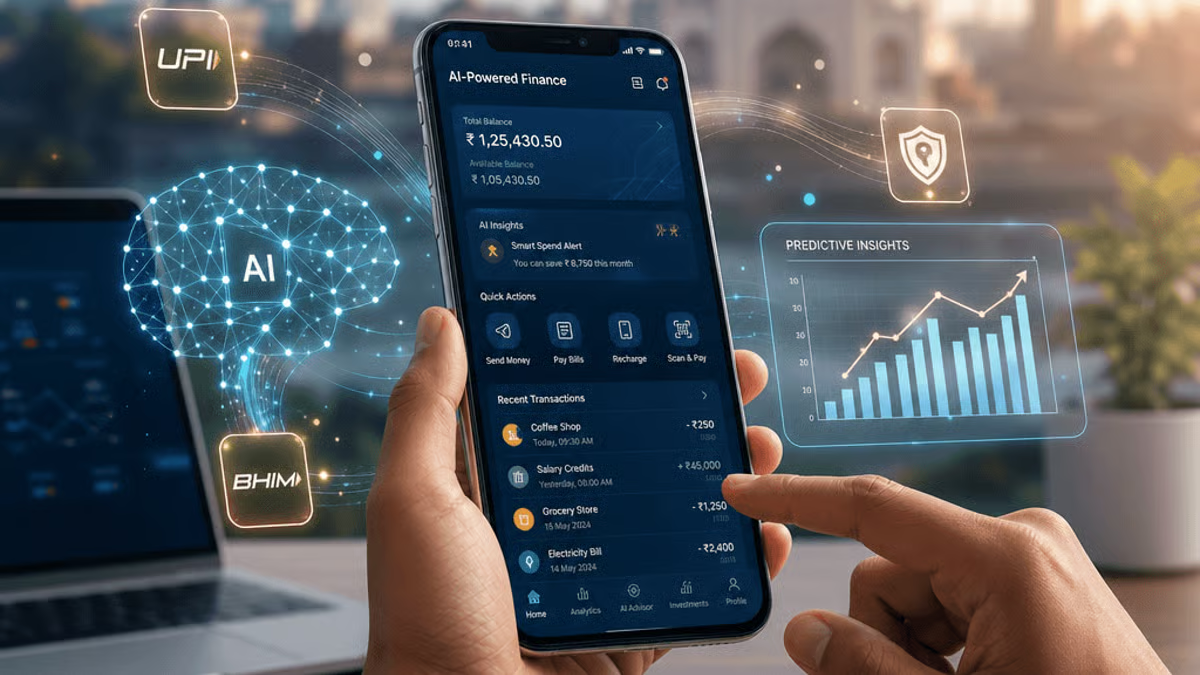
India’s digital payments infrastructure is about to get smarter. Dilip Asbe, the chief executive of the National Payments Corporation of India (NPCI), believes artificial intelligence will play a central role in the next phase of the country’s digital payment revolution. Speaking about the future of the Unified Payments Interface (UPI), Asbe suggested that newer payment apps could gain competitive ground by building viable commercial models around AI-powered features – a shift that could reshape how India’s 500 million UPI users interact with money.
The National Payments Corporation of India is eyeing artificial intelligence as the next frontier for its wildly successful UPI platform. Dilip Asbe, who leads NPCI, told TechCrunch that AI integration could help newer payment apps carve out market share in an ecosystem currently dominated by Google Pay and Walmart-owned PhonePe.
The timing is critical. India’s UPI system has become the backbone of the country’s digital economy, processing more than 14 billion transactions monthly with a total value exceeding $200 billion. But the platform faces a persistent challenge – most UPI transactions generate minimal revenue for the apps that facilitate them, creating sustainability questions for smaller players trying to compete with tech giants.
“Newer UPI apps could be more competitive with a viable commercial model,” Asbe said, hinting at AI-powered services that could justify premium features or subscription models. The statement marks a significant evolution in thinking for NPCI, which has historically focused on maximizing transaction volumes and financial inclusion rather than profitability for payment providers.
The AI integration Asbe envisions could take multiple forms. Payment apps might deploy machine learning models to offer personalized spending insights, predictive budgeting tools, or smart recommendations for bill payments and merchant offers. Some fintech observers believe voice-activated payment assistants and fraud detection powered by real-time AI analysis could become standard features within the next 18 months.
This strategic shift comes as India’s fintech ecosystem matures beyond simple peer-to-peer transfers. Paytm, Amazon Pay, and dozens of smaller apps are all hunting for differentiation in a market where basic payment functionality has become commoditized. PhonePe and Google Pay together control roughly 85% of UPI transaction volume, leaving newcomers scrambling for viable business models.
The regulatory environment supports this evolution. India’s Reserve Bank has been pushing for innovation in digital payments while maintaining strict interoperability standards. Unlike closed-loop systems in other markets, UPI’s open architecture means any app can theoretically access the same underlying infrastructure – making AI-powered user experience the primary battleground for competitive advantage.
NPCI itself has been experimenting with AI in backend operations, using machine learning algorithms to detect fraudulent patterns and optimize transaction routing across India’s banking network. Extending these capabilities to consumer-facing apps represents the logical next step, according to payments industry analysts.
The commercial model question looms large. UPI transactions have traditionally been free or nearly free for consumers, subsidized by venture capital or cross-selling opportunities for banks. AI features could provide the first sustainable revenue stream that doesn’t undermine UPI’s accessibility – if apps can convince users that smart payment assistants or advanced analytics are worth paying for.
International payment platforms are watching closely. WhatsApp Pay, which operates on UPI rails in India, has been testing AI-powered chat commerce features. Meta‘s broader push into AI could give it unique advantages in this space, potentially disrupting the current duopoly.
The infrastructure is ready. India’s India Stack digital public goods platform already combines UPI with digital identity verification and data portability frameworks – creating the perfect environment for AI applications that need secure access to financial and personal data. Privacy safeguards built into the system could actually give Indian payment apps an edge over Western counterparts still navigating stricter data regulations.
Asbe’s comments also hint at NPCI’s evolving role. The organization, which operates as a not-for-profit created by Indian banks, has historically stayed neutral in competitive dynamics between payment apps. By explicitly encouraging AI adoption and viable business models, NPCI appears to be actively shaping the ecosystem’s next phase rather than just maintaining the rails.
Asbe’s vision for AI-powered UPI apps represents more than incremental improvement – it’s a fundamental rethinking of what digital payments can be. If newer apps successfully build commercial models around intelligent financial services rather than just transaction processing, India’s payment ecosystem could leapfrog markets that remain stuck on simple money movement. The real test will be whether Indian consumers, accustomed to free transactions and minimal friction, will embrace AI features compelling enough to sustain the business models Asbe envisions. With half a billion UPI users already comfortable with digital payments, the infrastructure is in place. Now comes the hard part – making AI useful enough that people actually want to pay for it.










Leave a Reply