
Samsung just unveiled the engineering behind Galaxy Buds4 Pro’s crystal-clear calls, and it’s a masterclass in cramming serious AI horsepower into a tiny package. The company slashed its Deep Neural Network’s processing requirements to just 10% of the original load while shrinking the model to 30% of its size – all to make sure your voice cuts through subway chaos and street noise. It’s the kind of optimization that makes on-device AI actually work in the real world, not just on a spec sheet.
Samsung just pulled back the curtain on what makes its Galaxy Buds4 Pro sound so good on calls, and the answer is aggressive AI optimization meets sensor overload. The company published a deep technical breakdown showing how it wrestled a sophisticated Deep Neural Network into hardware the size of a bean.
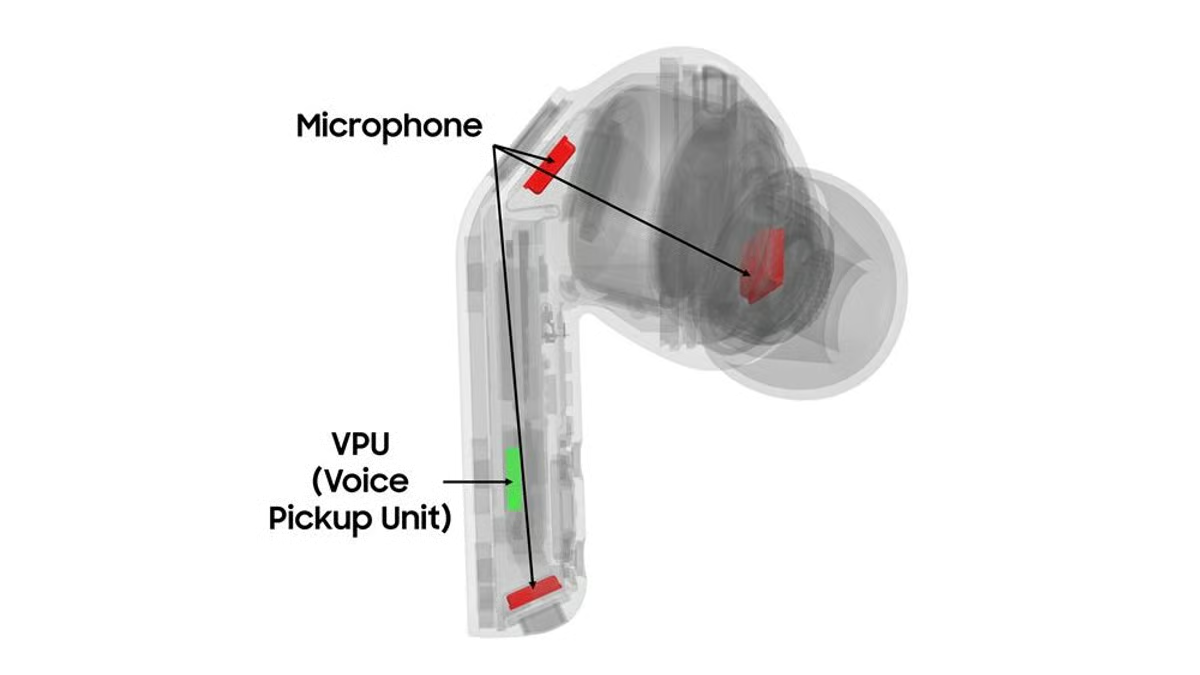
The core innovation is what Samsung calls Sensor Fusion technology. Instead of relying on a single microphone fighting a losing battle against street noise, the Buds4 Pro pack three mics plus a Voice Pickup Unit sensor based on bone conduction. Two external mics grab your voice from the air, a third internal mic catches speech vibrations transmitted through your body, and the VPU detects physical vibrations in your head when you talk. All four inputs feed into an AI algorithm that reconstructs your voice with what Samsung claims is pinpoint accuracy.
But here’s the tricky part – Deep Neural Networks usually need serious computing muscle. The kind that lives in data centers or at least your phone, not a wireless earbud with maybe a few hours of battery life. Samsung’s engineers had to slash the computational requirements to roughly 10% of what the algorithm originally demanded, while compressing the model size down to just 30%. That’s the difference between a theoretical AI feature and one that actually ships in a product you can buy.
The optimized DNN analyzes past, present and predictive sound data to adapt in real time as your environment shifts. Samsung says it captures 16 times more vocal detail than previous Galaxy Buds models, preserving everything from high-pitched tones to sharp consonants that typically get lost when ambient noise spikes above your voice. The system even accounts for fit leakage – when the earbuds shift during natural body movements and let background noise seep in. It continuously analyzes signals from inner and outer mics to estimate leakage and adjust on the fly.
When you pair the Buds4 Pro with a Galaxy smartphone, the voice clarity jumps even higher thanks to a Super Wideband connection running up to 16 kHz. That’s a noticeable step up from standard Bluetooth call quality, though you’ll need to stay in Samsung’s ecosystem to get it.
Samsung didn’t just engineer this in a lab and call it done. The company recreated real-world acoustic scenarios using massive wind simulators, then validated everything with field tests in bustling cafes, loud department stores, echoing train stations, and even cars with windows down. The goal was making sure the algorithm handles actual chaos, not just controlled test conditions.
The Sensor Fusion approach isn’t entirely new – Samsung notes it’s been supported since Galaxy Buds Live. But the Buds4 Pro represent a significant leap in how much intelligence the company can pack into the form factor. Shrinking a DNN to 30% of its original size while maintaining performance is the kind of optimization that takes months of iteration and trade-off analysis.
What’s interesting here is Samsung’s bet on on-device processing rather than cloud-dependent AI. Latency matters enormously for call quality, and shipping audio to the cloud and back introduces delays that wreck natural conversation flow. By keeping everything local, the Buds4 Pro can react instantly to changing environments without waiting for a server response.
The timing is notable too. As every tech company races to stuff AI into products, Samsung is showing what practical implementation actually looks like when you’re constrained by physics, power budgets, and thermal limits. This isn’t a chatbot or image generator – it’s AI doing unsexy but essential work in real time, thousands of times per second, while sipping power from a battery smaller than a dime.
For competitors like Apple and their AirPods Pro, Samsung’s technical disclosure sets a new benchmark for call quality transparency. Apple rarely discusses the specifics of its computational audio work, preferring to let products speak for themselves. Samsung is taking the opposite approach, making it clear they’ve solved hard engineering problems to get here.
The broader takeaway is that on-device AI is finally getting efficient enough to tackle problems that seemed impossible just a few years ago. Cramming a neural network into wireless earbuds required optimizations that make the tech viable for other ultra-compact devices. That’s the kind of work that doesn’t make flashy headlines but quietly enables the next generation of truly smart hardware.
Samsung’s Galaxy Buds4 Pro engineering breakdown reveals what practical AI implementation looks like when you’re fighting physics and power constraints. By compressing a Deep Neural Network to a fraction of its original size while maintaining performance, Samsung shows that on-device AI can tackle real problems in truly wireless form factors. For an industry obsessed with adding AI to everything, this is a rare example of the technology doing unglamorous but essential work – making sure people can actually hear you on a phone call. As competitors rush to match these capabilities, the optimization techniques Samsung developed here will likely ripple through the entire wireless audio market.











Leave a Reply