
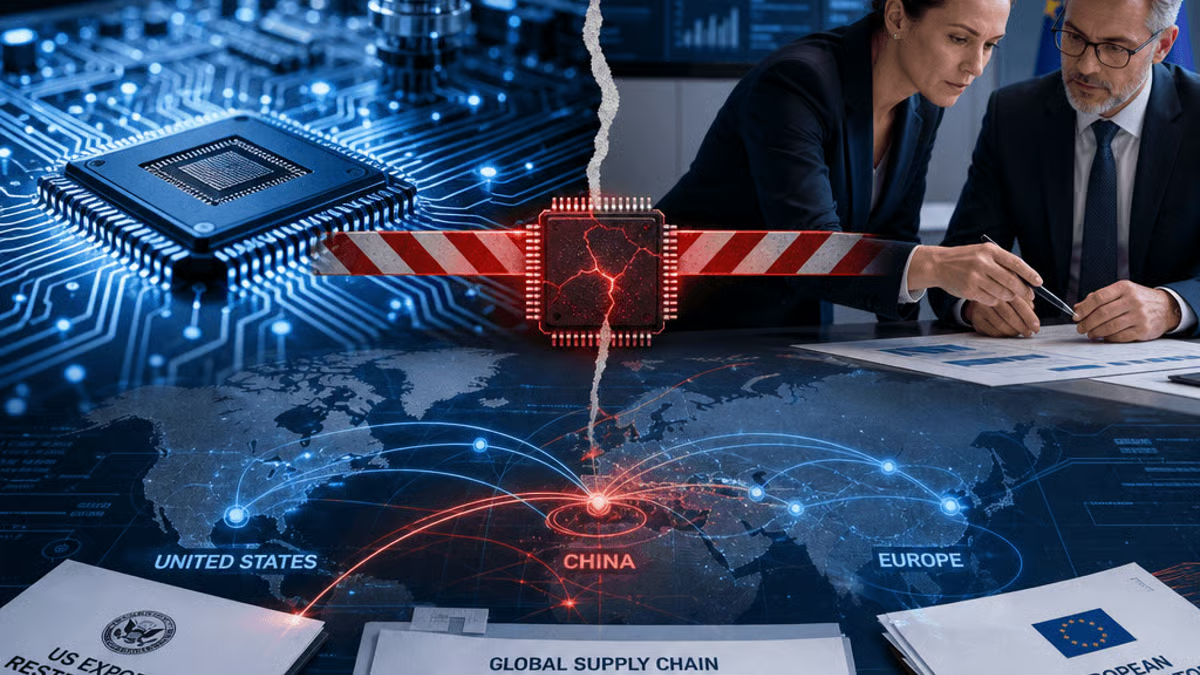
The transatlantic semiconductor alliance is showing cracks. European chipmakers are mounting a rare public challenge to Washington’s latest export restrictions, as the proposed MATCH Act threatens to cut off sales of older-generation equipment to China – gear that’s been flowing freely for years and represents billions in revenue. At the center of the storm sits ASML, the Dutch lithography giant whose deep ultraviolet machines have become an unexpected flashpoint in escalating US-China tech tensions.
Washington’s chip war with China just opened a new front, and this time America’s European allies aren’t falling in line. The proposed MATCH Act – which would extend export bans to older semiconductor manufacturing equipment – has triggered an unusually public rift between US policymakers and European chipmakers who’ve suddenly found themselves caught between geopolitics and their bottom line.
At the heart of the dispute is ASML, the Netherlands-based company that holds a near-monopoly on the lithography machines essential for chipmaking. As ASML CEO Christophe Fouquet told TechCrunch in May, what China can currently buy are older-generation deep ultraviolet tools – gear first shipped about a decade ago. These aren’t the cutting-edge extreme ultraviolet systems already banned from export, but workhorse machines that churn out chips for everything from smartphones to cars.
Now the MATCH Act wants to put those same DUV machines off limits. For ASML, that’s not just a policy shift – it’s a direct hit to billions in annual revenue from the Chinese market. The company shipped roughly €5.6 billion worth of equipment to China in 2025, with DUV systems representing a substantial portion of those sales. Cutting off that pipeline would force ASML to find new buyers in an already saturated market.
But the financial impact tells only part of the story. European officials are bristling at what they see as Washington’s unilateral decision-making on technology policy that directly affects European companies. The US has steadily tightened semiconductor export controls since 2022, each time raising the bar on what constitutes sensitive technology. The latest proposal to restrict decade-old equipment strikes many in Europe as overreach – an attempt to weaponize export policy without regard for allied interests.
The DUV systems in question use 193-nanometer wavelength light to pattern chips, technology that’s been commercially available since the mid-2000s. While less advanced than EUV machines that can print features as small as 3 nanometers, DUV equipment remains crucial for mature-node chip production. China has been stockpiling these tools as it races to build domestic semiconductor capacity, with Chinese foundries representing ASML’s fastest-growing customer segment over the past two years.
Industry insiders say European governments have been lobbying Washington to reconsider the MATCH Act, arguing that cutting off DUV sales won’t meaningfully slow China’s chip ambitions – it’ll just shift production to less efficient Chinese-made alternatives while hammering European manufacturers. The Dutch government, which already implemented export controls on ASML’s most advanced systems at US request, is reportedly reluctant to extend restrictions further without clear security justifications.
The timing couldn’t be more sensitive. Nvidia, Intel, and other US chipmakers have been navigating their own compliance headaches as export rules evolve. But those companies are American – they don’t have the option to push back. ASML’s European headquarters gives it different political leverage, and the company appears willing to use it.
Fouquet’s comments to TechCrunch mark a subtle but significant shift in tone from a company that’s historically avoided public disputes over export policy. By explicitly detailing what China can currently purchase, ASML is drawing attention to the stakes involved – both for its own business and for the broader principle of multilateral decision-making on technology controls.
The semiconductor industry has become the central battlefield in US-China technological competition, with equipment makers like ASML serving as unwitting foot soldiers. Washington views chip manufacturing capability as a national security issue, reasoning that advanced semiconductors power everything from AI systems to military hardware. But European companies and governments are increasingly questioning whether blanket restrictions serve security interests or simply fragment global supply chains.
China, meanwhile, continues to pour investment into domestic chip equipment manufacturing, hoping to reduce dependence on foreign suppliers. Every new US export restriction accelerates that timeline, potentially creating the very outcome Washington hopes to prevent – a bifurcated semiconductor ecosystem where Chinese manufacturers operate entirely outside Western influence.
The ASML dispute represents more than a disagreement over export policy – it’s a stress test of the Western alliance on technology issues. If Washington pushes ahead with the MATCH Act over European objections, it risks alienating the very partners it needs to maintain semiconductor supply chain security. But if it backs down, it signals that coordinated technology policy with allies remains as elusive as ever. For ASML and other European chipmakers, the message is becoming clear: in the new era of semiconductor geopolitics, neutrality isn’t an option anymore.










Leave a Reply