
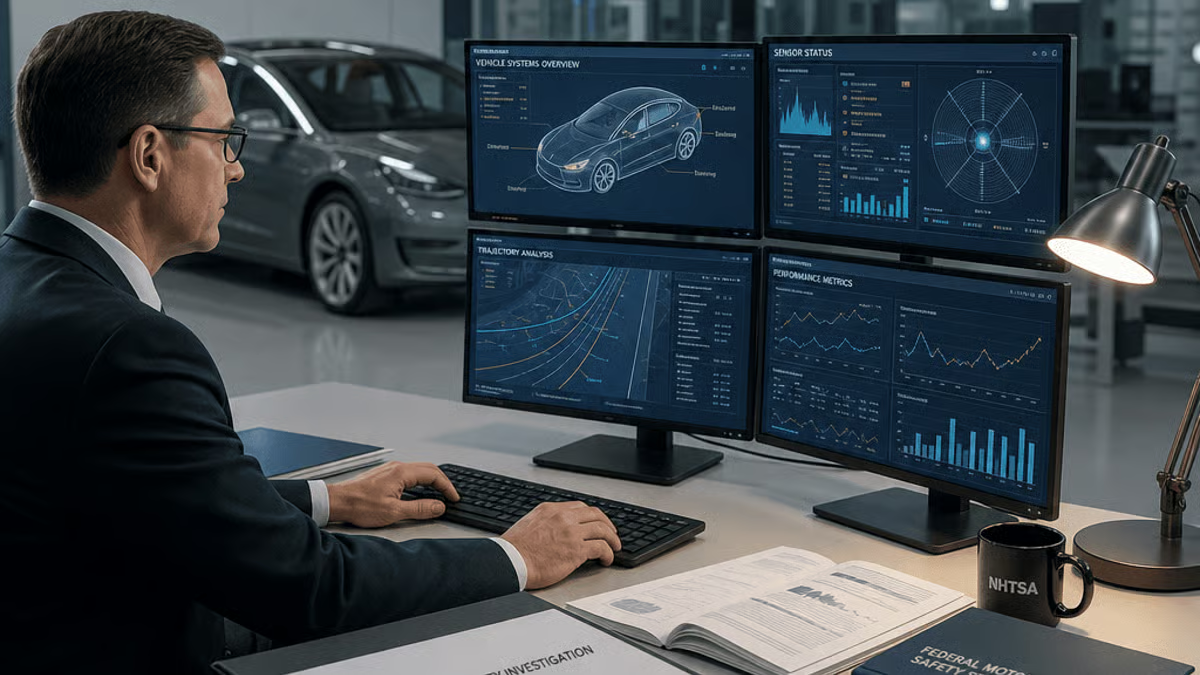
Federal safety regulators are investigating a fatal Tesla crash after a Model 3 slammed into a Texas home, killing a 76-year-old resident. The driver told Harris County authorities he’d been using Tesla’s partially automated driving systems when the vehicle veered off course in Katy, Texas. The incident marks the latest in a string of Autopilot-related crashes that have put Tesla’s self-driving ambitions under mounting regulatory pressure.
Tesla is facing another federal safety investigation after a Model 3 crashed into a residential home in Katy, Texas, killing a 76-year-old occupant. The National Highway Traffic Safety Administration confirmed it’s launched a probe into the incident, which occurred when driver Michael Butler says he was using the company’s partially automated driving features.
According to Harris County authorities, Butler told investigators he had engaged Tesla’s Autopilot system before the vehicle left the roadway and struck the home. The crash represents a grim reminder of the ongoing debate around autonomous driving safety, particularly as Tesla continues to market its Full Self-Driving capabilities despite regulatory warnings about the technology’s limitations.
This isn’t Tesla’s first rodeo with NHTSA. The agency has been investigating the electric vehicle maker’s driver assistance systems for years, opening multiple probes into crashes involving Autopilot and Full Self-Driving. In 2023, NHTSA pressured Tesla to recall over 2 million vehicles to add safeguards to its Autopilot feature after finding the system’s driver monitoring was inadequate. That recall relied on an over-the-air software update rather than physical repairs, a solution critics argued didn’t go far enough.
The timing couldn’t be worse for Tesla, which has been aggressively promoting its autonomous driving technology as a cornerstone of its future business model. CEO Elon Musk has repeatedly promised that Tesla vehicles would achieve full autonomy, even suggesting owners could earn passive income by adding their cars to a robotaxi network. But those predictions have consistently failed to materialize, while crashes like the Katy incident continue to pile up.
What makes this case particularly significant is the direct driver testimony about using Autopilot. In many previous investigations, determining whether Tesla’s automated systems were active during a crash required forensic analysis of vehicle data. Butler’s immediate acknowledgment to authorities provides investigators with a clear starting point for examining how the system performed – or failed to perform.
The investigation will likely focus on whether Autopilot correctly detected the roadway departure, whether driver monitoring systems were functioning properly, and what warnings – if any – the vehicle provided before the crash. NHTSA typically examines vehicle data logs, camera footage, and physical evidence to reconstruct exactly what happened in the moments before impact.
For the autonomous vehicle industry, this crash represents more than just another Tesla headline. It’s happening as regulators worldwide are grappling with how to oversee partially automated driving systems that require human supervision but are marketed with names like “Autopilot” and “Full Self-Driving.” Critics have long argued these names mislead drivers into over-trusting the technology.
The broader implications extend to competitors like General Motors, which suspended its Cruise robotaxi operations after a pedestrian dragging incident in San Francisco, and Waymo, which has faced its own share of minor incidents despite generally positive safety data. Every high-profile crash involving automated driving technology tightens the regulatory noose around the entire industry.
Tesla’s approach to autonomous driving differs fundamentally from most competitors. While companies like Waymo use expensive lidar sensors and high-definition maps to create detailed 3D environments, Tesla relies primarily on cameras and neural networks. Musk has argued this vision-based approach is superior and more scalable, but critics say it leaves critical safety gaps.
The Katy crash will almost certainly fuel calls for stricter federal oversight of automated driving systems. Consumer advocacy groups have been pushing NHTSA to require more robust testing and validation before allowing these features on public roads. Some lawmakers have proposed legislation that would establish clearer standards for what constitutes “self-driving” technology and impose penalties for misleading marketing.
For Tesla shareholders, the investigation adds another layer of uncertainty to a company already navigating production challenges, price cuts, and intensifying competition in the EV market. While individual crash investigations rarely move Tesla’s stock significantly, the cumulative effect of recurring safety probes has contributed to concerns about potential regulatory crackdowns or costly recalls.
What happens next depends largely on what NHTSA’s investigation uncovers. If the agency finds systemic issues with how Autopilot functions or how Tesla monitors driver attention, it could trigger another recall affecting millions of vehicles. In a worst-case scenario, regulators could move to restrict or prohibit certain Autopilot features until Tesla demonstrates they meet higher safety standards.
The Katy crash investigation arrives at a critical moment for autonomous driving technology. As Tesla pushes forward with ambitious self-driving promises and regulators struggle to keep pace with rapidly evolving AI systems, incidents like this force a reckoning with fundamental questions about safety, oversight, and accountability. The outcome of NHTSA’s probe won’t just affect Tesla – it’ll help shape the rules governing how automated vehicles share the road with human drivers for years to come. For now, the 76-year-old victim’s death stands as a sobering reminder that the gap between autonomous driving promises and reality can carry tragic consequences.




Leave a Reply