
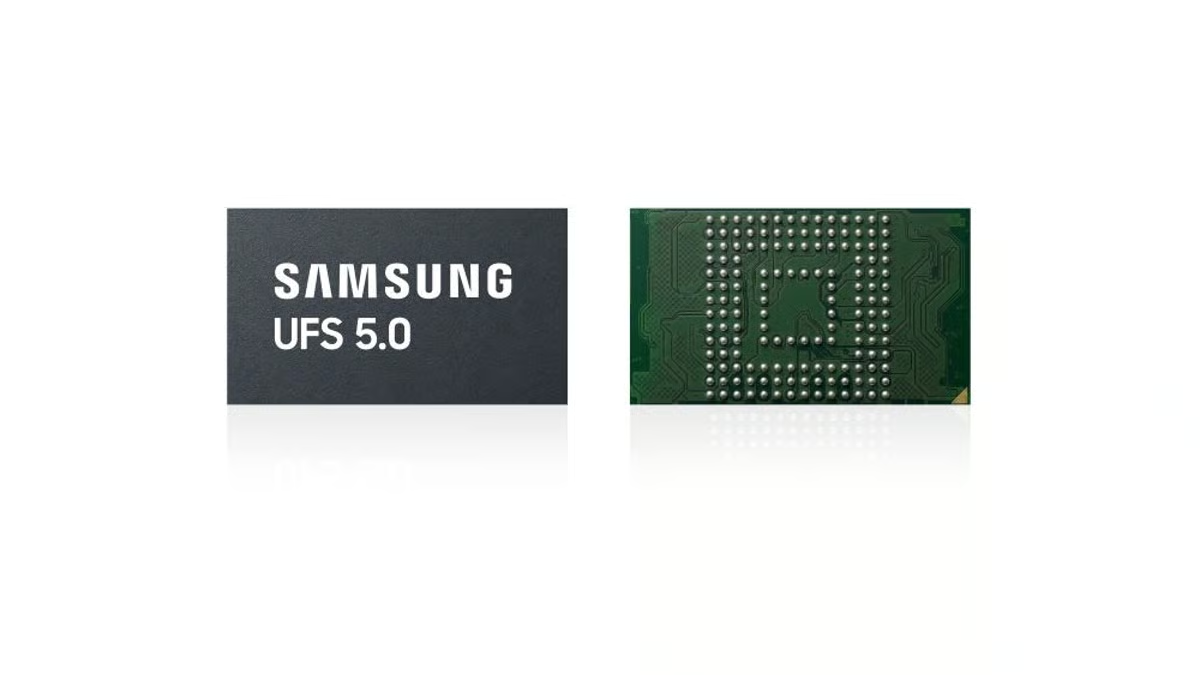
Samsung just leapfrogged the mobile storage market with UFS 5.0, the industry’s first flash storage solution purpose-built for on-device AI. The new standard hits 10.8GB/s read speeds – more than double its predecessor – and starts mass production in Q4 2026. As generative AI shifts from cloud to device, Samsung’s betting that storage speed will define which phones can actually run large language models without choking.
Samsung just rewrote the rules for mobile storage. The company announced it’s developed the industry’s first UFS 5.0 solution, achieving speeds that make current flagship phone storage look sluggish. With sequential read speeds hitting 10.8 gigabytes per second and writes reaching 9.5GB/s, Samsung’s new standard is more than twice as fast as the UFS 4.1 tech inside today’s premium devices.
The timing isn’t coincidental. As large language models migrate from data centers to smartphones, storage has become a critical bottleneck. “In the era of on-device AI, storage devices are evolving into a key driver defining AI experiences,” Jangseok Choi, head of Memory Product Planning at Samsung Electronics, said in the announcement. The shift from cloud-based to local AI processing creates massive data transfer demands that current storage simply can’t handle efficiently.
Samsung’s UFS 5.0 integrates JEDEC’s latest embedded memory interface standard, pushing bandwidth to an industry-high 10.8GB/s. But speed is only part of the equation. The solution delivers a 40% improvement in power efficiency compared to Samsung’s own UFS 4.1, using clock gating and multi-voltage technologies to cut the energy needed for data transfers. For devices running AI models continuously in the background, that efficiency gain translates directly to battery life – a critical factor as phones attempt to process AI locally instead of offloading to the cloud.
The physical package got a serious diet too. Samsung engineered UFS 5.0 into a 7.5mm x 13mm x 0.9mm form factor, shrinking the footprint by 16.7% versus the previous generation. That’s not just about making phones thinner. The compact design opens doors for AI-capable wearables and extended reality headsets, where internal space comes at an absolute premium.
Generative AI’s migration to the edge is reshaping what storage needs to do. According to Samsung’s announcement, storage is evolving “from a medium used primarily to store data to core infrastructure that supports AI computation.” That’s a fundamental shift. When your phone runs a multimodal AI model that processes voice, images, and text simultaneously, storage speed directly impacts response latency. Slow storage means laggy AI, regardless of how powerful the processor is.
The competitive implications ripple across the mobile ecosystem. Apple, which designs custom storage controllers but relies on suppliers like Samsung for NAND, will face pressure to match these speeds in future iPhones. Google and other Android flagship makers who’ve been pushing on-device AI features now have hardware capable of actually delivering smooth performance. The bottleneck just shifted elsewhere in the system.
Mass production kicks off in Q4 2026, with capacities scaling up to one terabyte. Samsung’s targeting flagship smartphones first, but the roadmap explicitly includes XR headsets and AI wearables. That 1TB capacity isn’t overkill when you consider that on-device AI models, offline maps, high-resolution video capture, and app data all compete for the same storage pool. The days of 128GB flagship phones are numbered.
“Samsung is setting a new standard for storage on the go and will continue to drive innovation for the next-generation mobile platform market,” Choi added in the press release. The company’s moved beyond development into production scale-up, suggesting design wins with major device makers are already locked in. Expect to see UFS 5.0 badges on 2027 flagship phone spec sheets.
The broader trend here is undeniable: AI workloads are coming home to devices, and the hardware stack is scrambling to keep up. Nvidia dominates cloud AI chips, but the on-device battle involves memory makers, processor designers, and software optimizers all fighting to eliminate latency. Samsung’s bet is that storage speed matters as much as GPU cores when you’re running a 7-billion-parameter model on a phone.
For device makers, UFS 5.0 solves a problem that’s been quietly brewing. Current storage can’t feed data to AI processors fast enough, creating idle time that wastes power and frustrates users. Doubling throughput while cutting power consumption by 40% fundamentally changes what’s possible in a phone-sized thermal and battery envelope. The question now is whether the rest of the system – processors, RAM, thermal management – can scale to match.
Samsung’s UFS 5.0 isn’t just a spec bump – it’s infrastructure for the on-device AI era that’s already here. By doubling storage speeds while slashing power consumption, Samsung’s created the foundation for phones, wearables, and XR devices that can actually run sophisticated AI models without constant cloud connectivity or battery anxiety. The real test comes when Q4 production ramps and device makers start integrating UFS 5.0 into their 2027 flagships. If the rest of the mobile hardware stack can keep pace, we’re looking at a genuine leap in what pocket-sized AI can do.











Leave a Reply