
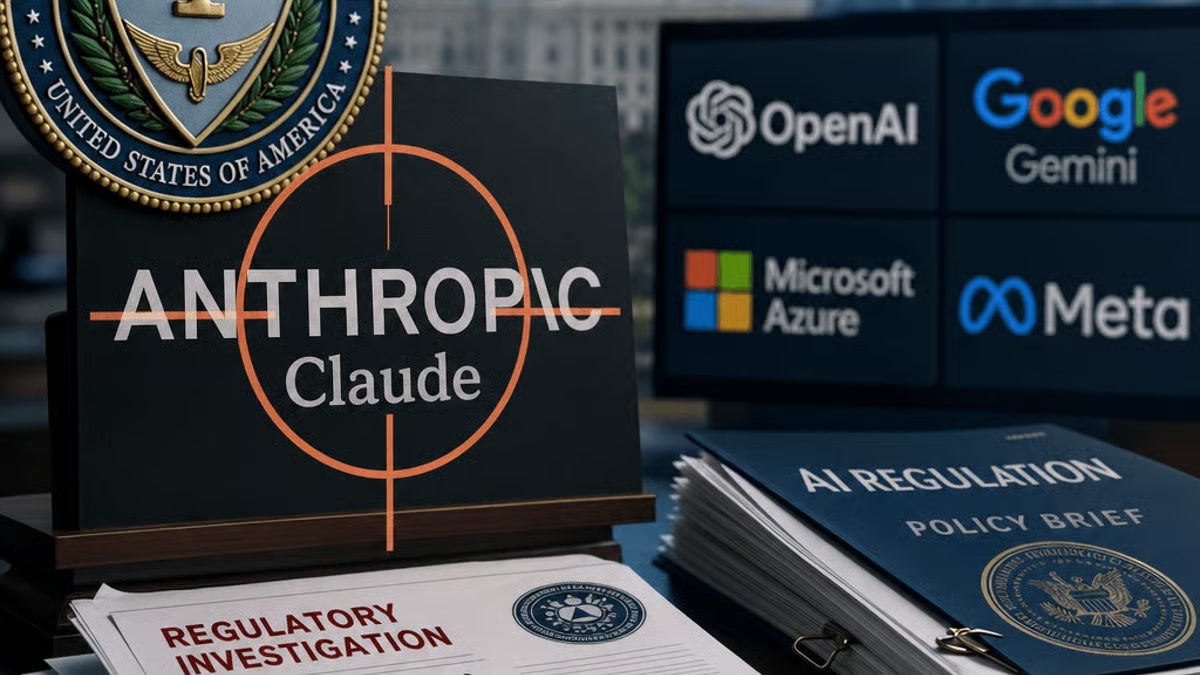
The Trump administration just made its most aggressive move yet against a leading AI company, and Anthropic is squarely in the crosshairs. The crackdown on the Claude AI maker, first detailed on TechCrunch’s Equity podcast, marks a sharp escalation in Washington’s approach to AI regulation – and could reshape the competitive landscape for OpenAI, Google, and other rivals racing to dominate the generative AI market.
The Trump administration’s sudden focus on Anthropic has sent shockwaves through Silicon Valley, with industry insiders scrambling to understand what triggered the federal government’s attention – and more importantly, who stands to gain.
According to TechCrunch’s Equity podcast, the administration’s latest moves against the AI safety-focused startup represent a dramatic shift in regulatory strategy. Unlike broad policy frameworks that target the entire AI sector, this appears to be targeted enforcement against a single company that’s positioned itself as the responsible alternative to more aggressive competitors.
The timing couldn’t be more critical for Anthropic. The company has raised billions from investors including Google and various venture capital firms, positioning its Claude AI assistant as a safer, more carefully governed alternative to OpenAI’s ChatGPT. That reputation for caution and AI safety research may have paradoxically made it a target.
But the question hanging over the industry isn’t just why Anthropic – it’s who benefits. OpenAI, which has cultivated closer ties to various political figures and maintains a more commercially aggressive stance, could find itself with reduced competition if regulatory pressure slows Anthropic’s momentum. Microsoft, OpenAI’s largest investor and partner, stands to gain indirectly from anything that hampers rivals.
Google, despite its investment in Anthropic, also competes directly with the company through its own Gemini AI models. The search giant has been walking a tightrope, investing in multiple AI players while pushing its own technology. A weakened Anthropic could actually benefit Google’s first-party AI ambitions, even as it complicates the company’s investment portfolio.
The selective nature of the enforcement raises uncomfortable questions about political motivations in tech regulation. The Trump administration has shown willingness to use regulatory power as both carrot and stick with major tech companies, and AI policy has become increasingly politicized. Some industry observers wonder whether Anthropic’s emphasis on AI safety and ethical development put it at odds with an administration prioritizing rapid commercialization and American AI dominance.
What remains unclear from the initial reporting is the specific nature of the administration’s actions. Regulatory crackdowns can take many forms – from antitrust investigations to export controls, from data privacy enforcement to national security reviews. Each would carry different implications for Anthropic’s business and its competitors.
The AI industry has been bracing for increased regulation, but most expected broad frameworks rather than targeted enforcement. The European Union’s AI Act takes a risk-based approach across the entire sector. California has debated comprehensive AI safety legislation. Federal agencies have issued voluntary guidelines and reporting requirements. But singling out one company for enforcement action represents a different playbook entirely.
For Anthropic, the stakes couldn’t be higher. The company has built its brand around responsible AI development, attracting talent from OpenAI and other competitors specifically because of its mission-driven approach. Regulatory trouble threatens not just its business operations but its fundamental value proposition as the trustworthy AI company.
The broader ecosystem is watching closely. Startups building on Anthropic’s Claude models through its API may need contingency plans. Enterprise customers evaluating AI providers will factor regulatory risk into their decision-making. Investors pricing future funding rounds will discount valuations based on political uncertainty.
Meanwhile, OpenAI, Google, and Microsoft continue pushing forward with their own AI initiatives, potentially gaining ground while their rival deals with Washington scrutiny. The competitive dynamics of the AI race were already intense – government intervention adds an unpredictable new variable that could determine winners and losers as much as technology itself.
The Trump administration’s crackdown on Anthropic marks a turning point in how Washington approaches AI regulation – shifting from broad policy discussions to targeted enforcement. As the dust settles, the AI industry faces a new reality where political considerations may matter as much as technological innovation. Whether this represents the beginning of more aggressive government intervention across the sector or remains an isolated incident will determine not just Anthropic’s fate, but the future competitive landscape of artificial intelligence. For now, rivals are watching carefully, weighing whether to distance themselves from similar regulatory risk or prepare for their own turn in the spotlight.






Leave a Reply