
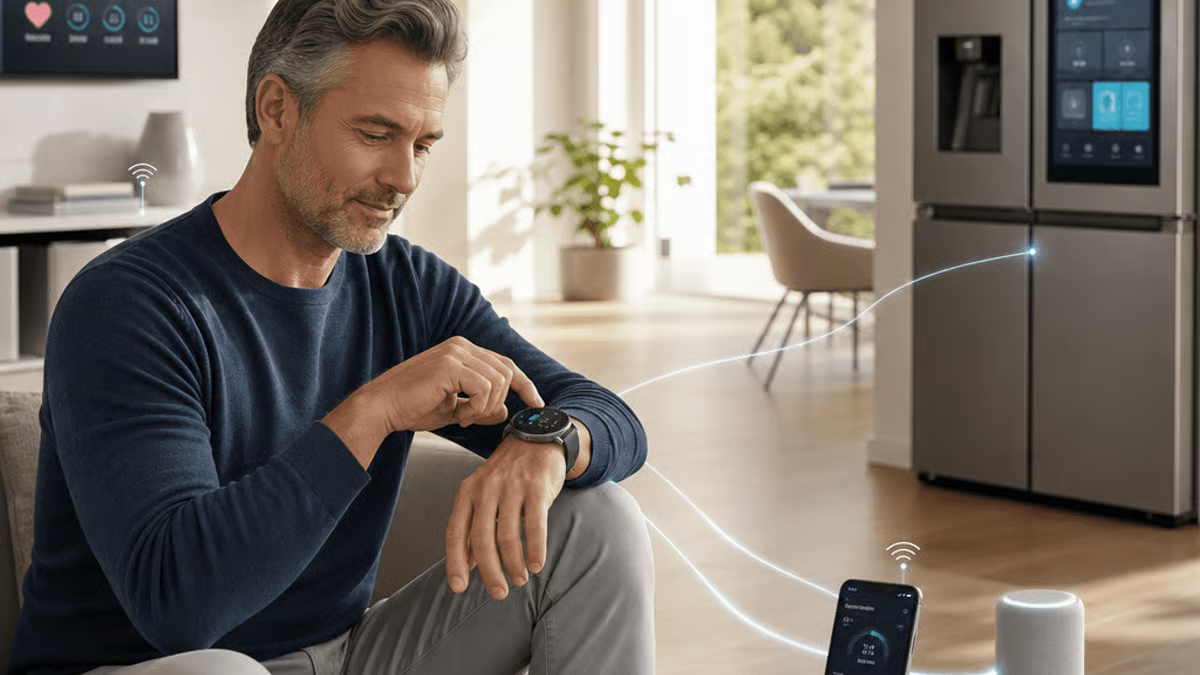
Samsung just laid out its blueprint for turning your home into a preventive health hub. At VivaTech 2026 in Paris, the company revealed how it’s weaving together 77 million Samsung Health users and 460 million SmartThings-connected devices with health startups like Xealth, Generation Lab, and SiPhox Health. The pitch: move healthcare from hospitals to living rooms through an open ecosystem that combines wearables, home appliances, and clinical-grade diagnostics.
Samsung is betting the future of healthcare happens in your kitchen, not a clinic. At VivaTech 2026 in Paris, the electronics giant unveiled how it’s turning its massive device ecosystem into a connected care platform by opening the gates to health tech startups that need scale.
The numbers tell the distribution story. Samsung Health now supports 77 million monthly active users, while the SmartThings platform connects 460 million users globally, according to company data shared at the event. That’s a ready-made audience most health startups would need a decade to build.
“The future of health cannot be built by one company alone,” David Lee, Head of Samsung Next, told the roughly 1,000 attendees during the panel. “It must be forged through an open ecosystem of collaboration among diverse innovators.” Lee moderated the discussion alongside Hon Pak, Samsung’s Head of Digital Health, and CEOs from three partner companies already plugging into the ecosystem.
The partnerships reveal what Samsung gets in return: capabilities it doesn’t have. SiPhox Health brings hospital-grade blood testing that works at home. Generation Lab adds biological age tracking and longevity management. Xealth bridges the gap between what happens in a doctor’s office and daily wellness routines.
“Samsung brings the device ecosystem already living in people’s homes and on their bodies,” Michael Dubrovsky, CEO of SiPhox Health, explained during the panel. “SiPhox adds the diagnostic layer that has always been missing from that picture. Together, continuous device data and continuous biomarker data create a truly complete health picture that has never existed outside a clinical setting.”
That’s the trade Samsung’s offering – we’ve got the devices in 460 million homes, you’ve got the health services we can’t build alone. Alina Su, CEO of Generation Lab, put it more bluntly: “What has been most exciting is Samsung’s genuine openness and distribution. There’s real scale and technical capability, but there’s also a willingness to collaborate, to co-create and to move quickly with partners. When you combine that with the devices people already use every day, you can bring innovation to people’s lives far faster than you could independently.”
The SmartThings platform serves as the connective tissue, linking everything from Samsung’s wearables and phones to home appliances, TVs, and compatible third-party devices. The company’s already built automation routines for family care and pet monitoring. Now it’s layering in clinical-grade health data.
Hon Pak framed the home as Samsung’s competitive advantage. “By connecting our device ecosystem around the home via SmartThings, we can innovate the health experience where it matters most, at a time when health is shifting to the home – a space in which prevention can happen at scale,” Pak said during the discussion.
To make this accessible beyond the three announced partners, Samsung’s opened the Samsung Health Software Development Kit (SDK) Suite to developers and researchers. The toolkit gives access to advanced sensor technology and the health platform, letting third parties build wellness services that Samsung Health’s 77 million users can adopt quickly.
Security becomes critical when you’re moving sensitive health data through refrigerators and TVs. Samsung’s relying on Knox, its defense-grade security solution that’s already integrated across mobile devices, home appliances, and TVs. The company positions Knox as the trust layer that lets users manage health information across the ecosystem without wondering which device might leak their blood test results.
Mike McSherry, CEO of Xealth, outlined a vision that connects the dots between clinical care and daily life. His company’s working on deep Samsung integration to provide what he calls “seamless, continuous healthcare” that doesn’t stop when you leave the hospital.
The AI angle emerged in Pak’s closing remarks about the next five years. “A daily companion that knows who I am, as well as what I need and when, will help me achieve my health goals seamlessly through lifestyle behaviors and connected innovative partner services,” he said. Translation: Samsung’s building toward an AI health assistant that knows your biomarkers, your habits, and which connected services to activate.
For the startups, Samsung’s ecosystem solves the distribution problem that kills most health tech companies. Generation Lab and SiPhox Health get instant access to millions of potential customers who already own the hardware. For Samsung, the partnerships fill gaps in its health offerings without requiring the company to become a diagnostics company or longevity specialist.
The strategy mirrors how Samsung’s approached SmartThings broadly – build the platform, open the APIs, let partners add specialized capabilities Samsung won’t develop in-house. Applied to healthcare, it’s a bet that the winner of connected health won’t be the company with the best single device, but whoever controls the ecosystem tying them together.
Samsung’s making a straightforward play – leverage the 460 million SmartThings users and 77 million Samsung Health users as bait for health startups that need distribution, while those startups fill Samsung’s capability gaps in diagnostics and clinical integration. If it works, your refrigerator might be ordering blood tests based on what your smartwatch detected last night. The real test isn’t the technology but whether users want their health data flowing through the same ecosystem that runs their TV. Samsung’s betting Knox security and the convenience of a unified platform will tip the scales toward yes.





Leave a Reply