

Marketing automation has crossed a threshold. What started as a way to schedule emails and automate follow-up sequences has evolved into something far more foundational – the operating layer that modern campaigns actually run on. At least 81% of marketing businesses use automation tools in some capacity. For marketing teams and content creators building campaigns in this environment, understanding what automation is actually doing and where it’s headed is no longer optional background knowledge. It’s operational literacy. Here’s a look at the ever-growing role of automation in modern marketing campaigns.
From Task Automation to Campaign Intelligence
The earliest version of marketing automation was straightforward: if this happens, do that. A contact fills out a form, then they get an email. A purchase is made, then a receipt goes out. It was useful, but limited. What’s happening now is categorically different.
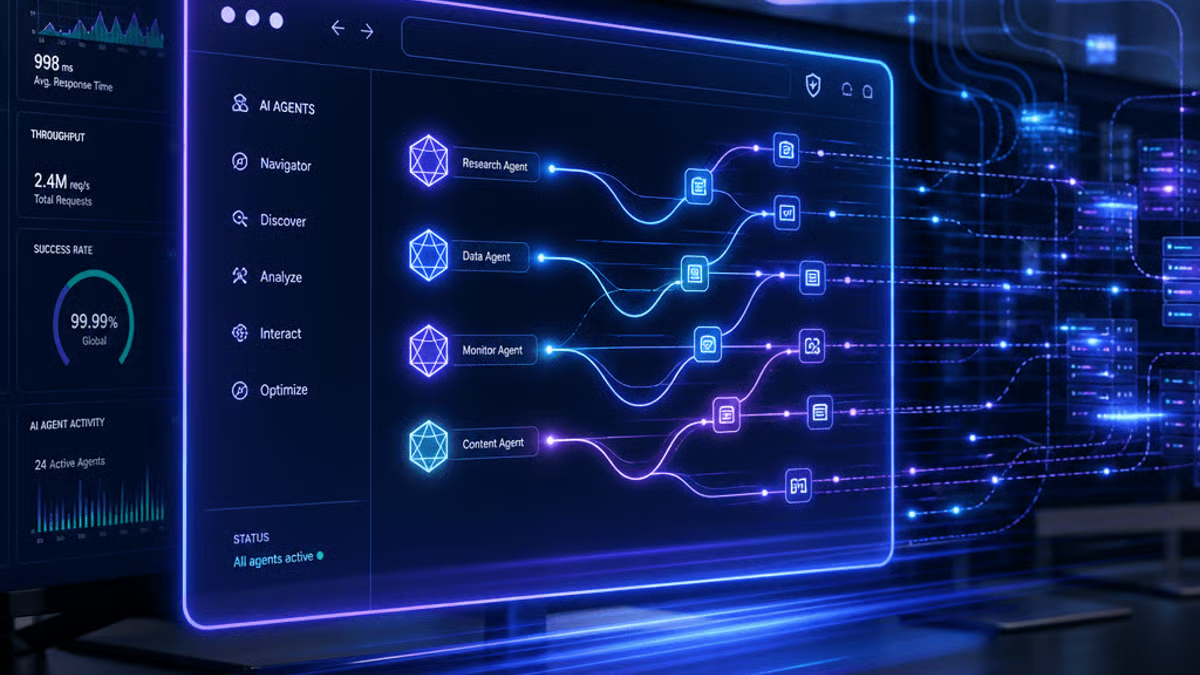
We are witnessing a fundamental shift from static “if-this-then-that” workflows to Agentic AI. These are autonomous systems capable of reasoning, decision-making, and executing complex goals without constant human oversight. Rather than automating individual tasks, modern marketing automation orchestrates entire customer journeys, all without a human making each individual decision.
This changes the role of marketers entirely. Instead of manually managing every touchpoint, teams now focus more on strategy, goals, audience behavior, and creative direction while automation systems handle timing, sequencing, optimization, and large-scale execution in the background.
Personalization at a Scale That Was Previously Impossible
Personalization has been a marketing goal for decades. The gap between the goal and the reality was always execution. You can’t manually customize messaging for thousands of customer segments simultaneously. Automation closes that gap.
The technology behind modern personalization combines real-time behavioral data, predictive modeling, and cross-channel orchestration. As a customer interacts with a brand, the system tracks their behavior, predicts their next likely action, and instantly adjusts the content they receive.
What makes this especially powerful is speed. Personalization now happens dynamically and continuously rather than through static audience buckets created weeks in advance. Campaigns can adapt in real time based on engagement, viewing habits, purchases, browsing behavior, and platform interactions, creating a marketing experience that feels significantly more relevant to each individual user.
AI-Generated Creative in the Automation Stack
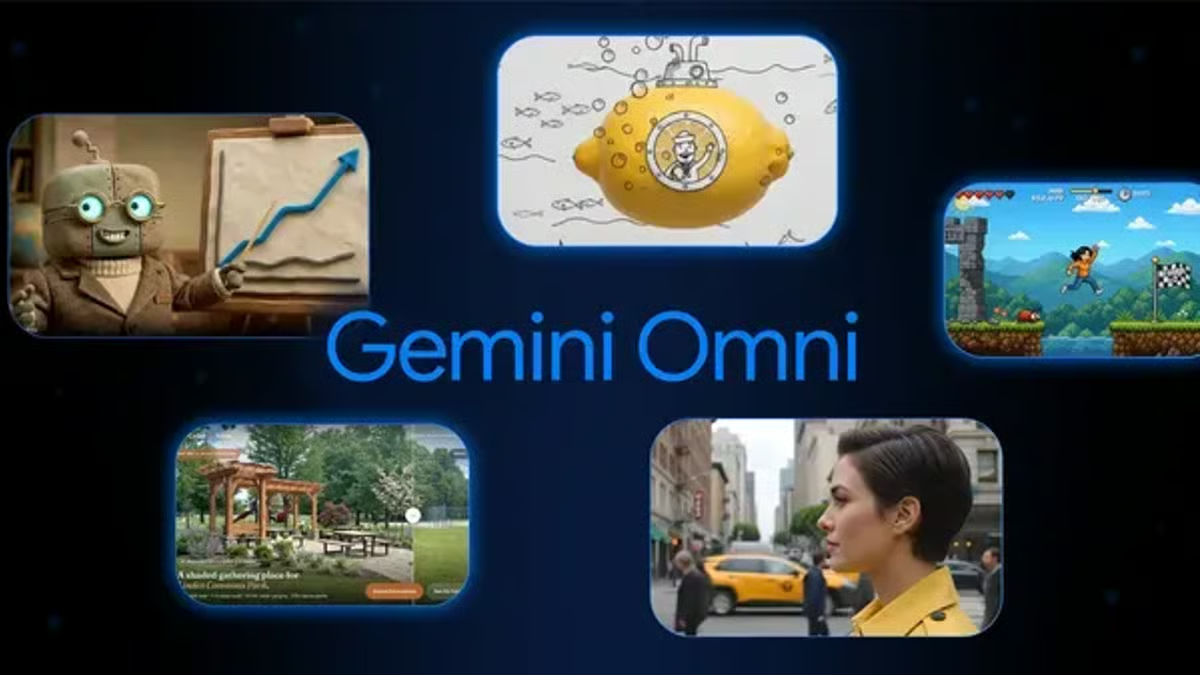
One of the most significant recent developments in marketing automation is the integration of generative AI into the content production layer. It’s no longer just the delivery of content that’s automated; the creation of it is increasingly too.
According to a recent study, two-thirds of marketers use AI for content creation. AI image generators produce on-brand visual assets at a speed and volume that traditional design workflows can’t match.
Video tools enable the production of AI-generated videos from a single piece of footage or even a still image that can be edited, repurposed, localized, and optimized for multiple platforms in a fraction of the usual production time and cost. This allows brands and creators to produce more content at scale without dramatically increasing budgets, production teams, or turnaround times.
AI voiceover tools generate professional narration for video ads, explainer content, and social media without a recording session. For marketing teams running campaigns across multiple channels simultaneously, the ability to generate creative variations at scale is what makes true multi-channel automation viable.
The ROI Case Is Unambiguous
If there’s a single reason marketing automation adoption has accelerated as fast as it has, it’s the return on investment data. Most businesses recoup their automation investment in under six months. The math is fairly straightforward.
Automation reduces repetitive manual work, shortens production timelines, improves campaign consistency, and allows smaller teams to operate at a much larger scale. Instead of spending hours on repetitive tasks, marketers can focus more on strategy, creative direction, and audience growth.
Over time, those efficiency gains compound into measurable cost savings and faster content output.
What Still Requires Human Judgment
The honest counterpoint to all of this is that automation is a multiplier, not a replacement for strategic thinking. The key is to utilize AI to enhance creativity and scale, rather than replace strategic thinking.
Brand voice, creative direction, campaign strategy, audience insight, and the kind of qualitative judgment that determines whether a piece of content will genuinely resonate remain fundamentally human responsibilities.
Data quality is also a persistent challenge. Automation scales whatever you put into it, which means poor data, weak creative, and unclear strategy all get amplified alongside the good decisions.
The marketing teams getting the best results from automation are the ones treating it as infrastructure for human creativity and not as a complete substitute for it. The strategy, the insight, the brand voice, the creative direction: those stay human. The execution, the personalization, the distribution, the optimization: that’s where automation earns its ROI.
Wrapping Up
Marketing automation in 2026 isn’t a tool category but now the operating layer that modern campaigns run on. From AI-generated creative to behavior-triggered personalization to agentic campaign management, automation is present at every stage of the campaign lifecycle. The teams building competitive advantage right now aren’t the ones working harder. They’re the ones who’ve built the automation infrastructure that lets their best creative thinking scale.









Leave a Reply