
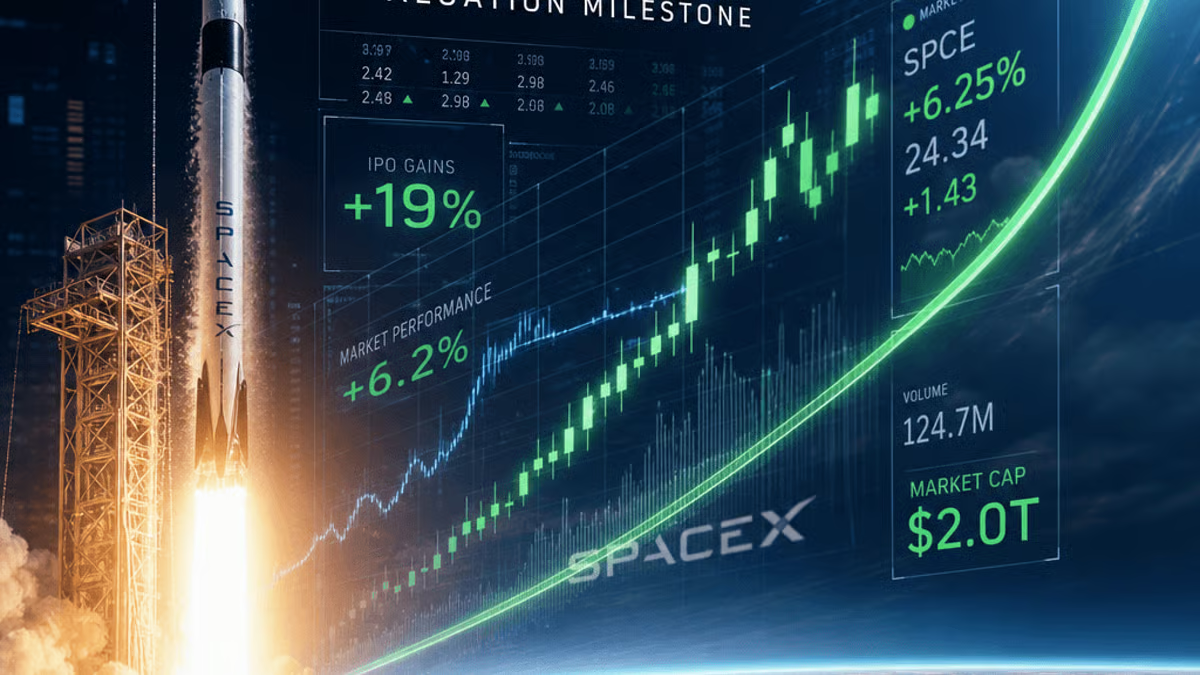
SpaceX isn’t slowing down. The company’s shares jumped 6% in premarket trading Monday, pushing its market capitalization past $2 trillion and extending the momentum from what’s already being called the most successful tech IPO in history. The move comes just one day after SpaceX’s debut saw shares surge 19%, and it’s igniting fresh debate on Wall Street about whether the valuation can hold or if we’re watching another tech bubble inflate in real time.
SpaceX shares are on fire again, and Wall Street can’t seem to agree on what it means.
The Elon Musk-led space exploration company saw its stock climb 6% in Monday’s premarket session, building on Friday’s explosive 19% IPO debut that already shattered records for first-day gains among tech offerings over $100 billion. At current levels, SpaceX’s market cap now exceeds $2 trillion, placing it in rarefied air alongside Apple, Microsoft, and Nvidia.
But unlike those established tech giants with decades of proven profitability, SpaceX is a 24-year-old company that only turned its first annual profit two years ago. That’s fueling an intense debate among analysts about whether the valuation makes sense or whether momentum traders are pushing shares into dangerous territory.
The bull case centers on SpaceX’s dominance in commercial space launches and the explosive growth of its Starlink satellite internet service. The company controls roughly 60% of the global commercial launch market and has deployed over 5,000 satellites, creating what some analysts describe as an unassailable moat in low-Earth orbit connectivity. Starlink alone is projected to generate $12 billion in revenue this year, according to industry estimates, with margins that rival traditional telecom giants.
“SpaceX isn’t just a rocket company anymore – it’s building the infrastructure layer for the next generation of global connectivity,” one institutional investor told trade publications covering the offering. “The addressable market for satellite internet is measured in hundreds of billions, and they’re years ahead of any competitor.”
That competitive advantage is real. Amazon’s Project Kuiper remains years behind schedule, while traditional satellite operators like Viasat struggle to match Starlink’s speed and latency. SpaceX’s reusable Falcon 9 and Starship rockets give it a cost structure that competitors can’t touch, with launch costs reportedly one-tenth of legacy providers.
But the bear case is equally compelling. At a $2 trillion valuation, SpaceX is trading at roughly 25 times projected 2026 revenue – a multiple that makes even high-flying software companies look cheap. The company’s path to justifying that price tag requires not just continued dominance in launches and Starlink growth, but successful execution on far more speculative bets like point-to-point Earth transport via Starship and eventual Mars colonization.
“There’s a lot of blue-sky thinking baked into this price,” one hedge fund manager noted. “If Starlink growth slows or they hit regulatory headwinds in key markets, this could unwind fast.”
Regulatory risk is particularly acute. SpaceX faces increasing scrutiny from the Federal Communications Commission over orbital debris concerns, while international markets like India and China have erected barriers to Starlink deployment. The company’s government contracts, while lucrative, also expose it to political risk that pure commercial players don’t face.
Trading volume tells its own story. Over 400 million shares changed hands in Friday’s debut session, with institutional block trades dominating the action. Monday’s premarket activity suggests that demand hasn’t cooled, though some analysts warn that retail investors chasing momentum could be setting themselves up for volatility.
The IPO itself raised $8.5 billion at a $1.9 trillion pre-money valuation, making it the largest tech offering since Saudi Aramco went public in 2019. Early investors, including Google and Fidelity, saw paper gains that dwarf even the most successful venture bets of the past decade. Musk, who retained a 42% stake, added roughly $800 billion to his net worth in a single day.
What happens next depends largely on SpaceX’s ability to translate its technological lead into sustained financial performance. The company has guided to $80 billion in revenue for 2026, implying 35% year-over-year growth. Meeting or beating that target in upcoming quarterly reports will be critical to maintaining investor confidence at these levels.
Options markets are pricing in significant volatility, with implied moves of 8-10% around the company’s first earnings report scheduled for August. That suggests traders are bracing for a wild ride regardless of which direction the stock ultimately heads.
For now, though, SpaceX is defying gravity in more ways than one. Whether it can sustain this trajectory or comes crashing back to earth remains the trillion-dollar question facing investors piling into what’s become the most closely watched stock of 2026.
SpaceX’s continued surge past $2 trillion raises fundamental questions about how markets value companies at the intersection of proven technology and speculative moonshots. The company’s dominance in commercial space and Starlink’s trajectory provide real justification for a premium valuation, but the multiple being assigned suggests investors are betting on outcomes that remain years away from realization. As institutional money continues flowing in and retail traders debate entry points, the next few months of earnings reports and operational updates will determine whether SpaceX can grow into its valuation or whether early investors are heading for a painful reality check. Either way, this is shaping up to be one of the defining market stories of the decade.










Leave a Reply