
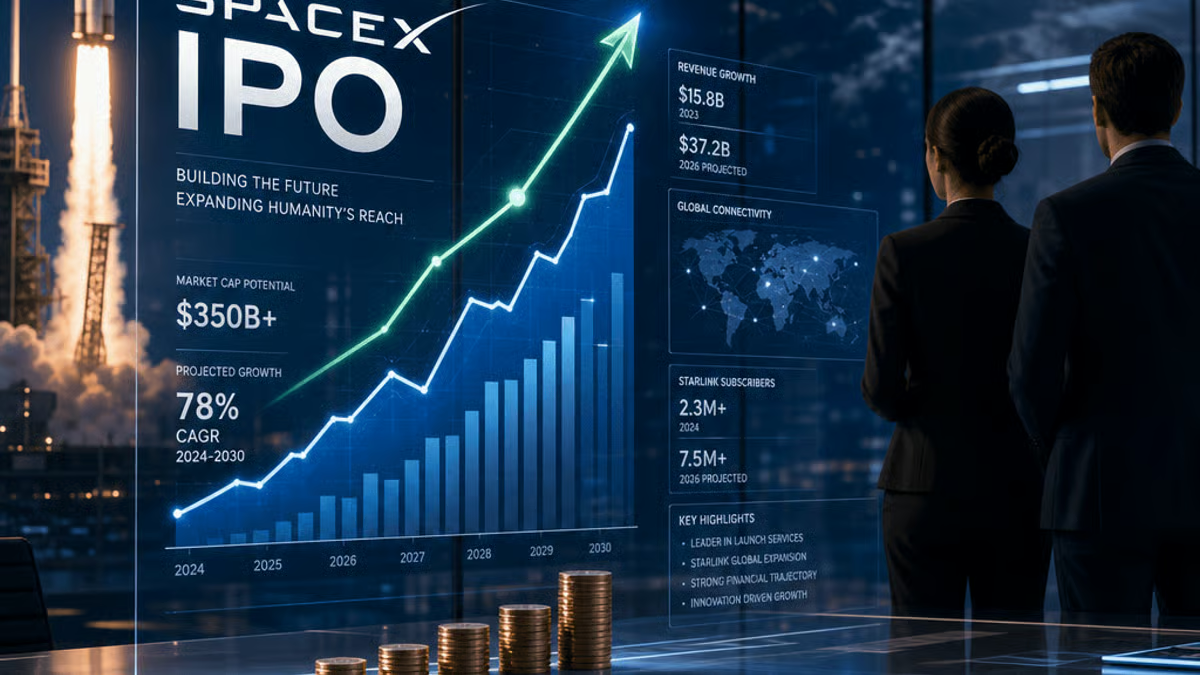
SpaceX just got even bigger. The Elon Musk-led space and AI company’s historic public offering has ballooned to $85.7 billion after underwriters exercised their full greenshoe overallotment option, adding $10.7 billion to the initial $75 billion raised last Thursday. The move signals overwhelming institutional demand for what’s already the largest tech IPO in history, dwarfing Saudi Aramco’s previous record and giving Wall Street a rare win in a market that’s been starved for blockbuster debuts.
SpaceX just made Wall Street history a little bigger. The company’s already record-shattering IPO grew to $85.7 billion on Monday after underwriters exercised their full greenshoe overallotment option, according to regulatory filings with the SEC. That’s an additional $10.7 billion on top of the $75 billion SpaceX raised when it priced its offering last Thursday, cementing its position as the largest technology public debut ever attempted.
The greenshoe mechanism – named after the Green Shoe Manufacturing Company that first used it in 1919 – lets underwriters sell up to 15% more shares than originally planned if demand warrants it. That SpaceX’s banking syndicate pulled the trigger less than a week after debut tells you everything about how institutional investors viewed the deal. When banks exercise the full overallotment this quickly, it’s typically because shares are trading above their offer price and demand is crushing supply.
Elon Musk’s space venture has been telegraphing this moment for months. The company spent years building a business that straddles two of the hottest sectors in tech – launching satellites via its Starlink constellation while simultaneously developing AI capabilities that leverage its massive data infrastructure. That dual positioning helped SpaceX command a valuation that seemed impossible even two years ago, when the company was still raising money privately at a fraction of its current price.
The $85.7 billion haul dwarfs every tech IPO that came before it. Meta’s $16 billion debut in 2012 held the previous tech record, while Alibaba’s $25 billion offering in 2014 claimed the overall crown until Saudi Aramco raised $29.4 billion in 2019. SpaceX just tripled that figure, pulling off a feat that seemed unlikely in a market where IPO volumes have cratered over the past two years.
The timing couldn’t be more pointed. Public markets have been largely frozen for major tech debuts since 2021, with rising interest rates and volatility keeping would-be issuers on the sidelines. SpaceX’s ability to not only go public but also trigger a full greenshoe exercise suggests institutional investors see the company as a rare exception – a business with revenue diversification, government contracts, and AI upside that justifies breaking the drought.
Underwriters on the deal – led by Morgan Stanley, Goldman Sachs, and JPMorgan according to industry sources – now have their answer about whether the market could absorb this much paper. The greenshoe exercise means they successfully placed roughly $10.7 billion in additional shares with institutional buyers who either missed out on the initial allocation or wanted to increase their positions. That’s not a small feat when you’re already digesting a $75 billion base offering.
What makes SpaceX’s raise even more remarkable is its positioning as both a space infrastructure play and an AI company. The firm has been quietly building machine learning capabilities that process data from its Starlink satellite network, creating what some analysts believe could become a proprietary edge in everything from autonomous systems to real-time Earth observation. That’s a narrative that resonates in a market where anything adjacent to AI commands premium multiples.
The greenshoe decision also validates SpaceX’s pricing strategy. Companies and their bankers typically leave some money on the table during IPOs, pricing shares conservatively enough that they pop on debut and reward early public investors. But if shares surge too much, it means the company left capital behind. The quick greenshoe exercise suggests SpaceX priced aggressively but not so much that it killed demand – threading a needle that’s eluded many recent issuers.
For Elon Musk, the $85.7 billion infusion gives SpaceX a war chest that few companies in history have commanded right out of the gate. The capital could accelerate development of Starship, fund expansion of the Starlink constellation, or bankroll AI initiatives that the company has kept largely under wraps. Musk has historically reinvested aggressively in his ventures, and there’s little reason to think this time will be different.
The move also sends a signal to other mega-cap private companies weighing IPOs. If SpaceX can raise $85.7 billion in this environment, suddenly the calculus changes for firms like Stripe, Databricks, or other unicorns that have delayed going public. The greenshoe exercise proves there’s institutional appetite for transformative stories, even when the macro backdrop remains uncertain.
The greenshoe exercise closes the book on the most extraordinary IPO in tech history, but it opens new questions about what SpaceX does with $85.7 billion in fresh capital and whether other private giants will follow through the door Musk just kicked open. For institutional investors who secured allocations, the quick overallotment suggests they bought into a company that’s rewritten the rules on how big a tech offering can actually get. The real test comes in the months ahead, when SpaceX has to prove its public market valuation wasn’t just hype but a reflection of businesses – plural – that can justify the biggest bet Wall Street has made in years.









Leave a Reply