
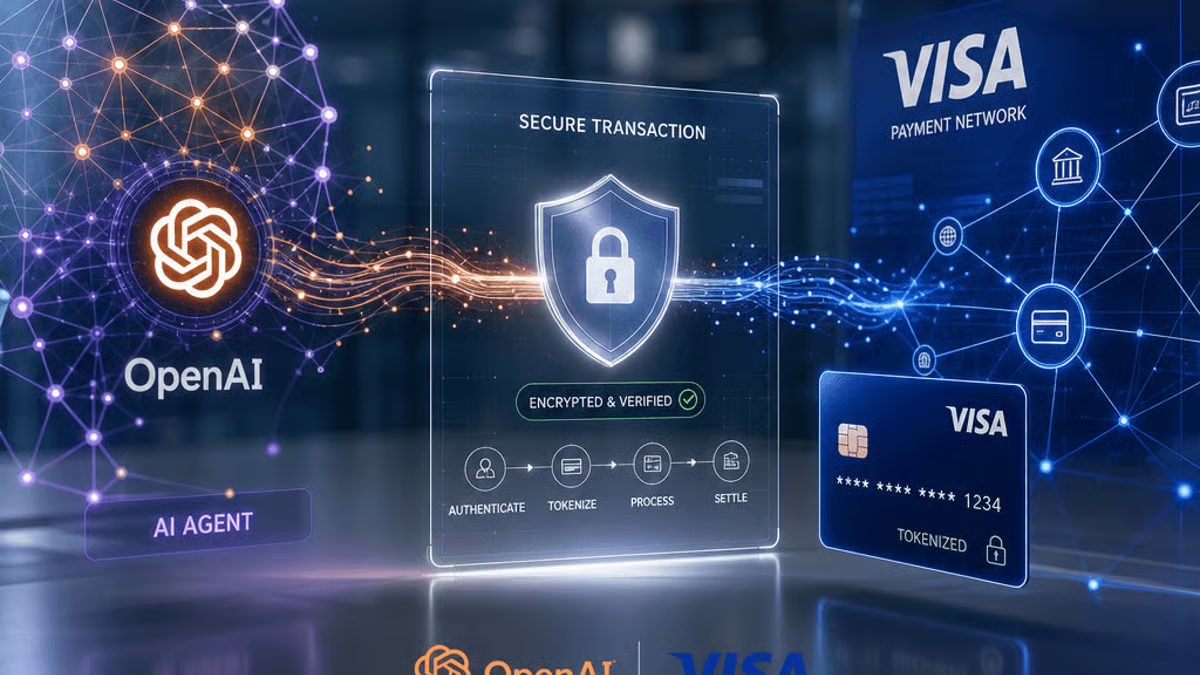
Visa and OpenAI just unveiled a partnership that could fundamentally change how AI agents handle money. The collaboration aims to build secure payment infrastructure for autonomous AI systems that can make purchases on behalf of users – a critical stepping stone toward the much-hyped future of agentic AI. As AI assistants evolve from answering questions to taking action, the ability to trust them with your credit card becomes the next major hurdle both companies are racing to solve.
Visa is making a bold bet that AI agents will soon be buying things on your behalf – and it wants to own the rails those transactions run on. The payments giant just announced a partnership with OpenAI to build what they’re calling secure “agentic transactions,” a system designed to let AI assistants make purchases without constant human approval.
The timing isn’t coincidental. AI agents have hit an inflection point. OpenAI‘s GPT-4 and competing models from Google and Microsoft can already book flights, order groceries, and schedule appointments through conversation. But actually completing those purchases? That’s where things get messy. Most systems still require users to manually enter payment details or click through confirmation screens – friction that defeats the entire purpose of having an AI handle tasks for you.
“We’re seeing enterprise clients ask for this capability constantly,” according to industry experts cited by ZDNet. The demand is real, but so are the risks. Handing your credit card to an AI raises obvious questions about fraud protection, spending limits, and what happens when the algorithm makes a mistake.
That’s where Visa‘s infrastructure comes in. The company processes over 250 billion transactions annually and has spent decades building fraud detection systems. Now it’s adapting that expertise for a world where the “cardholder” might be a large language model. The partnership will likely involve tokenization – replacing actual card numbers with temporary digital tokens – and real-time risk scoring tailored to AI behavior patterns rather than human ones.
For OpenAI, this solves a major enterprise adoption problem. Companies want to deploy AI assistants that can autonomously reorder office supplies, book team travel, or purchase cloud computing resources. But CFOs aren’t about to give unchecked spending power to a chatbot. A Visa-backed solution with built-in guardrails and compliance features could finally make that pitch palatable to corporate finance departments.
The competitive implications are significant. Google‘s Bard and Microsoft‘s Copilot are racing to add similar transactional capabilities, but neither has announced a payments partnership at this scale. Amazon already lets Alexa make purchases through its own ecosystem, but expanding that beyond Amazon’s walled garden requires exactly the kind of payment network Visa provides.
There’s also a fascinating regulatory angle. Financial regulators are still figuring out how to classify AI-initiated transactions. Is the AI acting as your agent? A third party? Something entirely new? How Visa structures this partnership – and whether it gets blessed by regulators – could set precedents for the entire industry.
The technical challenges are formidable. AI systems need to understand context, respect budgets, and handle edge cases like price changes or out-of-stock items. They need to know when to ask permission and when to proceed autonomously. And they absolutely cannot leak payment credentials or make unauthorized purchases. Visa‘s existing tokenization and encryption standards will form the backbone, but they’ll need significant adaptation for AI-specific use cases.
What makes this partnership particularly interesting is the power dynamics. OpenAI controls the AI interface – the point where users express intent. Visa controls the payment infrastructure. Whoever captures more of the transaction flow (and the data it generates) gains enormous strategic leverage as agentic commerce scales. Watch for both companies to emphasize their respective roles in future announcements.
Early enterprise pilots will likely focus on B2B scenarios with clear spending policies – think automated procurement systems or travel booking for distributed teams. Consumer applications, where the trust bar is even higher, will probably roll out more slowly. But if Visa and OpenAI can prove the model works at enterprise scale, consumer adoption could accelerate quickly.
This partnership represents more than a technical integration – it’s a bet on how commerce will work when AI agents become trusted intermediaries. If Visa and OpenAI can crack the security and trust challenges, they’ll likely define the standard for agentic transactions before regulators even finish writing the rules. For enterprises sitting on the fence about AI adoption, a proven payment solution could be the green light they’ve been waiting for. The real test comes when these systems handle their first million transactions – and how they respond when something inevitably goes wrong.










Leave a Reply