
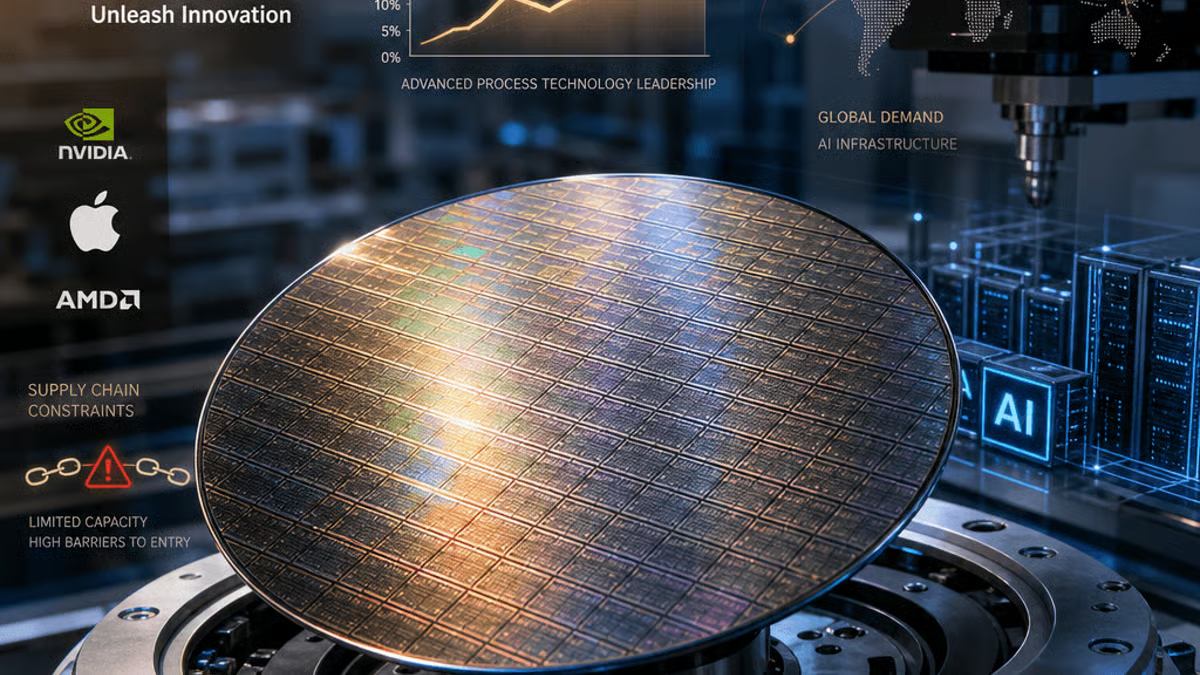
TSMC, the world’s largest contract chipmaker, isn’t ruling out price increases as manufacturing costs surge amid an unprecedented AI infrastructure buildout. In a rare interview with BBC News, a senior executive at Taiwan Semiconductor Manufacturing Company addressed the mounting pressures from explosive AI chip demand, geopolitical factory expansions, and the reality that someone will have to pay for it all. The signal matters because TSMC manufactures chips for virtually every major tech player, from Apple‘s iPhone processors to Nvidia‘s AI accelerators.
The world’s chip supply just got more expensive to secure. TSMC, which controls over 60% of global semiconductor foundry capacity, is opening the door to price increases as the company navigates surging demand from AI companies and mounting geopolitical pressures to build manufacturing capacity outside Taiwan.
In a rare sit-down with BBC News, a senior TSMC executive laid out the stark economics facing the semiconductor industry. The company isn’t committing to price hikes yet, but it’s also not ruling them out – a significant shift for a manufacturer that’s historically balanced premium pricing with long-term customer relationships. The admission comes as TSMC juggles record capital expenditures, factory construction in Arizona and Germany, and customer demand that shows no signs of cooling.
The stakes couldn’t be higher for the tech industry. TSMC manufactures the advanced processors that power Apple‘s entire iPhone and Mac lineup, Nvidia‘s H100 and upcoming Blackwell AI chips, and critical components for AMD and Qualcomm. Any price adjustments from TSMC don’t just affect one product category – they ripple across consumer electronics, data center infrastructure, and the economics of training massive AI models.
Nvidia has already seen its H100 GPUs command prices north of $30,000 per unit in the open market, with customers waiting months for delivery. If TSMC raises wafer prices even modestly, those costs will inevitably flow downstream to enterprises building AI infrastructure and consumers buying next-generation devices. Cloud providers like Microsoft Azure, Amazon Web Services, and Google Cloud – all racing to expand AI compute capacity – would face higher capital expenditure requirements at exactly the moment they’re already spending tens of billions on infrastructure.
The AI boom has fundamentally altered semiconductor demand patterns. Traditional chip cycles followed consumer electronics sales, with predictable seasonal fluctuations. But AI infrastructure operates on a different timeline. Companies aren’t buying chips for quarterly refresh cycles – they’re securing multi-year supply agreements to support model training and inference workloads that run 24/7. TSMC’s most advanced 3-nanometer and 5-nanometer production lines are essentially sold out through 2026, according to industry analysts.
Geopolitics compounds the cost pressure. The United States has pushed TSMC to build advanced fabs in Arizona, with the first facility expected to begin production in 2025. The company has committed over $40 billion to US manufacturing, far exceeding original projections. Meanwhile, European governments have courted TSMC for local production capacity. These geographically diversified fabs cost significantly more to build and operate than TSMC’s Taiwan facilities, where the company benefits from established supply chains and skilled workforce density.
The rare executive interview signals TSMC is preparing the market for a new cost reality. The company has historically avoided public discussion of pricing strategy, preferring to negotiate directly with major customers in multi-year agreements. Breaking that silence suggests the cost pressures have become too significant to absorb through efficiency gains alone. TSMC’s capital expenditure reached $36 billion in 2023 and is projected to remain elevated through the decade.
For Apple, which relies exclusively on TSMC for its custom silicon, higher wafer prices could squeeze margins on devices or push retail prices higher. The iPhone maker has thus far managed to hold pricing relatively stable while transitioning its entire product line to in-house chip designs. But if TSMC implements broad-based price increases, Apple will face difficult decisions about absorbing costs versus passing them to consumers.
The enterprise software and AI sectors face even more direct exposure. Companies building AI products have predicated their economics on current chip pricing and availability. OpenAI, Anthropic, and dozens of AI startups burn through compute resources at rates that would have been unthinkable five years ago. Higher chip costs translate directly to higher inference costs, potentially forcing adjustments to pricing models for AI services.
What makes TSMC’s position particularly powerful is the lack of alternatives. Samsung and Intel both operate foundry businesses, but neither has matched TSMC’s yields and performance at the most advanced process nodes. Intel is investing heavily to rebuild its foundry capabilities, but that’s a multi-year project. Samsung has struggled with yield issues on cutting-edge nodes. For now, if you want the best chips, you go to TSMC – and you pay TSMC’s prices.
The executive’s comments about AI and geopolitics acknowledge that TSMC sits at the intersection of two massive forces reshaping technology. AI workloads require the most advanced chips TSMC can manufacture, while geopolitical tensions have made semiconductor supply chains a matter of national security. Both trends drive costs higher while making TSMC’s manufacturing capacity even more valuable and strategic.
TSMC’s willingness to discuss pricing publicly marks a turning point for an industry that’s operated on predictable cost curves for decades. The combination of AI-driven demand, geopolitical factory requirements, and constrained manufacturing capacity creates conditions where the world’s most important chipmaker can – and likely will – exercise pricing power. For tech companies, this means rethinking hardware budgets and product economics. For consumers, it could mean higher prices for everything from smartphones to AI services. The real question isn’t whether chip costs will rise, but how quickly the industry can adapt to a new era where advanced semiconductors command premium pricing with limited supply alternatives.










Leave a Reply