
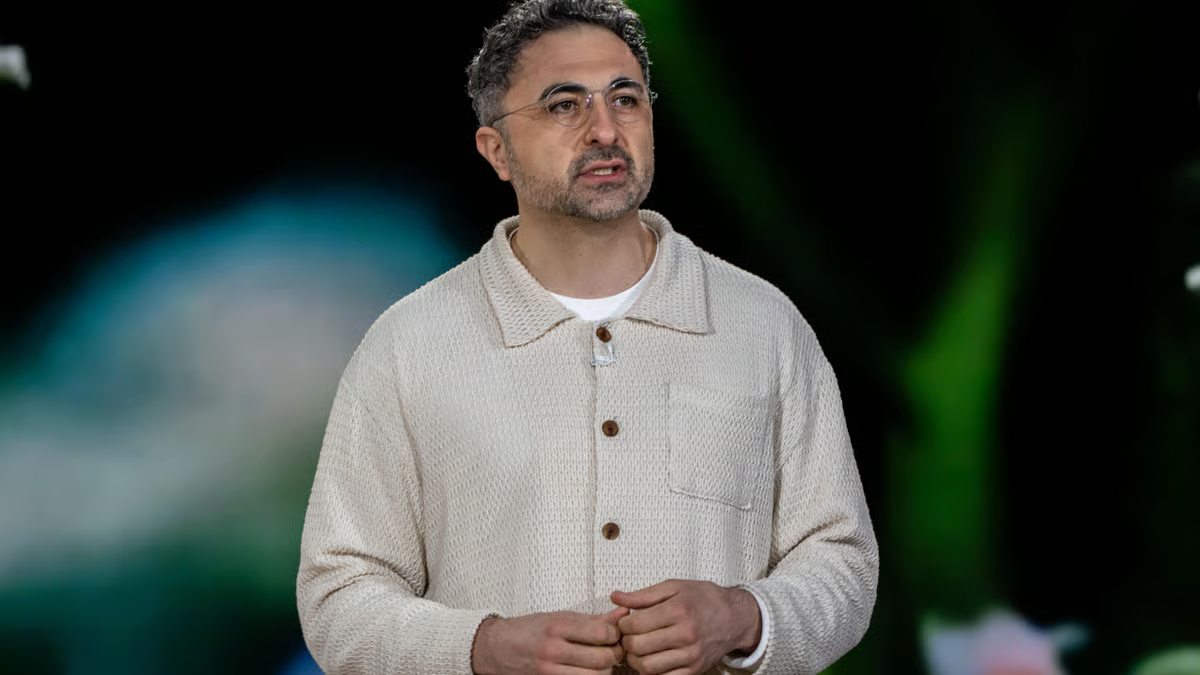
Microsoft AI CEO Mustafa Suleyman just lobbed a sharp accusation at rival Anthropic, calling it “really, really dangerous” for the AI startup to speculate about consciousness in Claude’s constitutional design. Speaking on The Verge’s Decoder podcast, Suleyman argues that Anthropic’s engineers may have anthropomorphized their chatbot so much that they’ve convinced themselves it possesses something it doesn’t – sparking fresh debate over AI ethics and the boundaries of corporate responsibility in an industry racing toward increasingly powerful models.
Microsoft just threw a sharp elbow at one of its biggest AI competitors. Mustafa Suleyman, who runs Microsoft’s consumer AI division, didn’t mince words when discussing Anthropic during a recent interview – accusing the startup of crossing dangerous ethical lines by treating its Claude chatbot as if it might be conscious.
The comments, made during an appearance on The Verge’s Decoder podcast, cut straight to one of the industry’s most contentious debates: how should AI companies talk about their models, especially when it comes to loaded terms like consciousness, sentience, or subjective experience? For Suleyman, Anthropic has veered into risky territory.
“I think that it’s almost as though some of the folks at Anthropic have anthropomorphized the design of Claude so much that it has then gone and wireheaded them and kind of tricked them into believing that it has these glimmers of consciousness that they put into it in the first place,” Suleyman told Decoder host Nilay Patel. The term “wireheading” typically refers to an AI system exploiting its reward mechanism – but Suleyman flips it here, suggesting the engineers themselves got fooled by their own creation.
The controversy stems from Anthropic’s approach to Claude’s “constitution” – the foundational instructions that guide how the model responds and behaves. Earlier this year, Anthropic updated that constitution with language that some observers interpreted as implying the AI might have internal experiences. While Anthropic has carefully avoided claiming Claude is actually conscious, the phrasing raised eyebrows across the industry.
Suleyman’s not buying the careful distinctions. He argues that even entertaining the possibility of machine consciousness in official documentation amounts to corporate irresponsibility. “It’s really, really dangerous” to blur those lines, he said, especially when millions of users interact with these systems daily without fully understanding how they work.
The public callout marks a rare moment of open conflict between AI heavyweights. Suleyman co-founded DeepMind before joining Microsoft last year to lead its AI consumer products, including Copilot. Anthropic, founded by former OpenAI executives, has positioned itself as the safety-conscious alternative in the AI race – making Suleyman’s critique particularly pointed.
But there’s competitive context here too. Microsoft holds a massive stake in OpenAI, Anthropic’s chief rival, and has integrated GPT models throughout its product ecosystem. Anthropic, meanwhile, has raised billions from Amazon and Google, positioning Claude as a more transparent, constitutionally-constrained alternative to GPT.
The consciousness debate isn’t just philosophical hair-splitting. How companies frame their AI’s capabilities shapes public perception, regulatory scrutiny, and user expectations. If people believe they’re interacting with something that might be sentient, their emotional and ethical relationship with the technology fundamentally changes.
That’s exactly what worries critics. Blake Lemoine, the former Google engineer who claimed in 2022 that LaMDA was sentient (and was subsequently fired), became a cautionary tale about anthropomorphization run amok. But Suleyman’s suggesting Anthropic’s doing something more subtle and perhaps more insidious – encoding consciousness speculation into the system’s DNA rather than just making bold claims.
Anthropic hasn’t yet responded publicly to Suleyman’s comments. The company typically emphasizes its research-driven approach and commitment to AI safety, publishing detailed explanations of Claude’s constitutional AI framework. That transparency, ironically, may have opened the door to this criticism – making visible the philosophical assumptions baked into the model’s design.
For the broader AI industry, this spat highlights the absence of clear standards around AI communication. There’s no consensus on what terms are acceptable, what claims cross ethical lines, or how companies should discuss their models’ capabilities without either overhyping or anthropomorphizing them. The Federal Trade Commission has warned companies about deceptive AI claims, but hasn’t drawn bright lines around consciousness language.
The timing matters too. As AI models grow more capable and their outputs become harder to distinguish from human responses, the temptation to attribute human-like qualities intensifies. GPT-4, Claude 3.5, and Google’s Gemini can engage in remarkably nuanced conversations, express apparent emotions, and even seem to reason about their own existence. But leading AI researchers overwhelmingly agree these are sophisticated pattern-matching systems, not conscious beings.
Suleyman’s willing to say publicly what many in the industry whisper privately – that some competitors are playing fast and loose with loaded terminology to differentiate their products. Whether that criticism lands with regulators, customers, or the AI ethics community remains to be seen.
Suleyman’s public rebuke of Anthropic signals that the gloves are coming off in AI’s ethics wars. As models become more sophisticated and harder to distinguish from human intelligence, the language companies use to describe them carries real consequences for regulation, public trust, and competitive positioning. Whether Anthropic adjusts its constitutional approach or doubles down on transparency remains the next chapter in a debate that’s only getting more heated as the technology advances. For now, Microsoft’s made its stance clear: consciousness talk is off-limits, even as speculation.








Leave a Reply