
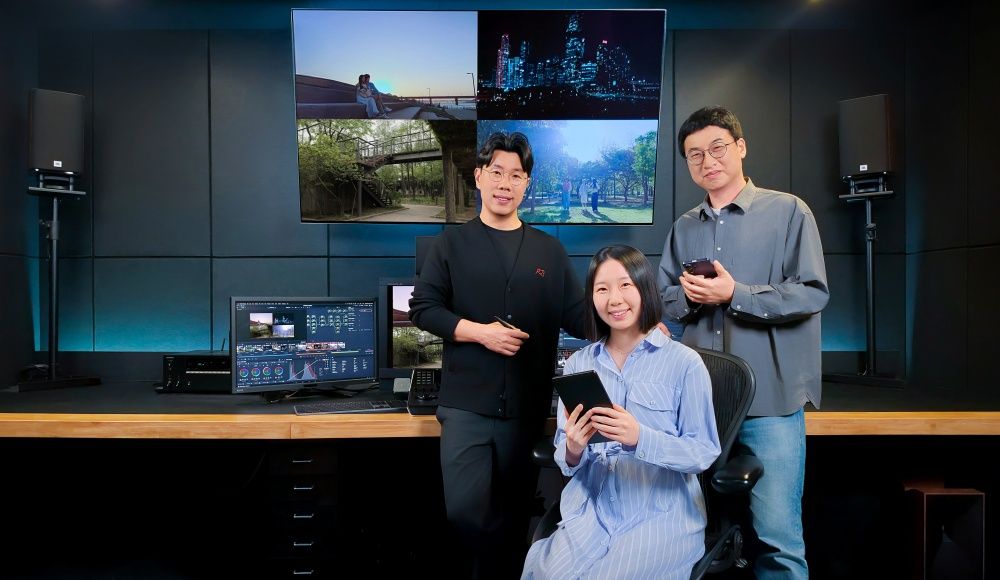
Samsung is putting Hollywood-grade color grading in everyone’s pocket. The Galaxy S26 series debuts Cinematic LUT – a professional color transformation tool that turns everyday phone footage into cinema-quality video with a single tap. Born from a two-year collaboration between Samsung’s Mobile eXperience Business, Samsung Research, and colorist studio U5K Imageworks, the feature reinterprets Samsung Log footage to deliver the depth and look of professional filmmaking. In an exclusive interview, the three key developers behind Cine LUT revealed how they made pro-level video creation accessible to anyone.
Video storytelling is shifting from pure resolution wars to mood and emotion. Samsung recognized this when it introduced the Advanced Professional Video codec on Galaxy S26 Ultra, laying groundwork for mobile video production while maintaining image quality. But the company asked a bolder question: can anyone create Hollywood-style videos on a Galaxy phone?
The answer is Cinematic LUT, and it’s already changing how people shoot video on their phones.
“A LUT is essentially a ‘map’ that transforms one set of colors into a desired look,” explains Sugon Baek of Samsung’s Camera Image Quality R&D Group. “Unlike conventional filters that simply overlay color, Cine LUT reinterprets Samsung Log footage to deliver the depth and look of professional filmmaking.”
Bomi Kim from Samsung Research’s Reality Media Lab adds critical context. “It’s optimized for Log video. By leveraging its wide gradation, the feature precisely reconstructs color and brightness to preserve subtle tonal details often lost with conventional filters for richer, more natural depth.”
The collaboration that produced Cine LUT started two years ago. Taesik Eom, CEO of U5K Imageworks – a colorist studio behind globally recognized film and TV productions – began advising Samsung on Rec. 709 LUT work for Samsung Log video. That experience evolved into the Cine LUT project.
“For this project, we developed multiple versions across three intensity levels – neutral, soft and strong – and tested them in diverse scenes, ultimately selecting four core styles,” Eom told Samsung Newsroom. Those four styles – Blockbuster, Coming-of-age, Romance, and Thriller – represent distinct visual languages from popular film genres.
But translating cinematic color grading to mobile presented unique challenges. Professional colorists work in controlled environments with consistent lighting and carefully managed exposures. Smartphone users shoot everywhere, in constantly changing conditions.
“We needed a large dataset to validate performance across diverse conditions,” Kim explains. “Testing in real-world environments – from natural and indoor lighting to day and night – and close collaboration were key to capturing the nuances of color.”
Baek’s team faced the technical challenge of maintaining consistent, undistorted color across wildly different shooting scenarios. “Through continuous testing, we developed a LUT that balances subjective preference with objective quality,” he says.
The technical validation process was rigorous. Building on U5K’s creative color direction, Samsung Research validated concepts against quantitative criteria, analyzing each frame using color charts, gray balance, and vector scopes. The goal: ensure consistent performance whether you’re shooting a sunset, a cafe interior, or a nighttime street scene.
“Since lighting, exposure and white balance constantly vary, we focused on creating looks that remain natural in any situation,” Eom notes. Reliability in real-world conditions was paramount.
The four chosen styles serve distinct creative purposes. Blockbuster delivers high-contrast visuals suited for outdoor and urban environments. Coming-of-age provides fresh, trendy aesthetics perfect for cafes or vlogs. Romance adds warmth to character-driven scenes. Thriller creates moodier, more striking impressions.
But Eom emphasizes there’s no fixed rulebook. “It depends on the situation,” he says, encouraging users to experiment.
Early user response has exceeded Samsung’s expectations. “We expected it might be seen as just another video effect, but the response exceeded expectations,” Baek reveals. “Users quickly recognized that combining Log shooting with Cine LUTs expands creative possibilities beyond simple filters.”
The feature is already inspiring new content creation workflows. High-quality videos with Cine LUTs applied are being widely shared across social media, with users actively choosing styles based on their scenes rather than applying a one-size-fits-all filter.
The user experience was carefully designed for simplicity. Creators can preview cinematic footage at the moment of capture, then apply a LUT and share the video with a single tap in the Gallery – no complex editing software required.
“We wanted to create an experience that lets users preview cinematic footage at the moment of capture, then apply a LUT and share the video with a single tap,” Baek explains. That seamless workflow makes professional-level color grading accessible to anyone, not just video editing experts.
Commercial and documentary director Heesub Han has already shot a series of short films on Galaxy S26 Ultra using the APV codec, Samsung Log, and Cine LUT, demonstrating the creative possibilities when Hollywood-grade tools meet mobile convenience.
The technical foundation matters. Samsung Log captures video using a logarithmic curve that expands detail in darker areas, reflecting how human eyes perceive light and shadow more accurately than standard video curves. That wide gradation gives Cine LUT the color information it needs to work its transformation magic.
This approach differs fundamentally from Instagram-style filters. Those typically overlay color adjustments universally. LUTs reinterpret the entire color space captured in Log footage, preserving subtle gradations and tonal nuances that give professional video its depth and dimensionality.
Samsung’s Cinematic LUT represents more than a flashy camera feature – it’s a genuine democratization of professional video tools. By partnering with actual colorists who grade Hollywood productions and validating performance across thousands of real-world scenarios, Samsung created something that works reliably in the chaos of everyday shooting. Early adoption suggests creators recognize the difference between superficial filters and genuine color science. As Baek and his team continue refining the Galaxy S26 as a professional-grade camera, they’re lowering barriers that once separated amateur phone videos from professional productions. The question isn’t whether mobile video can match cinema quality anymore – it’s what creators will do now that they have Hollywood’s color palette in their pockets.











Leave a Reply