
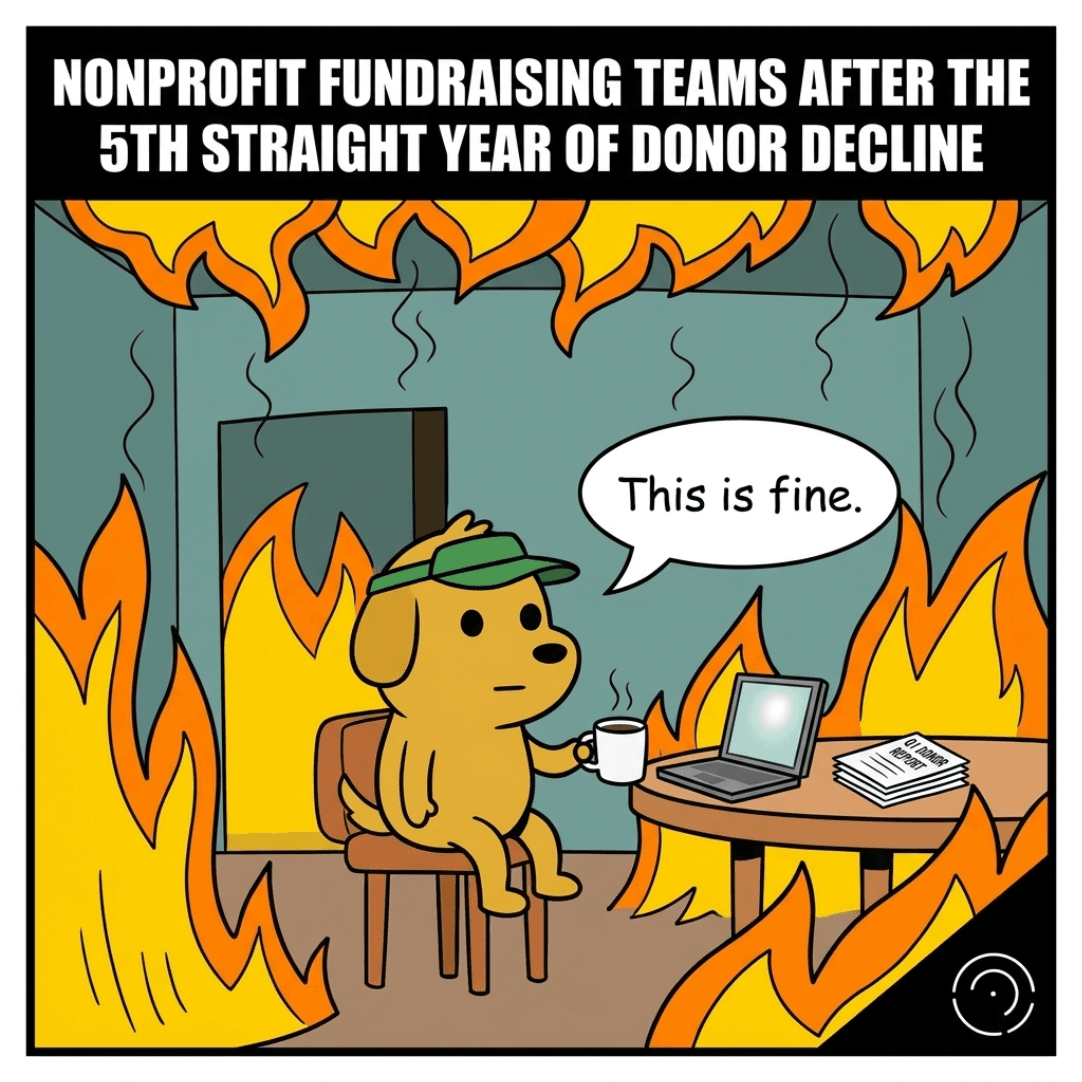
The American donor base just shrank for the fifth year in a row. Major donors now fuel roughly 80% of all giving while small-dollar participation drops quarter after quarter. Eight out of ten new donors never give a second time. And the single biggest tech response to this crisis, the platform that was supposed to make giving easier, is being sued by an attorney general for impersonating 1.4 million nonprofits without their consent.
I run behavioral research for a living. When the data on a system gets this ugly, the system is not having a bad year. The system is breaking.
Today, with the launch of the EAT Hunger Network, we are proposing a different model entirely. Not a better donate button. A structural pivot away from the donation paradigm itself.
Here is what you will get from this piece:
- Why the donor base is collapsing in real time, and what that means for every cause that depends on small-dollar giving
- How platform-led philanthropy quietly turned into impersonation, hidden tips, and litigation
- What the Hunger Network is, how it routes capital to verified hunger-relief organizations, and why our members are structurally not donors
- Why the next era of charitable infrastructure looks more like a public market than a fundraising appeal
Disclosure first. I co-founded WYDE. I am writing as someone building the alternative, not as a neutral observer. With that on the table, here is the case.
The donation model is breaking down faster than most people realize
The numbers are not subtle. The Fundraising Effectiveness Project, which tracks real-time data from more than 12,500 nonprofits, reports that donor counts fell an estimated -3.6% (±0.5%) in 2025, extending a streak that began in 2021. That is the fifth consecutive annual decline.
Inside that headline number, the mix is uglier. According to Stanford Social Innovation Review’s analysis earlier this year, gifts above $5,000 saw modest growth in 2024 while every other tier kept sliding. The sharpest fall hit the segment giving under $100, which still represents about half of all individual donors. Retention is in matching trouble. Roughly four in five first-time donors never return, and the share of prior-year donors who give again sat near 32% as of 2025.
Translate that into operational reality for any food bank or hunger-relief nonprofit. For every ten new donors you spend money to acquire, eight never come back. Of the two who do, one will likely lapse the year after that. You are running the acquisition treadmill at full speed just to stay in place.
Now layer in the demand side. The One Big Beautiful Bill Act cut $187 billion from SNAP over a decade, with 2.4 million Americans losing eligibility and states absorbing cost shifts of 50% to 75% of administrative expenses. Grocery prices remain more than 29% above 2020 levels. Forty-seven million Americans face food insecurity. One in five children does not have reliable access to food.
The capacity exists. Feeding America operates more than 200 food banks and 60,000 food pantries, distributing 9.7 billion meals last year. The infrastructure to feed people is in the field. What is missing is the funding model to keep it running when the donor base that traditionally backed it is statistically disappearing.
The tech response made the trust problem worse
Here is the part nobody at a fundraising conference wants to talk about. The technology that was supposed to fix this just spent six months becoming the cautionary tale.
In October 2025, GoFundMe quietly created donation pages for 1.4 million U.S. nonprofits. The charities did not know. They had not consented. The pages used scraped IRS Business Master File data, often with outdated information, and were optimized to outrank the nonprofits’ own websites in search results. The pages charged a 2.2% transaction fee, a 30-cent per-donation charge, and a default donor “tip” of 14% to 16.5% that was routed to GoFundMe rather than the nonprofit. A donor who thought their full $50 was reaching their local food bank could see roughly 17% to 19% siphoned off before the charity ever heard about the gift.
The legal backlash arrived in waves. On March 3, 2026, a coalition of 22 state attorneys general sent a joint letter demanding answers. On March 10, the Alaska Attorney General went further and sued six platforms, including GoFundMe, PayPal Giving Fund, Charity Navigator, JustGiving, Pledge, and Network for Good, alleging violations of Alaska’s 1993 Charitable Solicitations Act and the state’s Consumer Protection Act. Civil penalties run from $1,000 to $25,000 per violation. The next day, three Oregon nonprofits filed a federal class action in U.S. District Court alleging false association and unjust enrichment.
The lesson is not that GoFundMe is uniquely bad. The lesson is that when you bolt extractive tech onto a model that was already running on borrowed trust, you accelerate the collapse. The same week the GoFundMe lawsuits landed, a family sued a nonprofit for cutting them off from their own $21 million donor-advised fund, one of $326 billion currently sitting in DAFs with no statutory payout requirement. We covered the deeper version of the trust collapse in our exclusive on the secure philanthropic crypto alternative to the Eric Adams NYC memecoin crash earlier this year, and the pattern keeps repeating. Platforms keep finding new ways to monetize the gap between donor intent and nonprofit operations. The gap itself is the problem.
The donation model is structurally optimized for moments. A campaign, a year-end push, a viral disaster. Modern attention does not work that way. Trust does not work that way either.
A different model: the EAT Hunger Network
So we built something else. Today, with the Hunger Network live, I want to walk through exactly what it is, because the structural details are where the new model lives.
The Hunger Network is the public infrastructure layer of $EAT, the cause coin we launched on Coinbase’s Base blockchain on December 10, 2025. (TechBuzz first covered the trade-to-feed launch here.) The Network does two jobs at the same time. It is a free, open, account-less directory that helps people find verified hunger-relief organizations near them by ZIP code or city. And it is the allocation layer that routes the cause-pool fees generated by $EAT trading and spending to those same organizations.
The structural pivot is in one sentence. EAT members are not donors. They participate in a network. The network generates fees through trading, holding, and card spending. Those fees fund the WYDE Association treasury. The Association, a Wyoming Decentralized Unincorporated Nonprofit Association with IRS 501c(4) determination, makes grants to verified 501c(3) hunger-relief organizations on a published cadence. No one is being asked to donate at any step.
That distinction looks subtle. It is load-bearing. Asking someone to donate triggers a different cognitive process than asking them to participate. Donations are framed as sacrifice. Participation is framed as joining. The donor model fights against self-interest. The member model aligns with it. When the system works, members benefit personally (governance rights, debit-card access, partner discounts, trading rewards) while the cause receives funding as a structural byproduct.
Here is how the cause pool is split:
| 50% Pool | 50% Pool |
|---|---|
| Exclusive National Partner. Feed the Children, an 18-month grant agreement effective April 1, 2026. National-scope hunger relief. (Read our Feed the Children partnership coverage.) | Community-Voted Pool. Each month, WYDE Association curates a Top Ten ballot of verified organizations. $EAT holders vote. All ten receive a grant, weighted by vote share. Quadratic voting flattens whale influence. |
The phased rollout is honest about what is live today and what activates in the coming weeks. Phase 01 (Public Directory) and Phase 02 (Verification and Eligibility) are live now at eat.ong. Any U.S. 501(c)(3) hunger-relief organization operating at least one year can claim its listing in roughly two minutes and become eligible for funding. Phase 03 (Curated Top Ten) and Phase 04 (Community Vote and Allocation) are activating now, with the first community-voted rounds starting soon. Phase 05 is the multi-cause expansion: e.g., water, education, healthcare, climate, and housing, each with its own cause coin and community.
Voting mechanics, on-chain. $EAT balances are captured by a custom snapshot contract on Base when voting opens. Vote weight as a quadratic function aiming to balance participation with ownership. Quadrative voting takes the square root of token balance, so a holder with 1,000,000 $EAT casts 1,000 effective votes rather than 1,000,000. Each round would run ten days (seven for voting, three for execution) on a monthly cadence. Every organization on the slate would already passed Association diligence before voting opens, which means there is no scenario in which members vote for an organization that cannot receive the grant. Grants disburse in ETH, USDC, or ACH at the recipient’s election.
The free directory tier and the optional Premium tier will be eligible for monthly funding rounds on identical terms. Paying will never influence allocation. Premium aims to exist for organizations that want amplified visibility in the directory, not for organizations that want to buy their way onto a ballot. We aim to be deliberate about this. Every nonprofit fundraising scandal of the past decade has involved someone paying for placement. We are removing the option.
The numbers, the milestones, and the velocity advantage
As of this writing, $EAT trades around $0.00097 with a market cap near $9.7 million across roughly 1,204 holders, having climbed 564% in the 30 days leading up to its CoinMarketCap and Coinbase listings. The token has crossed 25,000 meals funded since December launch, using the conservative aggregate of $1 equals 5 meals (Feeding America references $1 equals 10 meals; we use the lower figure across all reporting to keep impact claims defensible).
Today, April 28, BitMart launched a 30-day Trade-to-Feed competition paying out up to $4.4 million USDT, marking $EAT as the first cause coin listed on a major centralized exchange. Trading activity from that competition flows through the same 50/50 cause pool. (Live token data is at CoinGecko. Live impact metrics are at eat.ong/live-impact.)
The forward model is documented in the 20,000-scenario Monte Carlo simulation WYDE Association published earlier this month. Five vesting milestones (100M, 250M, 500M, 750M, and 1B meals funded) trigger team, treasury, and partner unlocks. The vesting is meals-based, not time-based. Supply does not unlock until the impact happens.
The velocity argument is simple. A traditional small-dollar donation is a single, discrete event that has to be re-acquired the next year. Fee-funded grant-making compounds. Every trade, every card swipe, every governance round generates capital for the treasury without anyone deciding to give again. The funding base stops being a list of donors that shrinks every year and becomes a network whose participation creates funding as a byproduct.
Why I believe this works when donations are failing
Two reasons, both behavioral.
First, the model removes the ask. Donor fatigue is not a discipline problem. It is a structural inevitability of any system that has to interrupt someone, frame a request, and overcome the immediate cost of giving in order to function. Remove the ask and you remove the fatigue. The Hunger Network works whether or not any individual member thinks about hunger relief during a given month, because the cause pool fills from network activity rather than network solicitation.
Second, the model makes transparency structural rather than promised. Every nonprofit on a ballot is pre-vetted by the Association before the round opens. Every grant disbursement is recorded on Base and published at eat.ong/allocation-history. A donor who is statistically distrustful of nonprofit overhead claims (and the data says most donors are now exactly that) can verify the entire flow themselves, end to end, without taking anyone’s word. That is the answer to the trust crisis the GoFundMe scandal exposed. Not better disclosures. Verifiable allocation as a default property of the system.
The Hunger Network is the proof of concept. The same architecture (verified directory, curated ballot, quadratic-weighted community vote, on-chain allocation) is cause-agnostic. Once it demonstrates the model at scale, the WYDE Impact Exchange® extends it to additional verticals, each with its own cause coin and community.
I am not predicting the donation model disappears overnight. Major donors will continue to fund foundations. DAFs will continue to grow. The grassroots base, though, the half of all American donors who give under $100, is exiting the system through structural attrition. They need somewhere to land that does not require them to keep absorbing the donor pitch. The Hunger Network is one of the first credible somewheres.
If you run a hunger-relief organization, claim your listing at eat.ong/claim/start. Free. About two minutes. Eligibility for monthly funding rounds is identical regardless of the tier you choose. If you are a $EAT holder, your first community-voted round is approaching on the published schedule.
The donation era is not ending because anyone declared it over. It is ending because the math stopped working. Members are how it gets replaced.
📋 IMPORTANT DISCLOSURE
This article reflects my analysis as a co-founder of WYDE Association and is not financial or investment advice. I hold $EAT, which creates a direct conflict of interest. Token values fluctuate. Impact outcomes depend on nonprofit execution, trading volume, and governance participation. Past performance does not guarantee future results. Always conduct your own research and consult qualified financial and legal advisors before making decisions. Never invest more than you can afford to lose.
Aaron Rafferty is co-founder of WYDE Association, the Wyoming 501(c)(4) operating the first Impact Exchange. He researches behavioral economics applied to coordination problems and writes regularly for TechBuzz on philanthropy, Web3 infrastructure, and the legal architecture of decentralized organizations.




Leave a Reply