
- ■
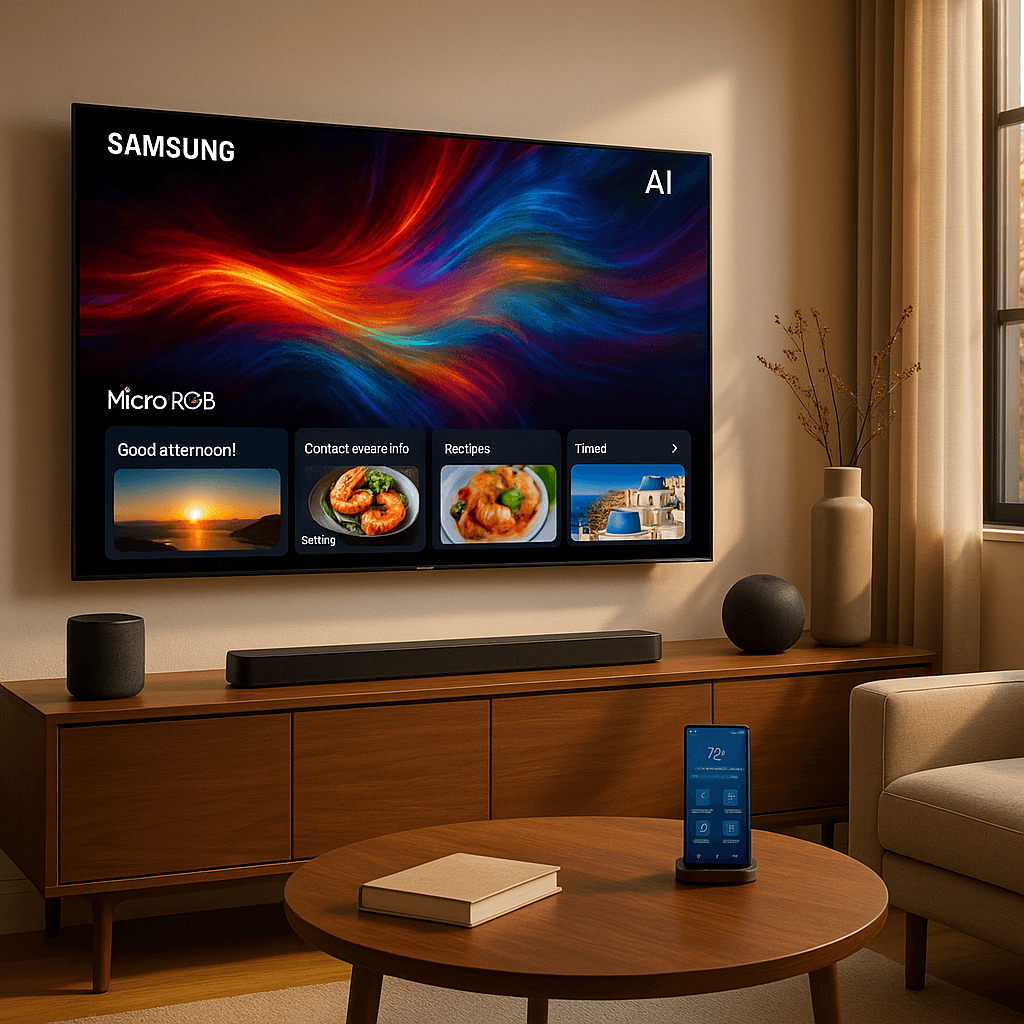
Samsung debuts Vision AI Companion platform at Frankfurt Tech Seminar, extending AI capabilities across all 2026 TV models
- ■
New Micro RGB technology achieves 100% BT.2020 color coverage with real-time AI optimization via Micro RGB AI Engine Pro
- ■
Flagship S99H OLED features FloatLayer Design and Pantone Validated ArtfulColor, while Glare Free tech expands to S90H model
- ■
Gaming lineup includes Odyssey G6 OLED with 500Hz refresh rate and 32-inch Odyssey G8 with 6K resolution
Samsung is making its biggest AI push yet into consumer TVs. At its 15th annual European Tech Seminar in Frankfurt, the company unveiled Vision AI Companion, an integrated AI platform that transforms TVs from passive screens into interactive smart home hubs. The rollout marks Samsung’s commitment to embedding AI across its entire 2026 lineup – from premium OLEDs to entry-level models – as it defends its 20-year reign as the world’s top TV brand.
Samsung just turned the TV into something that actually talks back. At the company’s European Tech Seminar in Frankfurt this week, Samsung showcased Vision AI Companion (VAC), an integrated AI platform that makes TVs context-aware and genuinely helpful beyond just streaming content.
The move signals Samsung’s belief that the living room screen should do more than display Netflix. According to Samsung’s announcement, VAC surfaces real-time information about what’s playing, suggests recipes when cooking shows are on, and helps plan travel when wanderlust documentaries roll. It’s Samsung’s answer to making the TV a central smart home interface, not just another appliance.
“This year, we are expanding advanced AI across our full lineup, from premium to more accessible models, while embedding Samsung’s distinctive AI capabilities throughout the entire screen experience,” Hun Lee, Executive Vice President of Visual Display Business at Samsung Electronics, told attendees according to Samsung’s official release.
The AI integration goes deep into content optimization too. AI Upscaling Pro sharpens low-res content with what Samsung calls enhanced clarity and contrast. AI Soccer Mode Pro adapts picture and sound to match live sports intensity. And AI Sound Controller Pro breaks down audio into discrete elements – dialogue, music, sound effects – letting viewers dial down crowd noise or boost commentary independently. It’s granular control that assumes people want to customize, not just consume.
But Samsung’s real technical flex came with Micro RGB display technology. The new panels achieve 100% color coverage of the BT.2020 standard, which represents a significantly wider color gamut than the older Rec. 709 standard most content still uses. Powered by the Micro RGB AI Engine Pro, the display continuously refines color and contrast in real time based on what’s showing. A 75-inch demo unit at the seminar highlighted scalability, suggesting Samsung plans to bring this tech across multiple screen sizes.
Samsung’s Picture Quality Solution Lab team demonstrated how the technology delivers “highly precise color control, deeper contrast and a more immersive visual experience,” according to the company’s presentation materials. The enhanced local dimming performance means brighter highlights and darker shadows can coexist in the same frame without washing out.
The 2026 OLED lineup – S99H, S90H and S85H – expands Samsung’s options for buyers who want deep blacks and rich color. The flagship S99H features a FloatLayer Design that makes the screen appear to hover, along with Pantone Validated ArtfulColor for faithful color reproduction. It’s a design language aimed at buyers who treat TVs as furniture, not just tech.
Glare Free technology, previously exclusive to higher-end models, now extends to the S90H. The feature reduces reflections and maintains picture quality whether you’re watching in a sunlit living room or dimmed home theater. It’s the kind of quality-of-life improvement that doesn’t show up in spec sheets but matters when you’re actually using the thing.
Beyond TVs, Samsung showed off gaming monitors built for competitive players. The Odyssey G6 OLED (G60FS) hits a blistering 500Hz refresh rate – overkill for most, essential for esports pros. The 32-inch Odyssey G8 (G80HS) pushes 6K resolution for creators and gamers who want extreme clarity. These aren’t casual displays; they’re purpose-built for demanding environments where milliseconds and pixels matter.
Samsung’s also pushing into lifestyle audio with Music Studio 7 and Music Studio 5 speakers. Music Studio 7 features a 3.1.1-channel configuration with enhanced Q-Symphony, which syncs sound across connected Samsung devices for room-filling audio. Music Studio 5 packs AI Dynamic Bass Control into a compact form, using algorithms to deliver deeper low frequencies without distortion. Both products reflect Samsung’s strategy of making audio hardware that blends into modern spaces rather than dominating them.
The Frankfurt seminar, now in its 15th year, gives media and industry pros hands-on time with products before they hit retail. It’s Samsung’s way of building buzz and gathering feedback ahead of global rollouts. This year’s focus on AI reflects broader industry trends, but Samsung’s betting that comprehensive integration – across picture, sound, and interface – will differentiate it from competitors also slapping “AI” labels on products.
Samsung has held the global TV market crown for 20 consecutive years, according to industry tracking data. That streak relies on continuous innovation in display tech, but also on ecosystem plays that lock users into Samsung’s connected experience. Vision AI Companion represents the next evolution of that strategy – making the screen indispensable by making it smarter.
Samsung’s 2026 lineup isn’t just about sharper pixels or louder speakers – it’s about redefining what a TV should do in a connected home. Vision AI Companion positions the screen as an interactive hub rather than a passive display, while Micro RGB and expanded OLED options push picture quality forward. The gaming monitors and lifestyle audio products show Samsung’s ambition extends beyond traditional TV categories. As AI becomes table stakes in consumer electronics, Samsung’s betting that comprehensive integration across its entire range – not just flagship models – will keep it ahead of rivals chasing the same smart home vision. The real test comes when these products hit shelves and consumers decide if AI companions justify premium pricing.











Leave a Reply