
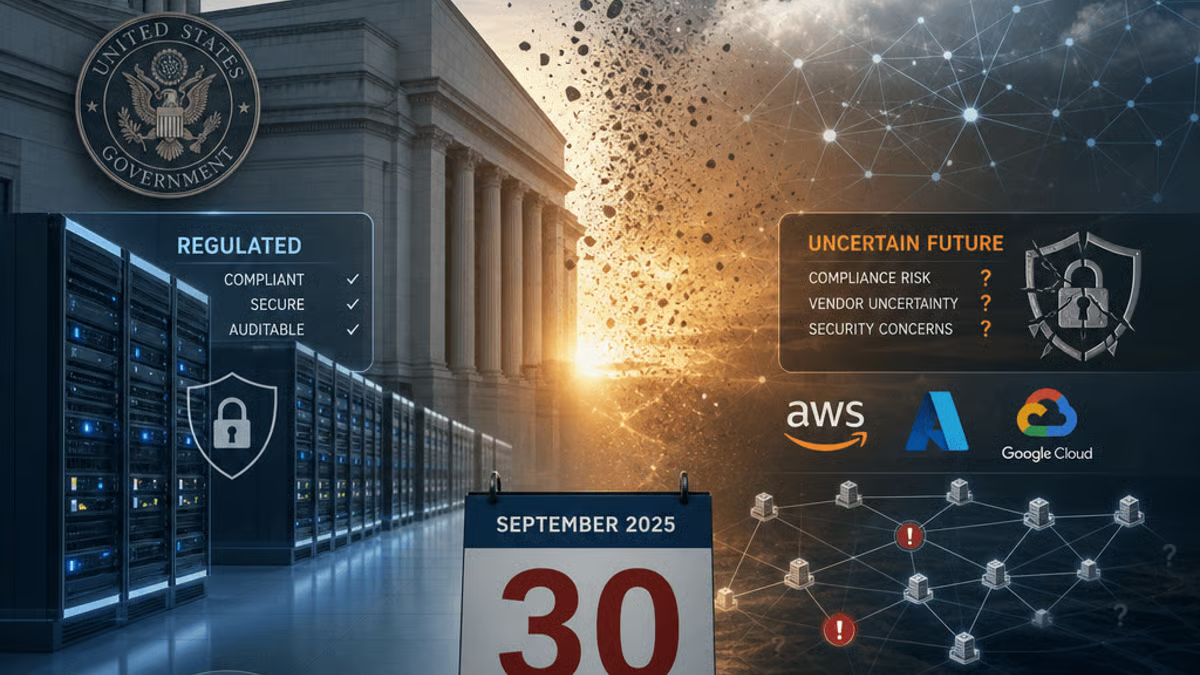
The federal government is letting a critical regulation governing data center operations expire this September with no replacement on the horizon, according to a Wired report. The move leaves federal agencies without clear operational standards just as AI workloads and cloud infrastructure demands surge across government IT systems. Industry watchers warn the regulatory vacuum could create inefficiencies and security gaps at a time when federal data center spending is accelerating.
The federal government is walking away from data center oversight at precisely the wrong moment. A key regulation governing how federal agencies operate their data centers is set to sunset in September, and officials have signaled no replacement is coming. The decision marks a sharp reversal from years of federal efforts to modernize and consolidate government IT infrastructure.
The timing couldn’t be more precarious. Federal agencies are racing to deploy AI capabilities and migrate workloads to cloud platforms from Amazon Web Services, Microsoft Azure, and Google Cloud. Without regulatory guardrails, agencies could revert to the fragmented, inefficient data center sprawl that plagued government IT for decades.
The regulation in question established standards for energy efficiency, security protocols, and operational benchmarks across federal data centers. It was part of a broader push to eliminate redundant facilities and shift government workloads to more efficient infrastructure. According to federal data center consolidation initiatives, agencies closed thousands of outdated facilities over the past decade, saving billions in operational costs.
Now that progress faces uncertainty. Industry sources tell The Tech Buzz that cloud providers with major federal contracts are quietly lobbying for clarity on what comes next. The regulatory void creates procurement headaches – agencies won’t have clear benchmarks for evaluating data center proposals or measuring vendor performance against government standards.
The enterprise implications extend beyond federal contracts. Cloud providers have built entire business units around meeting federal compliance requirements. AWS GovCloud and similar offerings from Microsoft and Google rely on consistent regulatory frameworks to demonstrate compliance. When those frameworks disappear, vendors face costly uncertainty about what standards they’re building toward.
Some agencies may attempt to create their own standards in the absence of federal guidance, but that fragmentation defeats the purpose of centralized regulation. The Department of Defense, intelligence community, and civilian agencies could end up with incompatible requirements, making it harder for vendors to serve multiple government customers efficiently.
The decision comes as federal IT budgets are shifting dramatically toward AI and machine learning infrastructure. Agencies need massive compute resources for training models and running inference workloads. Without efficiency standards, they could end up paying premium prices for suboptimal infrastructure – exactly the problem the original regulation was designed to prevent.
Energy efficiency is another casualty. Data centers are notorious power consumers, and federal facilities handle sensitive workloads that can’t easily migrate to the most efficient commercial clouds. The expiring regulation included provisions for measuring and improving energy usage – standards that helped agencies reduce their carbon footprint while cutting costs. Environmental groups have raised concerns about agencies backsliding on sustainability commitments without regulatory teeth.
The policy vacuum also affects cybersecurity. The regulation included baseline security requirements for federal data center operations. While agencies still must comply with broader federal security mandates, the data center-specific provisions filled important gaps around physical security, access controls, and incident response protocols. Security researchers worry that inconsistent implementation across agencies will create vulnerabilities that adversaries can exploit.
Some industry observers see the sunset as an opportunity. They argue that rigid regulations stifle innovation and prevent agencies from adopting cutting-edge cloud technologies. The counterargument is that federal IT has a track record of inefficiency without strong oversight – the very problem that sparked data center reform efforts in the first place.
What’s clear is that September will bring a significant shift in how the federal government approaches data center operations. Agencies are already preparing for a world without centralized standards, while vendors game out scenarios for what procurement looks like in the regulatory void. The question isn’t whether this creates uncertainty – it’s how much that uncertainty will cost taxpayers in the long run.
The expiration of federal data center regulation in September represents more than bureaucratic housekeeping – it’s a test of whether government IT can maintain efficiency standards without regulatory enforcement. As agencies navigate AI adoption and cloud migration, the lack of clear operational benchmarks could reverse years of progress in consolidating and modernizing federal infrastructure. For enterprise cloud providers, the regulatory vacuum creates both opportunity and risk as procurement standards shift beneath their feet. The coming months will reveal whether agencies can self-regulate effectively or whether the absence of oversight triggers a return to the inefficient data center sprawl that cost taxpayers billions.











Leave a Reply