
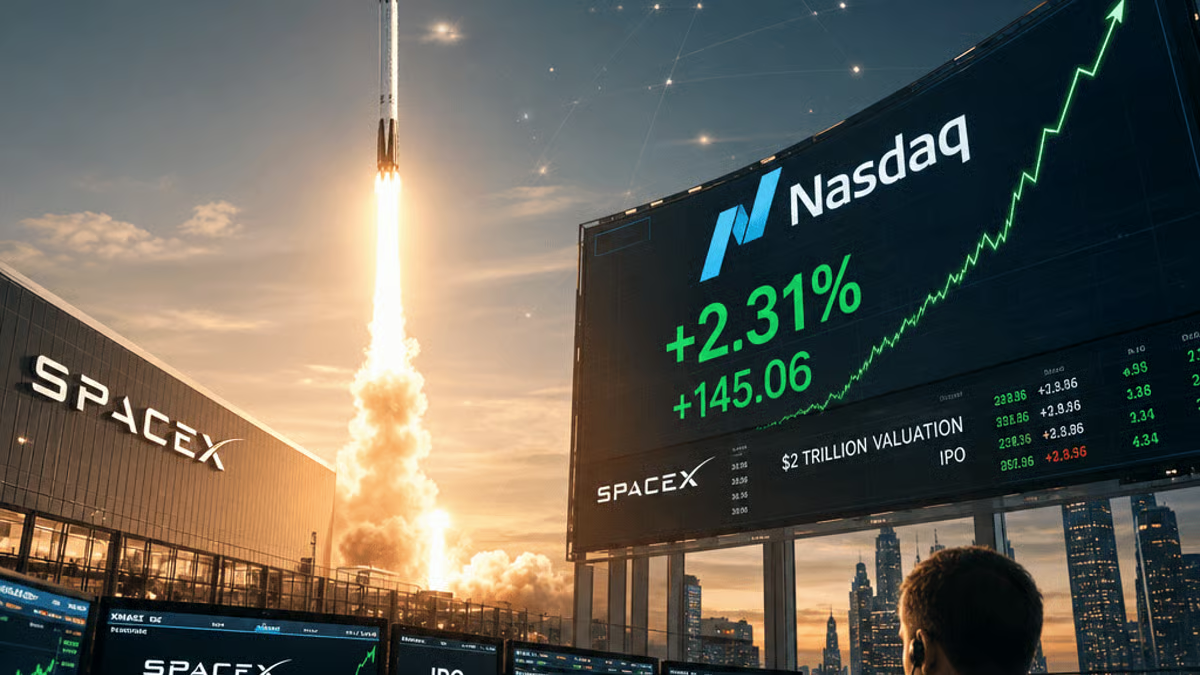
SpaceX just pulled off one of the most explosive IPO debuts in tech history. Shares of Elon Musk’s aerospace giant surged 19% on Friday as trading kicked off on the Nasdaq, pushing the company’s market capitalization past $2 trillion and cementing its position as one of the world’s most valuable publicly traded companies. The debut marks a watershed moment for the commercial space industry and gives retail investors their first chance to own a piece of the dominant force in orbital launch services.
SpaceX shares rocketed 19% higher on Friday as Elon Musk’s aerospace juggernaut made its long-awaited public debut on the Nasdaq, pushing the company’s valuation past the $2 trillion threshold in a stunning first-day performance that exceeded even bullish Wall Street expectations.
The explosive opening marks a defining moment for commercial space exploration and hands retail investors their first opportunity to buy into the company that’s reshaped orbital access. Trading commenced Friday morning with immediate buying pressure that sent shares soaring, according to CNBC, as institutional and retail investors scrambled for exposure to the dominant player in launch services.
The $2 trillion valuation puts SpaceX in rarified air, trailing only Apple, Microsoft, Nvidia, and Alphabet in market cap among tech companies. It’s a remarkable achievement for a company that was nearly bankrupt in 2008 and represents the largest space sector IPO in history.
Investor enthusiasm reflects SpaceX’s stranglehold on the global launch market. The company now handles roughly 80% of all orbital payload mass reaching space annually, flying more missions than all other providers combined. Its reusable Falcon 9 rocket has slashed launch costs while maintaining an unprecedented reliability record across more than 300 successful flights.
But the real growth driver isn’t rockets—it’s Starlink. SpaceX’s satellite internet constellation now serves over 4 million subscribers across 75 countries, generating recurring revenue that’s transformed the company’s financial profile. The service has proven especially lucrative in underserved rural markets and is expanding into maritime and aviation connectivity, opening massive new revenue streams that traditional satellite operators can’t match.
The timing of the IPO comes as SpaceX pushes toward its most ambitious goal yet: making humanity multiplanetary. The company’s Starship mega-rocket completed its first orbital refueling demonstration last month, a critical milestone toward enabling crewed missions to Mars. That long-term vision—once dismissed as Musk’s fantasy—now carries the weight of public market scrutiny and quarterly earnings expectations.
Competitors are taking notice. Blue Origin, Jeff Bezos’s space venture, has ramped up New Glenn development in response to SpaceX’s market dominance. Traditional aerospace giants like Lockheed Martin and Boeing are reassessing their launch strategies as SpaceX’s cost advantages reshape customer expectations across commercial and government contracts.
The IPO also validates a new investment thesis around space infrastructure. Where investors once viewed space ventures as speculative science projects, SpaceX’s profitability—the company reportedly generated over $9 billion in revenue last year—demonstrates that orbital services can deliver traditional tech-style returns. That’s already triggering increased VC funding into adjacent space sectors from in-orbit manufacturing to asteroid mining.
Still, challenges loom. SpaceX faces regulatory scrutiny over Starlink’s orbital debris risks and spectrum allocation battles with legacy satellite operators. The company’s heavy reliance on government contracts, particularly from NASA and the Department of Defense, creates concentration risk that public investors will now monitor closely. And Musk’s divided attention across Tesla, X, and other ventures remains a governance concern.
The first-day pop also raises questions about whether SpaceX left money on the table with its IPO pricing. A 19% surge suggests the offering price was set conservatively, though that approach often builds goodwill with long-term institutional investors who secured allocations. Volume was heavy throughout the session, indicating broad participation beyond just the initial allocation.
For Musk, the public listing provides a new currency for acquisitions and employee compensation while maintaining his controlling stake through a dual-class share structure. It’s a familiar playbook from the Tesla IPO, which has delivered extraordinary returns despite constant volatility and Musk’s unconventional leadership style.
SpaceX’s blockbuster debut signals that space infrastructure has graduated from moonshot speculation to mainstream investment opportunity. The $2 trillion valuation and enthusiastic first-day reception validate not just SpaceX’s business model, but the broader thesis that orbital services—from launch to connectivity—represent a genuine growth sector with tech-style margins. For investors, the question now shifts from whether space companies can be profitable to which one will dominate as the industry scales. Friday’s trading suggests the market has already picked its winner, though maintaining that momentum under the scrutiny of quarterly earnings and public governance will test whether SpaceX can translate its operational excellence into shareholder returns.










Leave a Reply