
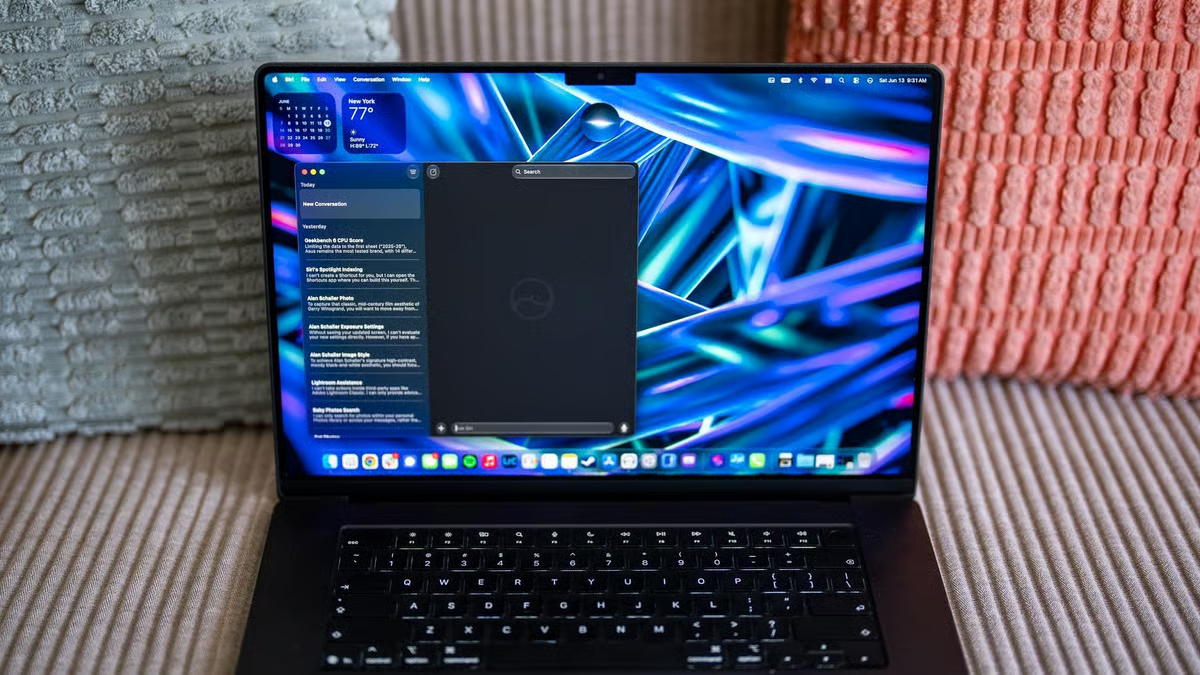
After years of keeping Siri switched off, Apple‘s new Siri AI in macOS 27 Golden Gate is making at least one longtime skeptic reconsider. Antonio G. Di Benedetto from The Verge spent his first 24 hours testing the AI assistant in developer beta on M5-powered MacBooks, finding early signs that Apple might finally be addressing the shortcomings that made Apple Intelligence feel “fruitless.” While still in preview with plenty of runway before launch, the Mac-specific implementation suggests a different trajectory than previous iterations.
Apple‘s Siri has a credibility problem with power users, and the company knows it. For years, Mac users have disabled the assistant entirely, finding it more intrusive than helpful. The subsequent rollout of Apple Intelligence didn’t move the needle much either. But something’s different with Siri AI in macOS 27 Golden Gate, at least according to the first hands-on testing.
Antonio G. Di Benedetto, writing for The Verge, captures a rare moment of cautious optimism from someone who “turned off Siri on the Mac years ago and never looked back.” After just 24 hours with the developer beta, he’s already seeing enough to warrant a second look. That’s notable given his admission that he found Apple Intelligence “so fruitless I never engage with it.”
The testing environment itself tells part of the story. Di Benedetto ran Siri AI across two of Apple’s latest machines – the M5 MacBook Air and M5 Max MacBook Pro. The fact that the system was still indexing files and folders after 24 hours suggests Siri AI is doing deeper system-level work than previous iterations. This kind of file system integration has been a missing piece in Apple’s AI story, especially compared to how seamlessly competitors like Microsoft’s Copilot can surface documents and data.
The timing matters too. Apple’s been playing catch-up in the AI assistant race while Microsoft, Google, and OpenAI grabbed headlines with increasingly capable models. ChatGPT integration rumors have swirled around Apple for months, but the company has largely stuck to its own path with Apple Intelligence. macOS 27 Golden Gate represents a critical test of whether that strategy can deliver results that match the hype.
What’s particularly interesting is the Mac-specific angle. While iOS 27 has gotten most of the attention in AI assistant coverage, the macOS implementation faces different challenges. Mac users expect deeper productivity integration, better file handling, and more sophisticated automation than iPhone users typically demand. The fact that Siri AI is getting separate attention on the Mac platform suggests Apple recognizes these distinct use cases.
Di Benedetto’s careful framing – “slightly rethinking things” rather than full endorsement – reflects the measured expectations longtime Apple users now bring to AI announcements. He explicitly notes he’s “still early in testing” and that the feature is “in an early preview state on the dev beta.” Translation: there’s lots of room for this to disappoint before the public release later this year.
The developer beta timeline is worth watching. Apple typically runs multiple beta cycles before public launch, meaning the version available now could be substantially different from what ships in fall 2026. Previous Apple Intelligence features have seen significant changes between preview and release, sometimes gaining capabilities and sometimes having features pulled entirely.
But the indexing detail hints at something more ambitious than previous Siri updates. If Siri AI can actually understand and surface information from across a user’s file system, email, messages, and apps, that would represent a genuine leap forward. It’s the kind of contextual awareness that’s made tools like Notion AI and Mem popular with knowledge workers who’ve given up on Siri.
The M5 chip requirement also signals where Apple’s headed. By tying advanced AI features to its latest silicon, Apple can leverage on-device processing for privacy and speed – a key differentiator from cloud-dependent competitors. The M5’s neural engine presumably handles the heavy lifting for Siri AI’s file indexing and natural language processing, though Apple hasn’t detailed the technical architecture publicly.
What happens between now and the public release will determine whether Siri AI becomes a genuine productivity tool or another half-step in Apple’s gradual AI evolution. The developer beta serves as both a technical test and a market signal – Apple’s way of showing it hasn’t given up on making Siri relevant again, even as the AI assistant landscape gets more crowded and competitive every month.
One 24-hour test doesn’t make a trend, but it does suggest Apple might finally be addressing the fundamental issues that made Siri irrelevant to power users. The real question isn’t whether Siri AI works in a controlled developer beta, it’s whether Apple can deliver meaningful improvements before competitors like Google and Microsoft extend their leads even further. For Mac users who’ve spent years ignoring Siri, the stakes are simple: this either marks a genuine turning point, or it’s another reason to keep that toggle switched off. We’ll know which by the time macOS 27 Golden Gate ships later this year.







Leave a Reply