
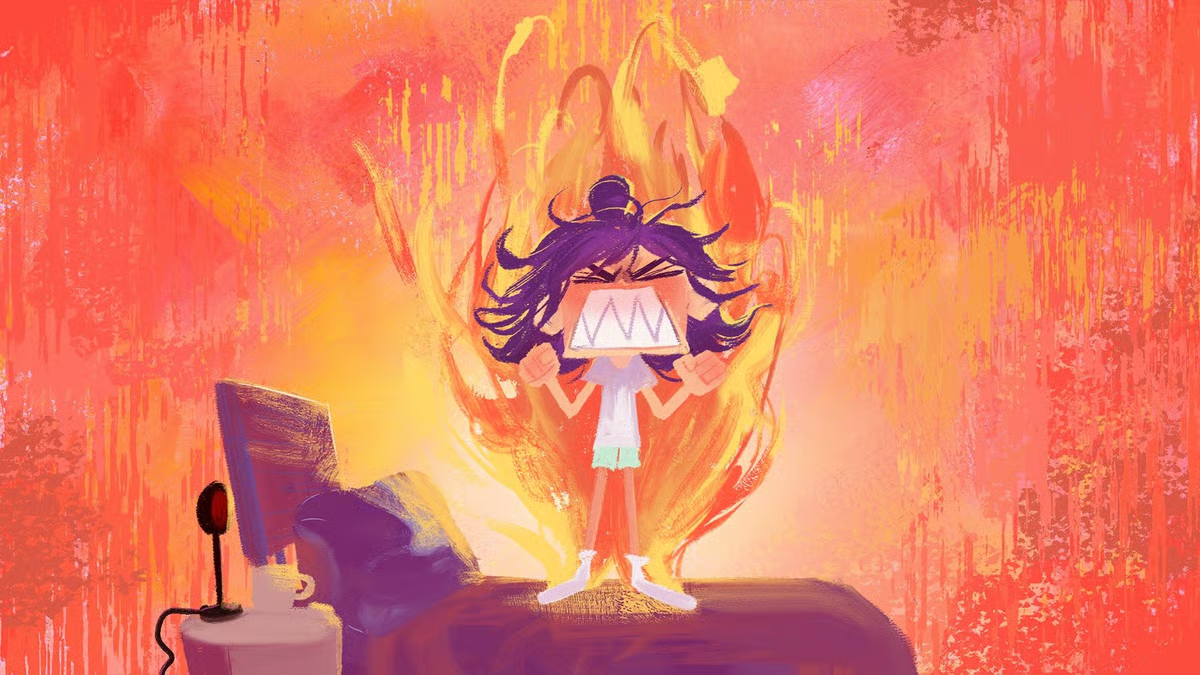
Google DeepMind just revealed what Hollywood’s real AI future looks like – and it’s not about typing prompts into off-the-shelf models. The company’s custom-trained versions of Veo and Imagen for ‘Dear Upstairs Neighbors,’ showcased at Tribeca 2026, represent a fundamental shift from generic video generation to purpose-built entertainment AI. While studios have struggled with inconsistent AI slop and collapsing partnerships, DeepMind’s approach suggests the industry’s actual path forward requires bespoke model training, not vanilla tools.
Google DeepMind is rewriting Hollywood’s AI playbook with a project that ditches the prompt-and-pray approach entirely. The company’s work on ‘Dear Upstairs Neighbors’ – showcased at Tribeca 2026 – relies on custom-trained versions of its Veo and Imagen models, built specifically for this production using the project’s own concept art and visual references.
It’s a stark departure from the industry’s current AI mess. For months, studios have been experimenting with generic generative AI tools that churn out what the industry’s now calling “video slop” – short, visually inconsistent clips that lack the coherence needed for actual entertainment. Major partnerships between Hollywood and AI firms have collapsed unexpectedly, leaving studios questioning whether they can rely on Silicon Valley’s promises.
But DeepMind’s approach suggests there’s been a category error all along. Instead of treating AI video generation as a one-size-fits-all tool, the company trained bespoke versions of its models using concept art from ‘Dear Upstairs Neighbors’ itself. The result: AI systems that understand the specific visual language, character designs, and aesthetic requirements of this particular project.
The concept art shows a young woman engulfed in a flaming aura while standing on a bed – imagery that became training data for customized Veo and Imagen builds. This isn’t about feeding prompts into OpenAI’s Sora or other general-purpose models. It’s about creating AI tools as unique as the productions themselves.
This matters because Hollywood’s AI experiments have largely failed to produce anything audiences would actually pay to see. Disney’s partnership with OpenAI fizzled, and even major production houses have struggled to move beyond short-form content that feels more like tech demos than finished entertainment.
The custom training approach solves several problems at once. Generic AI models produce inconsistent results because they’re trained on massive, unfocused datasets. But when you train a model specifically on your project’s visual DNA, you get coherent output that actually matches your creative vision. It’s the difference between asking a stranger to paint your portrait and working with an artist who’s studied your face for months.
There’s also a competitive angle here. While OpenAI has positioned Sora as a revolutionary filmmaking tool, the model’s public demonstrations have mostly shown nostalgic recreations rather than original storytelling. Google‘s bet on custom builds could leapfrog that entire approach.
The Tribeca showcase arrives as Hollywood’s relationship with AI reaches an inflection point. The industry’s initial enthusiasm – fueled by promises of cost savings and faster production – has given way to skepticism as partnership after partnership delivers underwhelming results. Netflix and other streamers have publicly discussed AI integration, but few have shown finished products that justify the hype.
Custom model training requires more upfront investment than simply licensing access to existing AI tools. Studios would need technical expertise, computational resources, and time to build bespoke systems for each project. But ‘Dear Upstairs Neighbors’ suggests that investment might be the only path to AI-generated content that doesn’t immediately feel like algorithmically-generated filler.
The approach also creates a moat. If every major production requires custom-trained models, then filmmaking AI becomes less about who builds the best general-purpose tool and more about who can most effectively tailor systems to specific creative visions. That could shift power back toward studios and away from AI companies trying to sell universal solutions.
It’s still unclear whether ‘Dear Upstairs Neighbors’ represents a glimpse of Hollywood’s future or just an expensive proof-of-concept. The project’s success will likely determine whether other studios follow Google DeepMind’s lead or continue chasing the dream of plug-and-play AI filmmaking tools that don’t quite exist yet.
Hollywood’s AI revolution won’t come from feeding better prompts into generic models – it’ll come from building bespoke systems for each production. Google DeepMind’s work on ‘Dear Upstairs Neighbors’ demonstrates that custom-trained AI can deliver the visual consistency and creative control that off-the-shelf tools can’t match. As failed partnerships and video slop continue plaguing the industry’s AI experiments, expect more studios to abandon the dream of universal AI filmmaking tools in favor of purpose-built systems. The question now is whether the economics of custom model training make sense at scale, or if this approach only works for flagship projects backed by tech giants with resources to burn.



Leave a Reply