
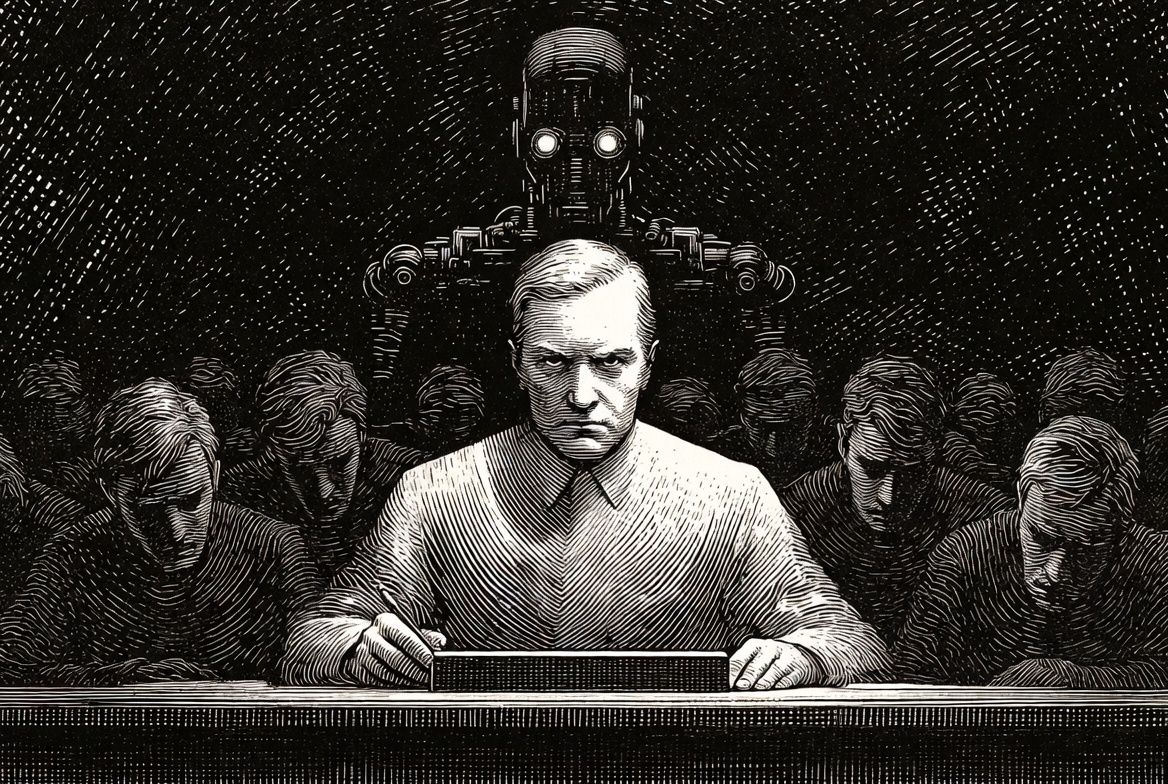
There is a particular sentence that has been circulating in founder circles for the better part of two years, sometimes as a joke, increasingly as a thesis. It runs, with minor variations, like this: an AI agent doesn’t call in sick, doesn’t ask for equity, doesn’t have a bad day, doesn’t quit, doesn’t sue you, doesn’t take parental leave, doesn’t need health insurance, doesn’t argue about strategy, doesn’t go on Glassdoor, doesn’t unionize, doesn’t expect a promotion, doesn’t ghost you in week four, doesn’t get poached by a competitor, doesn’t lose interest, doesn’t lose its mind.
Read the sentence again. Notice what is being listed.
The Human Problem Hidden Inside the AI Pitch
Every item on the list is a human condition. Illness is what bodies do. Equity is what people who help build something reasonably expect to share in. Parental leave is the consequence of being part of a species that has to make more of itself. Health insurance is what one needs in a country that has decided to attach medicine to employment. Glassdoor is what happens when you mistreat workers and they have throats. The sentence is not a description of what AI lacks. It is a description of what humans are. Stripped of the marketing varnish, the founder is saying: I would prefer to do this without people, because people are people.
That preference is worth taking seriously before it is taken apart. The frustration behind it is not invented. Anyone who has run a small company knows the particular weight of being responsible for someone else’s livelihood, the dread of performance management, the calculus of who to let go in a bad quarter, the way a single departure can hollow out a team for six months. The Society for Human Resource Management puts the cost of replacing a mid-level employee at 125 percent of their annual salary, and the cost of replacing a senior executive at over 200 percent. CB Insights’ analysis of 431 startups that died between 2023 and 2025 found that 23 percent of failed founders cited the wrong team as a primary cause.
Reece Chowdhry, whose Concept Ventures is one of Europe’s largest pre-seed funds, has said the single most common reason early companies die in the first eighteen months is that the founders stop getting along. Family health premiums in 2024 averaged $25,572, with employers paying about 75 percent of that, and Mercer projected another 5.4 percent increase the following year on top of more than a decade of three to four percent annual increases. Option pools at most American venture-backed startups absorb 15 to 20 percent of fully diluted equity before the founders see a Series A, which means the founding team gives away roughly a fifth of the company to people who do not yet exist, in exchange for the hope that those people will show up and stay.
Set these numbers next to the price of a Claude API call and the appeal becomes legible. Wade Foster, the CEO of Zapier, told the Madrona podcast in 2026 that his company now has more AI agents than its 800 employees. Jack Dorsey laid off roughly half of Block in 2026 citing AI tools that “fundamentally change what it means to build and run a company.” A Draper Associates partner told Fortune that the startups he was talking to in early 2026 were reducing engineering teams by a third. Sam Altman’s group-chat bet on the one-person billion-dollar company is not a fantasy at the margins; it is the operating thesis of a sizable fraction of seed-stage capital.
The One-Person Unicorn Fantasy
Now consider what the thesis actually proposes. It proposes that the friction of employing people is a defect to be removed rather than a feature of how value gets created. This is where the argument starts to come apart, and not for the reasons critics usually reach for.
Begin with the equity line. “It doesn’t ask for equity” sounds like an observation about compensation. It is not. Equity is the mechanism through which the people who help build something share in its eventual upside, and it exists for a very specific historical reason: founders figured out, somewhere in the long arc between the railroad era and the semiconductor boom, that asking talented people to work eighty-hour weeks for cash alone produced talented people who left. Equity was the deal. We will pay you below market in salary, you will accept the risk that the company fails, and if it succeeds, you will own a piece. That deal built Silicon Valley. The founder who now says, with relief, that the AI agent does not ask for equity is not saying that the AI is cheap. The founder is saying that the AI does not require a sharing of upside. Whatever value the system creates flows back to one place. It is a preference, dressed in efficiency language, for not having to distribute the proceeds of one’s success.
Hannah Arendt, who is not usually invited into startup discourse, would have recognized the shape of this. In The Human Condition, published in 1958, she distinguished three kinds of activity. Labor is what we do to keep the species alive, the cyclical, consumable, never-finished work of cooking, cleaning, growing food, the metabolic stuff. Work, in her usage, is the making of durable things: a chair, a building, a poem, a piece of software that will outlast its author. Action is the third and rarest mode, the appearance of a person in public through speech and deed, the disclosing of who one is among others.
Arendt’s worry, made sixty-seven years ago, was that modernity was collapsing all three into the first. We would become animal laborans, valued only for what we could produce and consume, and the higher modes of human existence, the building of durable things and the appearance of distinct selves in shared life, would atrophy. Read her now and the founder discourse looks like a literal enactment of her warning. The AI agent does not labor in Arendt’s sense, because it has no body to maintain. But it also does not work or act, because it has no self to disclose. It executes. The preference for it is the preference for execution over everything else humans bring to a room.
Kant, Means and Ends, and the Vanishing Worker
Kant said the same thing in a colder register. Treat humanity, in your own person or in any other, never merely as a means. The crucial word is “merely.” Kant was not a fool, he understood that we use one another all day long, that the bus driver is a means to my getting across town and the engineer is a means to my company’s roadmap. The moral failure, in his framework, is the elimination of the “also.” Also an end. Also a person whose own purposes deserve consideration. The line “it doesn’t call in sick” is not, in itself, evidence of Kantian wrongdoing. The mindset it expresses is, because what it celebrates is the disappearance of the “also.” There is nothing left of the worker to treat as anything but means, because there is no worker.
This is older than the Valley pretends. Frederick Winslow Taylor’s Principles of Scientific Management, published in 1911, was the first systematic attempt to study human work with a stopwatch and break it into motions efficient enough to be performed by people who did not need to understand what they were doing. Taylor’s defenders argue, correctly, that he raised productivity and wages. His critics, including Lenin in 1913, called it “man’s enslavement by the machine.” What Taylor actually did was prove that if you could make a person behave enough like a machine, you could replace skilled craft with cheaper, more interchangeable labor.
The current AI discourse is the same project at a higher resolution. We have stopped trying to make humans behave like machines and have started making machines that can perform the parts of human work that look most machine-like. The continuity matters. Taylorism was the original promise that automation would liberate workers; instead, as labor historians have documented for a century, it deskilled them, intensified their pace, and concentrated decision-making at the top. The Luddites, who were not anti-technology cranks but skilled artisans defending the value of years of craft, saw this coming in 1811 and broke the knitting frames. They lost. We are still arguing about whether they were wrong.
Alienation for Founders Too
Marx, whose framework I find easier to take seriously than most people raised on Silicon Valley do, called the result alienation. The worker becomes separated from the product of their labor, from the activity of laboring itself, from their fellow workers, and ultimately from what he called species-being, the human capacity for conscious, creative work. The version of this critique you encounter on factory floors is familiar. The version that should interest us now is that the founder who prefers automation is also being alienated, just from the other direction. The founder who builds a company without colleagues, without people who can argue back, without anyone whose loyalty has to be earned, is also being separated from something. The thing being lost is the version of the founder that can be challenged, sharpened, made better by the resistance of other minds. The pathology runs in both directions.
Now consider what the automation thesis promises to deliver and whether it actually does.
In February 2024, Klarna’s CEO Sebastian Siemiatkowski announced that the company’s OpenAI-built assistant was doing the work of 700 customer-service employees, handling 2.3 million conversations in 35 languages, and that this proved AI could “do all of the jobs that we, as humans, do.” By May 2025, Siemiatkowski was on Bloomberg admitting that cost had been “a too predominant evaluation factor” and that the result was “lower quality.” Klarna started hiring humans back. An IBM survey of 2,000 CEOs in 2025 found that only 25 percent of AI projects delivered their promised ROI and only 16 percent were successfully scaled. Air Canada lost a 2024 tribunal case in British Columbia after one of its chatbots invented a bereavement-fare policy and a customer sued, with the airline arguing, remarkably, that the chatbot was a “separate legal entity” responsible for its own actions. The tribunal disagreed.
The economics are similarly less obvious than the pitch deck suggests. McKinsey’s 2025 State of AI survey found that 62 percent of enterprises are experimenting with AI agents but only 23 percent have scaled agentic AI across even one business function. Average monthly enterprise AI spend reached $85,521 in 2025, a 36 percent jump year over year. Galileo’s analysis of agentic AI deployments found infrastructure costs commonly jumping from $5,000 a month in prototyping to $50,000 a month in staging once real workflows hit unoptimized retrieval pipelines.
AI-native startups, by some accounts, spend 60 to 80 cents of every revenue dollar on inference alone. None of this is to argue that AI does not produce real productivity gains; OpenAI’s enterprise data suggests workers using its tools recover nearly an hour a day. It is to argue that the “doesn’t ask for equity” framing systematically obscures where the costs actually go. They go to Nvidia. They go to AWS. They go to the colocation providers and the GPU resellers and the power utilities. The founder has not eliminated the equity question; the founder has paid the equity to a different stack of vendors and called it COGS.
And the labor has not disappeared either. Mary Gray and Siddharth Suri’s Ghost Work documented an estimated eight percent of Americans who have done at least one stint as a data labeler, content moderator, or “human in the loop” for some AI system, typically earning below minimum wage and with no benefits. Time magazine’s 2023 reporting on the Sama workers in Kenya who labeled traumatic content to make ChatGPT safer for general use found them earning roughly $2 an hour to read descriptions of child abuse, bestiality, and torture, with predictable psychological consequences. A 2025 arXiv study mapping data-labor supply chains across Africa found content-moderation operations spanning 43 of 55 countries. The phrase “doesn’t call in sick” describes, at best, the front-end agent. The back-end workforce calls in sick all the time, because it is composed of people who are routinely traumatized by the work, and the founders who buy access to that work have insulated themselves from knowing it.
The 10x Engineer Myth Was Always Leading Here
The 10x engineer myth, which has hung around Silicon Valley since Steve McConnell repurposed some 1960s productivity studies in his 1996 book Rapid Development, is the cultural prequel to all of this. The dream of the lone superhuman who outproduces an entire team has always been, at root, a dream of a human who behaves like a machine. The 10x engineer doesn’t get tired, doesn’t ask for vacation, doesn’t have a wife or a kid or a hobby, doesn’t burn out, doesn’t disagree with management. The 10x engineer is the AI agent in flesh, which is why the AI agent is so easily marketed as the 100x engineer. The pattern is the same. Both are fantasies of labor without a laborer.
What gets lost when companies actually try to operationalize the fantasy is well-documented but rarely discussed in the same room as the productivity gains. Lisanne Bainbridge’s 1983 paper “Ironies of Automation” made the point that has never stopped being relevant: the more reliable an automated system becomes, the more critical and harder to fulfill the role of the remaining human operator. Air France 447 went into the Atlantic in 2009 because the autopilot disengaged and the pilots had been so deskilled by years of automated cruise that they did not know how to fly an airplane through a stall. The pattern repeats. Automation does not eliminate the need for human judgment, it just postpones it, raises the stakes when it arrives, and ensures that fewer people are competent to provide it.
The counter-examples to the automation thesis are not obscure. Costco runs annual turnover near 7 percent in an industry where 60 to 70 percent is typical, pays its hourly workers more than $30 an hour, promotes 70 percent of warehouse managers from within, and has outperformed the S&P 500 for decades. Zeynep Ton at MIT Sloan has spent her career documenting that the “good jobs strategy,” which treats workers as investments rather than costs, beats the alternative on the financial metrics the alternative claims to optimize. Sam’s Club under John Furner saw a 16 percent productivity increase, a 25 percent turnover drop, and a 25 percent sales increase in two years after raising wages. The point is not that Costco is morally better than the average software company, though it probably is. The point is that the data does not support the premise that minimizing the human element maximizes returns. The data points the other way.
The Founder’s Real Desire
There is a deeper psychological tell in the “doesn’t ask for equity” framing, and it is worth ending here. The line is usually delivered with a small, slightly nervous laugh. Listen for it on the podcasts. The laugh is the giveaway. The founder knows that the sentence sounds bad. The founder is testing whether the audience will let them keep saying it. What the laugh covers is the admission underneath: that the appeal of automation, for a certain kind of builder, is not really efficiency. It is the elimination of dependency. The founder who has been burned, or who is afraid of being burned, by the messiness of people, who has watched a key engineer leave at the worst possible moment, who has been blindsided by a co-founder breakup, who has spent six months managing an underperformer they should have fired in week three, who has been called out in a Glassdoor review, who has had a board meeting derailed by an HR complaint, that founder finds in the AI agent something the human workforce can never offer: total control.
The agent does what it is told. The agent does not have opinions about strategy. The agent does not look at the founder with the slow, dawning recognition that the founder is not actually that good at this.
Paul Graham’s 2024 “Founder Mode” essay, which celebrated direct hands-on involvement and dismissed professional managers as “skillful liars,” is the same impulse in a different costume. The fantasy is a company in which the founder’s will translates directly into output without the intervening complication of other minds. AI agents are the perfection of that fantasy. They are Founder Mode taken to its logical end, where the company is, finally, just the founder, multiplied. Sam Altman has been explicit about the appeal of this, and so has every venture capitalist now telling founders that the new minimum viable team is three operators and a stack of agents.
What Kind of Society Does This Create?
This is the part the philosophical critique gets at that the economic critique cannot. The cost-benefit analysis of automation matters, and as the Klarna case and the Air Canada case and the IBM survey all suggest, the analysis does not always come out the way the founder discourse claims. But the deeper issue is what kind of person you become when you start preferring systems that cannot disagree with you. The deeper issue is what kind of company you build when nobody in it has any standing to push back. The deeper issue is what happens to a society in which the people who control the most capital have organized themselves into a class that no longer needs to share the upside of their work with anyone, because nobody else worked on it. That society has a name. It is not a startup ecosystem. It is something older and worse.
The honest version of the founder’s complaint is something like this: managing people is hard, expensive, emotionally exhausting, and frequently unfair to both parties. The honest response is that managing people is also where most of the durable value of a company actually gets created, because companies are not collections of tasks but collections of judgments, and judgments require beings who can be wrong, who can be persuaded, who can be loyal, who can change their mind, who can be hurt by a bad decision and try to make a better one next time. Strip those beings out and you have not built a more efficient company. You have built a more efficient way to fail at the things companies are for.
The AI agent will not call in sick. This is true. It will also not notice that the strategy is wrong. It will not warn you, six months before the crash, that the culture is rotting. It will not stay late on the night before the launch because it cares. It will not invent the thing nobody asked for that turns out to be the company. The list of things it will not do is much longer than the list of things you wanted it not to do, and the founders who are about to discover this in real numbers, in 2027 and 2028 and the years after, will not say it was a philosophical failure. They will say the model wasn’t quite there yet. They will be wrong about that too.










Leave a Reply