
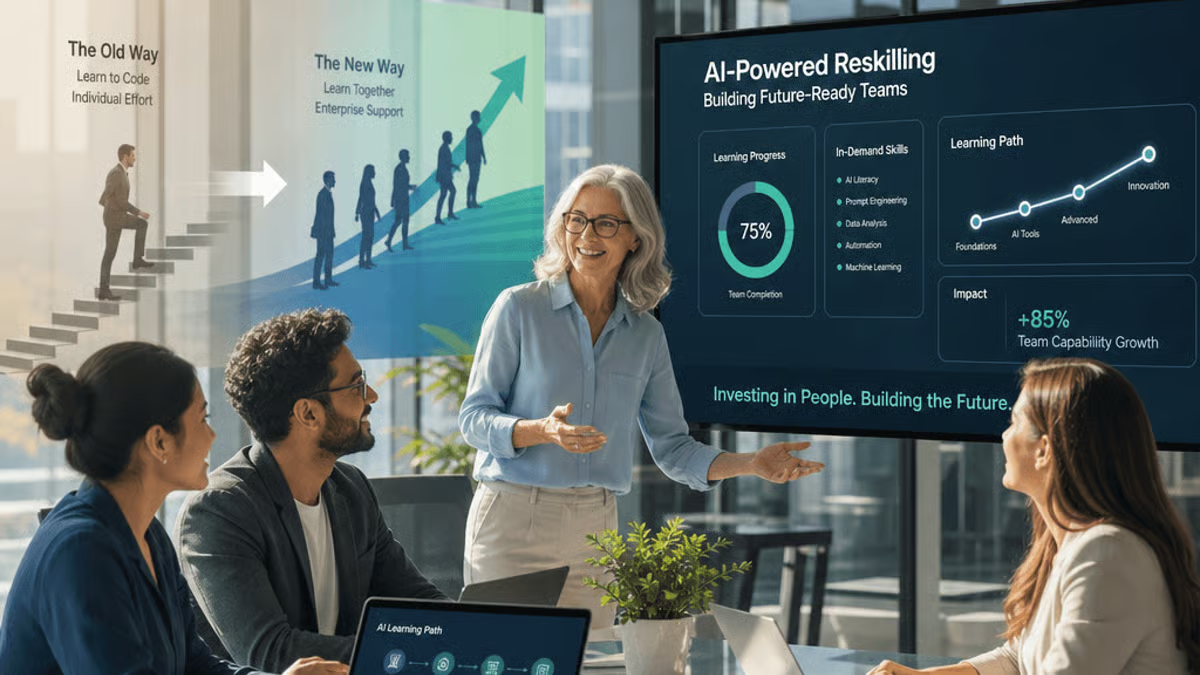
The tech industry’s favorite mantra just got a funeral. After a decade of pushing workers to ‘learn to code’ their way into stability, AI automation is flipping the script entirely. Companies can no longer offload training to bootcamps and online courses – they’re now on the hook for reskilling their own workforce as AI tools fundamentally reshape what it means to work in tech. It’s a dramatic reversal that exposes how hollow that advice always was.
The tech industry just admitted what everyone suspected all along: telling people to ‘learn to code’ was never a real solution. ZDNet reports that AI’s rapid advancement has forced a complete rethinking of who’s responsible for workforce development, and the answer isn’t coding bootcamps anymore.
For years, tech companies deflected responsibility for training by pointing workers toward online courses and expensive bootcamps. That convenient arrangement is collapsing under the weight of AI automation. When GitHub Copilot can write production code and ChatGPT can debug in seconds, the skills bootcamps taught six months ago are already outdated.
The shift is already visible in hiring patterns. Companies that once demanded five years of Python experience are now seeking people who can prompt-engineer AI tools and validate machine-generated code. That’s not something you learn in a three-month bootcamp – it requires understanding business context, system architecture, and AI capabilities simultaneously.
Microsoft and Google have quietly been building internal reskilling programs for the past 18 months, recognizing that external training can’t keep pace with their own AI deployments. Microsoft’s internal AI training now reaches over 100,000 employees, focusing not on coding syntax but on how to work alongside AI systems. Google’s approach emphasizes ‘AI augmentation’ – teaching engineers to become more productive with tools rather than replacing them entirely.
But most companies lack that infrastructure. The coding bootcamp industry, which exploded to a $600 million market by 2023, is now contracting. Enrollment dropped 32% year-over-year as prospective students question whether coding skills will remain relevant. Meanwhile, corporate learning budgets increased 47% in the past year, according to enterprise software spending data.
The economics tell the real story. Companies spent a decade avoiding training costs by hiring ‘job-ready’ bootcamp graduates. Now they’re discovering that AI moves faster than any external curriculum can follow. An engineer trained on React in January might find that AI code generation has completely changed React development patterns by June. Companies either invest in continuous internal training or watch their workforce become obsolete in real-time.
Amazon exemplifies this transition. The company committed $1.2 billion to reskilling programs in 2021, but that was still focused on traditional tech skills. Their 2026 programs look completely different – teaching employees how to design AI-powered workflows, validate model outputs, and integrate automated systems. The focus shifted from ‘learn to code’ to ‘learn to work with AI.’
The last decade’s ‘learn to code’ push always had a cruel irony: it placed the burden of adaptation entirely on workers while companies enjoyed cheap labor without training costs. AI automation exposes that model as unsustainable. When job requirements change every six months, no individual can self-fund continuous retraining while working full-time.
Enterprise software companies are responding with corporate-focused training platforms. Microsoft’s Viva Learning and similar tools now emphasize AI-adjacent skills over pure coding. The content focuses on prompt engineering, AI ethics, automation design, and human-AI collaboration – skills that didn’t exist in most job descriptions two years ago.
The resistance from some companies is predictable. Training programs cost money and take time away from immediate productivity. But the alternative is worse – teams unable to leverage AI tools that competitors are already using effectively. Early adopters of internal AI training are reporting 25-40% productivity gains as employees learn to augment their work rather than being replaced by it.
What the industry can learn from the bootcamp era is instructive. Those programs failed not because they taught the wrong content, but because they put all responsibility on individuals in a system designed to extract maximum value with minimum corporate investment. The AI era makes that approach impossible – change happens too fast for external training to keep up.
The question now is whether companies will actually invest in proper reskilling or just lay off workers and hire new ones with current skills. Early signals suggest a mix – tech giants are building comprehensive programs while smaller companies resort to hiring for AI skills. But that second approach has a shelf life measured in months before those new hires also need retraining.
For workers, the shift creates both uncertainty and opportunity. The burden of staying current is finally moving where it always belonged – onto employers who profit from that labor. But the transition period will be chaotic as companies figure out how to build training infrastructure they’ve avoided for years. The ‘learn to code’ era didn’t prepare anyone for this, least of all the companies who repeated that advice while doing nothing to support it.
The death of ‘learn to code’ isn’t really about coding – it’s about who pays for workforce adaptation in a rapidly changing economy. For a decade, tech companies outsourced that cost to workers through bootcamps and self-study. AI’s acceleration just made that model collapse faster than anyone expected. Companies that invest in real reskilling infrastructure now will have productive, AI-augmented teams. Those that don’t will cycle through workers until they can’t hire fast enough to keep up with change. The era of cheap labor through worker-funded training is over, and it’s taking the coding bootcamp industry down with it.










Leave a Reply