

OpenAI is making its most aggressive competitive move yet against Anthropic, announcing both the GPT-5.6 model and a new enterprise product called ChatGPT Work. The dual launch represents a direct challenge to Anthropic’s Claude dominance in enterprise AI, with OpenAI betting that superior price-to-performance and productivity features will win over corporate customers. According to ZDNet’s coverage, this is far more than just another model iteration – it’s a strategic repositioning in the escalating AI wars.
OpenAI just fired a warning shot across Anthropic’s bow. The company’s announcement of GPT-5.6 alongside a brand-new enterprise product called ChatGPT Work makes it clear – this isn’t just about having the smartest AI anymore. It’s about winning the enterprise.
The timing couldn’t be more pointed. While Anthropic has been steadily gaining ground in enterprise deployments with Claude’s reputation for safety and reliability, OpenAI is betting that most companies care more about three things: how fast it runs, how much it costs, and whether it actually makes their workers more productive.
GPT-5.6 arrives with performance improvements that OpenAI is positioning directly against Claude. According to ZDNet, the model delivers measurable advantages in speed and efficiency – the kind of metrics that matter when you’re processing millions of API calls across an enterprise. But it’s the pricing strategy that really matters here.
ChatGPT Work is the more interesting play. It’s OpenAI’s attempt to do what Microsoft did with Office – become the default productivity suite, except powered entirely by AI. The product bundles GPT-5.6 with enterprise-grade features designed for teams: advanced admin controls, data residency options, and integration hooks into existing business workflows.
This represents a fundamental shift in how OpenAI is approaching the market. Instead of just selling API access to developers, they’re going after the C-suite directly with a packaged solution. Companies won’t need to build their own AI infrastructure or hire specialized teams. They just deploy ChatGPT Work and start seeing productivity gains – at least that’s the pitch.
The competitive landscape has changed dramatically over the past year. Anthropic raised $7.3 billion and positioned Claude as the responsible choice for enterprises worried about AI safety and reliability. Google’s Gemini models have been improving steadily. Even Meta is making noise with open-source Llama models that companies can run on their own infrastructure.
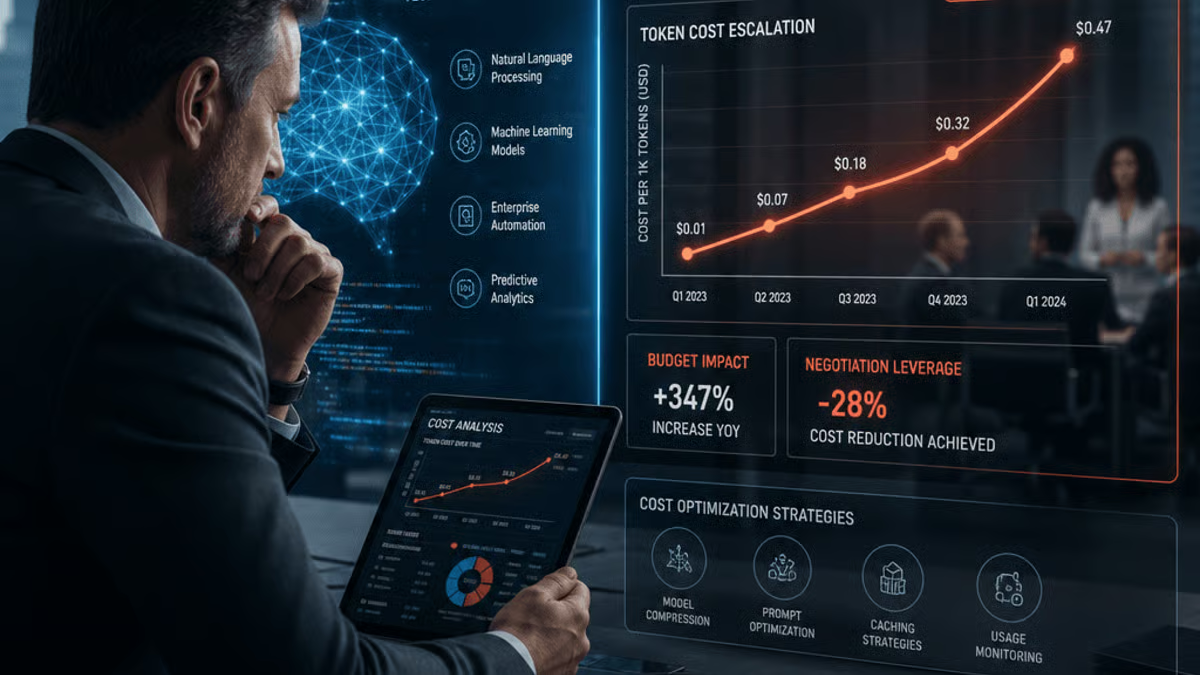
OpenAI’s answer appears to be speed and economics. If GPT-5.6 can deliver comparable or better results than Claude while running faster and costing less per token, that’s a compelling value proposition for CFOs evaluating AI budgets. The ChatGPT Work wrapper makes it easier to deploy without requiring deep technical expertise.
What’s notable is what OpenAI isn’t emphasizing – raw capability improvements. GPT-5.6 isn’t being positioned as dramatically smarter than GPT-4 or Claude 3.5. Instead, the focus is operational: faster inference, better token efficiency, lower costs. That’s a sign of market maturity. The AI arms race is moving from “who has the smartest model” to “who can deliver the best total package for enterprises.”
The productivity angle matters too. Enterprise AI adoption has been slower than many predicted, partly because companies struggle to translate AI capabilities into actual workflow improvements. If ChatGPT Work can demonstrate clear ROI through measurable productivity gains – fewer hours on routine tasks, faster document processing, better customer service response times – it could accelerate enterprise adoption significantly.
Anthropic won’t sit still. The company has built strong relationships with enterprises by emphasizing safety, constitutional AI principles, and reliability. Those aren’t trivial advantages, especially for regulated industries like healthcare and finance. But OpenAI has brand recognition and a head start with developers that’s hard to overcome.
The enterprise AI market is projected to reach $150 billion by 2027, and every major player is fighting for position. Microsoft’s Copilot products leverage OpenAI technology but compete with ChatGPT Work for enterprise attention. Google’s Workspace AI features create another alternative. Amazon’s Bedrock platform offers multiple models including Claude.
What happens next depends on how well these products perform in real-world enterprise deployments. Benchmarks and demos only matter if they translate to actual business value. Companies will evaluate GPT-5.6 and ChatGPT Work based on practical criteria: Does it actually save time? Does it reduce costs? Can we trust it with sensitive data? How easy is it to manage at scale?
OpenAI’s dual launch of GPT-5.6 and ChatGPT Work signals a strategic pivot from pure capability competition to enterprise value delivery. By emphasizing price, speed, and productivity over raw intelligence, OpenAI is acknowledging that the enterprise AI market cares more about ROI than benchmark scores. Whether this strategy succeeds against Anthropic’s safety-first positioning and Google’s infrastructure advantages will depend on real-world performance and whether ChatGPT Work can actually deliver measurable productivity gains at scale. The enterprise AI wars are heating up, and customers are about to have more leverage than ever to negotiate on price and features.









Leave a Reply