
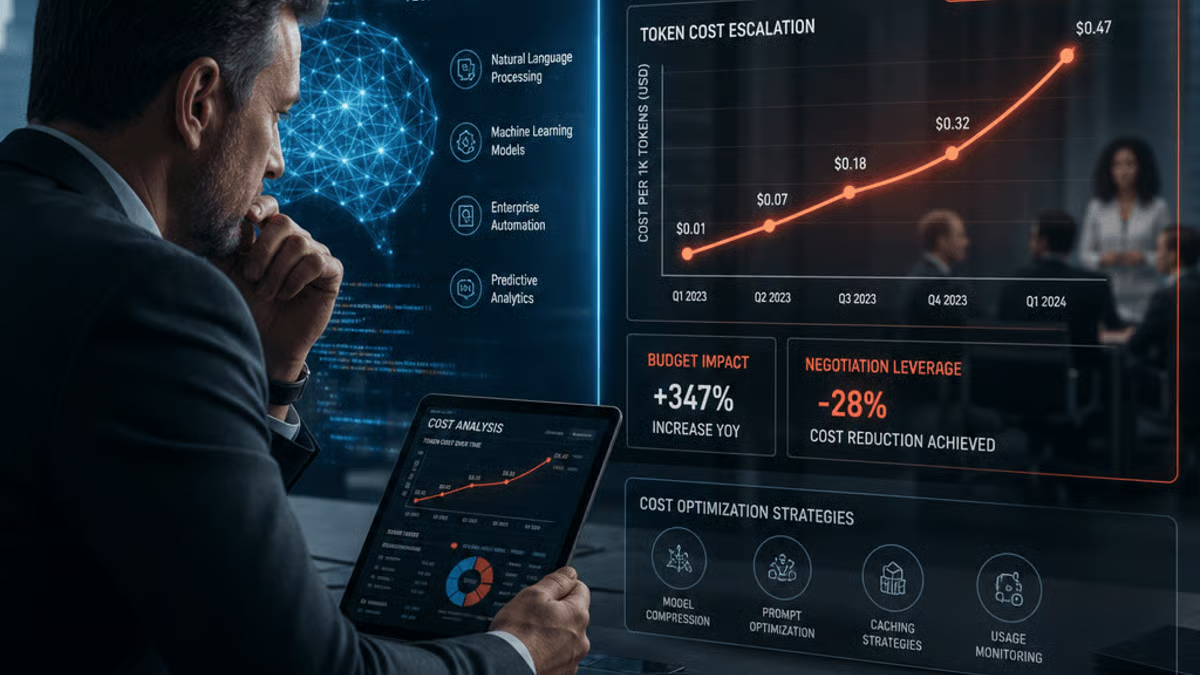
The enterprise AI boom just hit a major speed bump. Palo Alto Networks CEO Nikesh Arora is sounding the alarm on spiraling token costs, arguing that AI pricing needs to plummet 90% before businesses can actually deploy these systems at scale. The blunt assessment from one of cybersecurity’s most prominent leaders exposes a growing rift between AI hype and economic reality – where per-token pricing models threaten to price out the very enterprise customers that AI vendors are chasing.
Palo Alto Networks CEO Nikesh Arora just said the quiet part out loud. While AI vendors tout enterprise transformation, the math doesn’t work – and he’s calling for a 90% price cut to fix it.
Speaking to CNBC, Arora warned that sky-high token costs could prevent businesses from adopting artificial intelligence at the scale needed to justify the investments. It’s a stark admission from a Fortune 500 CEO who’s supposed to be leading his company’s AI transformation, not questioning the entire industry’s pricing foundation.
The timing couldn’t be more pointed. As OpenAI, Microsoft, and Google race to sign up enterprise customers, they’re running headfirst into spreadsheet reality. Token-based pricing – where companies pay per API call or per unit of text processed – made sense for experimental projects. But when you’re talking about embedding AI across security operations, customer service, and business analytics, those micro-charges add up fast.
Arora’s not alone in this frustration. Enterprise buyers are quietly balking at AI bills that can run into six or seven figures monthly for production deployments. One CISO at a major retailer told analysts the company shelved plans to use AI for real-time threat detection after projected token costs exceeded their entire security software budget.
The economics get ugly quickly. A single enterprise deploying AI-powered chatbots across a 10,000-person workforce could rack up millions in annual token fees – before adding in training, integration, and infrastructure costs. That’s forcing hard conversations in boardrooms about whether AI delivers enough value to justify the spend.
This isn’t just about Palo Alto Networks trying to negotiate better rates for its own AI products. Arora’s company is both a buyer and seller of AI – they’re embedding models into security tools while also purchasing API access from the major providers. He sees both sides of the ledger, and neither looks sustainable at current prices.
The pressure on AI providers is mounting from multiple directions. Meta is giving away Llama models for free, letting companies run inference on their own hardware and dodge token fees entirely. Amazon Web Services and Microsoft Azure are offering volume discounts and committed-use pricing to lock in customers. Meanwhile, startups like Together AI and Replicate are undercutting the big players on price.
But Arora’s calling for something more dramatic than incremental discounts – a fundamental repricing of the AI market. A 90% reduction would drop costs from dollars per million tokens to pennies, fundamentally changing the ROI equation for enterprise deployments.
The AI giants face a dilemma. They’ve spent billions building infrastructure and training models, with investors expecting returns on those investments. OpenAI reportedly burns through hundreds of millions monthly on computing costs. Google and Microsoft are racing to recoup their AI investments through cloud revenue. Slashing prices 90% would crater those projections.
Yet the alternative might be worse – watching enterprise adoption stall as companies realize the math doesn’t work. Nvidia keeps selling chips for AI infrastructure, but if businesses can’t afford to actually run the models at scale, that demand eventually dries up too.
What happens next depends on who blinks first. If enough enterprise customers echo Arora’s concerns, the pricing pressure becomes impossible to ignore. We’re already seeing signs of movement – OpenAI has quietly offered custom pricing to large enterprise customers, while Microsoft bundles AI capabilities into broader licensing agreements to soften the sticker shock.
The cybersecurity angle adds another wrinkle. Palo Alto Networks wants to embed AI into threat detection and response systems that need to analyze massive volumes of data in real-time. Token pricing makes that prohibitively expensive compared to traditional rule-based systems – even if the AI approach is technically superior.
Industry observers expect the pricing model to evolve rapidly. Subscription-based unlimited usage, outcome-based pricing, and hybrid approaches are all being tested. But Arora’s public callout accelerates that timeline, giving other enterprise buyers permission to push back on current rates.
Arora’s 90% pricing demand isn’t just corporate posturing – it’s a signal that the enterprise AI market is hitting a critical inflection point. The gap between AI’s technical capabilities and its economic viability is widening, and someone had to say it. Whether the major providers respond with dramatic price cuts or new pricing models, this conversation marks the moment when enterprise AI moved from proof-of-concept budgets to CFO scrutiny. For businesses evaluating AI investments, the message is clear: current pricing isn’t sustainable, and waiting for the inevitable correction might be the smartest move. For AI vendors, the clock is ticking to prove they can deliver value that justifies the cost – or watch enterprises build their own solutions with open-source models instead.










Leave a Reply