
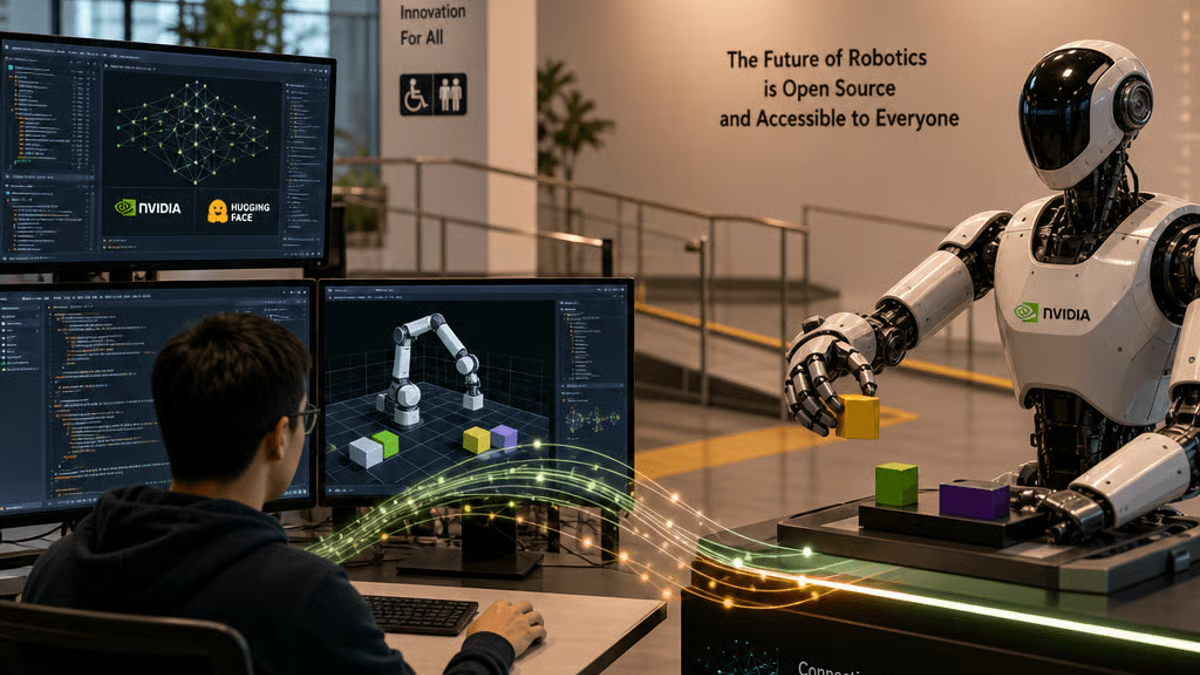
NVIDIA and Hugging Face just launched a major collaboration to tear down the barriers holding back robotics innovation. The partnership brings new models and frameworks to LeRobot, Hugging Face’s open-source robotics platform, aiming to solve what’s been robotics’ biggest problem – the costly, fragmented landscape of datasets, foundation models, and simulation tools that’s kept physical AI development locked behind corporate walls. If open source transformed software AI, this could do the same for robots.
NVIDIA and Hugging Face are making a big bet that robotics is about to have its ChatGPT moment. The two companies announced they’re joining forces to supercharge LeRobot, Hugging Face’s open-source platform for robotics AI, with new models and development frameworks that could fundamentally change who gets to build the next generation of physical AI.
The move comes as robotics developers face a brutal reality check. While software AI exploded after models like GPT and Llama went public, robotics has stayed stuck in a costly, fragmented world. Large datasets cost millions to collect. Robot foundation models remain locked in corporate labs. Simulation environments don’t talk to each other. Compute resources price out academic researchers and startups. It’s the kind of fragmentation that kills innovation before it starts.
NVIDIA knows this problem intimately. The company dominates AI chips, but physical AI – robots that interact with the real world – represents the next frontier. According to NVIDIA’s recent developer conference, the company’s been quietly building out its robotics stack, from Isaac Sim for training to Jetson hardware for deployment. Now they’re taking those tools public through LeRobot.
Hugging Face launched LeRobot earlier this year as the robotics equivalent of its wildly successful model hub for language AI. The platform lets developers share robot training data, pre-trained models, and even entire policy networks. But it needed serious compute backing and industrial-grade frameworks to compete with what companies like Tesla and Boston Dynamics build internally. That’s where NVIDIA comes in.
The collaboration brings NVIDIA’s simulation and training infrastructure directly into LeRobot’s ecosystem. Developers can now access pre-trained robot foundation models optimized for NVIDIA hardware, tap into cloud-based simulation environments, and validate their models using the same tools NVIDIA uses for its own robotics research. It’s not just about making things free – it’s about making them actually work together.
The timing matters. Tesla’s Optimus robot and the wave of humanoid robotics startups have shown there’s real commercial demand for general-purpose physical AI. But most developers can’t afford Tesla’s approach of collecting millions of hours of real-world data. They need synthetic data from simulation, transfer learning from foundation models, and validation tools that catch problems before expensive hardware breaks.
What’s changed is that the software stack for robotics AI has finally matured enough to be modular. You can train a manipulation policy in simulation, fine-tune it with a small real-world dataset, and deploy it across different robot platforms – if you have the right tools. NVIDIA and Hugging Face are betting that open-sourcing those tools will create a Cambrian explosion of robotics applications, the same way open-source language models unleashed thousands of AI startups.
The collaboration also signals where NVIDIA sees the puck moving. The company’s made billions selling GPUs for training language models, but that market’s maturing. Physical AI – robots, autonomous vehicles, industrial automation – represents fresh growth. By anchoring LeRobot with its tools, NVIDIA positions itself as the infrastructure layer for whatever robotics boom comes next.
For developers, the practical impact is immediate. A researcher who previously needed a $50,000 hardware setup and months of data collection can now prototype robot behaviors in simulation, train them on shared datasets, and deploy to affordable hardware platforms. A startup building warehouse automation doesn’t need to reinvent computer vision and motion planning – they can start with foundation models and customize for their use case.
But open source in robotics faces challenges software AI didn’t. Physical systems are messy. A policy trained in simulation often fails spectacularly on real hardware because of sensor noise, timing delays, or physics the simulator didn’t model perfectly. Unlike language models where you can iterate in minutes, testing on real robots takes hours and risks breaking expensive equipment. The collaboration will need to solve what roboticists call the sim-to-real gap, where beautiful simulated performance turns into chaos when the robot actually tries to pick up a cup.
Still, the infrastructure play here is undeniable. NVIDIA gets developer mindshare and a pipeline of customers who’ll eventually need its chips for production deployment. Hugging Face cements its position as the GitHub of AI models, extending from language to physical intelligence. And the robotics community gets tools that were science fiction five years ago, now available through a Python package.
This isn’t just another partnership announcement – it’s infrastructure being built for a robotics revolution that hasn’t quite arrived yet. NVIDIA and Hugging Face are making the same bet the open-source software community made a decade ago: that innovation happens faster when tools are accessible, and that the winners will be whoever provides the best infrastructure for that innovation. Whether LeRobot becomes the TensorFlow of robotics or just another platform that looked good on paper depends on whether the community actually builds on it. But for the first time, developers who’ve been priced out of robotics AI have a real shot at competing with the big labs. The next few months will show whether open source can work its magic on physical intelligence the way it did for language models.






Leave a Reply