
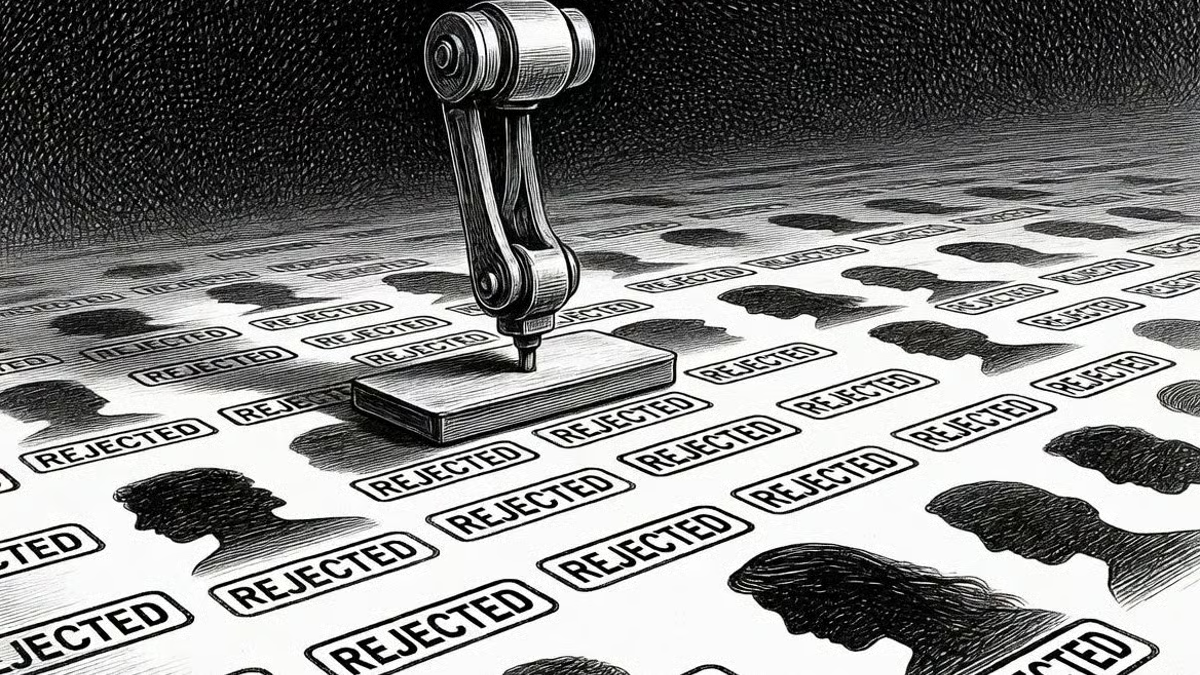
Every debate about AI resume screening and attrition scoring makes the same silent comparison: the algorithm versus a fair, consistent, bias-free human reviewer. That reviewer does not exist, and once you drop the comparison, most of the panic gets a lot more complicated.
The real baseline for small and mid-sized businesses is unstructured gut-feel resume review on the hiring side and after-the-fact surprise on the retention side, the resignation letter nobody saw coming. Measured against that baseline, structured scoring, including algorithmic scoring, usually wins. The harder question is not whether AI is biased. All evaluators are. It’s that algorithmic bias behaves differently than human bias, and that difference is what actually deserves your attention before you buy or ban anything.
The baseline you’re replacing is already discriminatory
Personnel psychology has one of the most replicated findings in the social sciences: structure beats gut feel. Schmidt and Hunter’s 1998 synthesis of 85 years of selection research put structured interviews at a validity of r = .51 against r = .38 for unstructured ones, with unstructured interviews sitting near the bottom of the predictive hierarchy. A 2022 re-analysis by Sackett, Zhang, Berry and Lievens revisited the numbers and, if anything, strengthened the case for structure as the single best predictor of job performance available. Unstructured interviews are also measurably more susceptible to bias than structured ones.
And “gut feel” is not a neutral placeholder. It’s a documented discrimination machine. Bertrand and Mullainathan’s 2004 field experiment sent roughly 5,000 fictitious resumes to 1,300 job ads in Boston and Chicago. Identical resumes with white-sounding names drew a 9.65% callback rate against 6.45% for Black-sounding names, meaning white-sounding names pulled in about 50% more callbacks for the same qualifications. That is the actual baseline AI tools are replacing, not some idealized human evaluator.
The evidence on removing human discretion is just as direct. Hoffman, Kahn and Li’s 2018 study of job-testing rollouts across 15 service-sector firms found that managers who overrode algorithmic recommendations ended up with worse hires on average, and higher test scores predicted longer tenure. When managers deviate from a tool’s recommendation, that deviation usually looks like bias, not superior judgment.
The failure mode isn’t more bias. It’s uniform bias.
Here’s where it gets genuinely difficult. Human bias is inconsistent: it varies by manager, mood, and company, so a rejected candidate usually gets other shots elsewhere. Algorithmic bias is systematic. The same model, deployed across thousands of employers, applies the same skew to every candidate at once, and it does so wearing the authority of a number.
Amazon’s scrapped resume tool is the canonical example. Trained on a decade of male-dominated hiring data, it taught itself to penalize the word “women’s” and downgrade graduates of women’s colleges. Amazon killed the project because it couldn’t guarantee the model wouldn’t just find new proxies for the same pattern.
That pattern hasn’t gone away. A 2024 audit by Wilson and Caliskan tested open-source embedding models used in resume screening across nine occupations and found they favored white-associated names in 85.1% of cases and female-associated names in only 11.1% of cases, with Black male candidates disadvantaged in up to 100% of tested scenarios. A separate Stanford Law audit of GPT-4-class models found consistent disadvantages for names associated with racial minorities and women across 42 different prompt templates, with Black women coming out worst. The bias isn’t a bug that shows up occasionally. It’s the default setting, replicated everywhere the model is deployed.
It can also get baked in before any algorithm runs a single score. Research on job-ad language going back to 2011, replicated again in 2024 for startups, shows that masculine-coded words like “competitive” and “dominant” measurably reduce how appealing a job looks to women without affecting how men respond. If the job description is skewed, the applicant pool is skewed before the AI ever touches it.
The retention side is a much weaker claim
Employee engagement as a concept rests on solid research. Gallup’s Q12 program now spans 736 studies across nearly 184,000 business units and 3.3 million employees, and it reliably links engagement to turnover at the organizational level. But predicting which specific employee is about to quit is a different and much shakier claim. The strongest published accuracy numbers, often 85 to 98%, come almost entirely from one small synthetic dataset of 1,470 fictional records, and the papers that use it routinely admit to overfitting. When IBM’s own CEO claimed 95% accuracy at a conference in 2019, that was a marketing statement, not a validated result. Gartner’s Helen Poitevin, one of the more credible independent voices in this space, puts realistic flight-risk accuracy closer to 70 to 80%, and says she’s skeptical of vendors claiming 90% or better.
The bigger issue isn’t accuracy anyway. It’s what happens once a manager sees a flight-risk score. HR analysts and SHRM’s own reporting document a consistent punitive pattern: employees flagged as flight risks get quietly pulled from high-potential tracks or passed over for development, the opposite of the early-warning, supportive conversation the tools are supposed to enable. A pending ACLU complaint against Intuit and HireVue, still unproven and denied by both companies, alleges that automated speech scoring misread a Deaf employee’s compliance with a script and contributed to her reassignment. Whatever the outcome, it illustrates the surveillance edge this category can slide toward without deliberate guardrails.
None of this would matter as much if AI screening and attrition scoring stayed locked inside enterprise HR departments with legal counsel and audit budgets on standby. They haven’t. The features have moved down-market fast, and a five-person company can now buy the same “objective score” that used to require a Fortune 500 HR analytics team.
Plural is worth a closer look here, precisely because it was built for this end of the market rather than adapted down to it. It’s a careers page and applicant tracking layer for small teams: candidates apply through one branded link, every application gets scored against your job description and hiring guidance automatically, and Plural writes plain-language summaries of a candidate’s relevant experience and gaps rather than a bare number. You can search your own pipeline the way you’d ask a colleague, something like “Brooklyn stylists with salon leadership experience,” and it surfaces matches by meaning instead of keyword tricks. It syncs interview scheduling to your calendar, pushes new-application alerts to Slack, and connects directly to Claude or ChatGPT so you can ask hiring questions in plain conversation. For a small business that has never had an ATS, let alone an I/O psychologist, that’s a meaningfully lower floor to get structured, defensible hiring right.
It sits alongside a broader wave: JazzHR’s Hero plan starts under $40 a month, BambooHR bundles third-party AI screeners that write 0-to-100 match scores directly into candidate profiles, Breezy HR ships AI credits on its paid tiers, and Culture Amp, Lattice, and Workday Peakon all now offer predictive attrition scoring as a standard feature rather than an enterprise add-on. The direction is unambiguous. The tooling used to require a compliance team. Now it requires a credit card.
What to actually do about it
The evidence doesn’t point toward banning these tools, and it doesn’t point toward trusting them blindly either. It points toward a specific, boring, defensible playbook.
-
Adopt structured scoring on the hiring side. The evidence that structure beats gut feel is overwhelming enough that “AI might be biased” shouldn’t talk you back into unstructured review, which is worse on both validity and fairness.
-
Demand a disparate-impact audit in writing, and keep it current. Ask your vendor directly whether the tool has been tested for adverse impact by race, sex, and age, and whether it meets NYC Local Law 144-style disclosure even if you’re not based in New York. “Our tool is bias-free” is a red flag, not a reassurance. The EEOC has said as much explicitly.
-
Keep a human in the loop, and treat scores as support, not rules. Both the EEOC’s iTutorGroup settlement and the ongoing Mobley v. Workday case turn on automated rejection without meaningful human review. A hard cutoff is legal exposure. A ranked shortlist a person actually reads is defensible.
-
On retention, report flight-risk data in aggregate, never by name to individual managers. This is the one guardrail every serious analyst in this space agrees on. Use the signal to fix systemic drivers like pay and promotion velocity, not to quietly sideline the people it flags.
-
Discount any accuracy claim north of 80%. The retention-prediction literature is thin and built almost entirely on one synthetic dataset. Treat vendor accuracy numbers as marketing until they’re proven against your own workforce.
The bottom line
The regulatory floor is rising fast and unevenly. The EU AI Act classifies hiring and monitoring tools as high-risk with obligations landing in August 2026. NYC’s Local Law 144 already requires annual bias audits. The EEOC has already settled its first AI hiring case, and Mobley v. Workday could reach hundreds of millions of applicants nationwide. State law is moving in every direction at once, which means the safeguard that survives every version of it is the same one worth adopting on your own terms before a regulator makes you: keep a human in the loop, audit for disparate impact, and use the score as a starting point for judgment, not a replacement for it.
AI didn’t invent bias in hiring and retention. The unstructured process it’s replacing was already quietly discriminatory, just inconsistently so. What AI changes is the shape of the problem: bias that used to be scattered and hard to prove is now systematic and easy to audit, if anyone bothers to look. That’s not a reason to avoid these tools. It’s the reason to pick one that scores transparently, explains itself in plain language, and gives you an audit trail instead of a black box.









Leave a Reply