
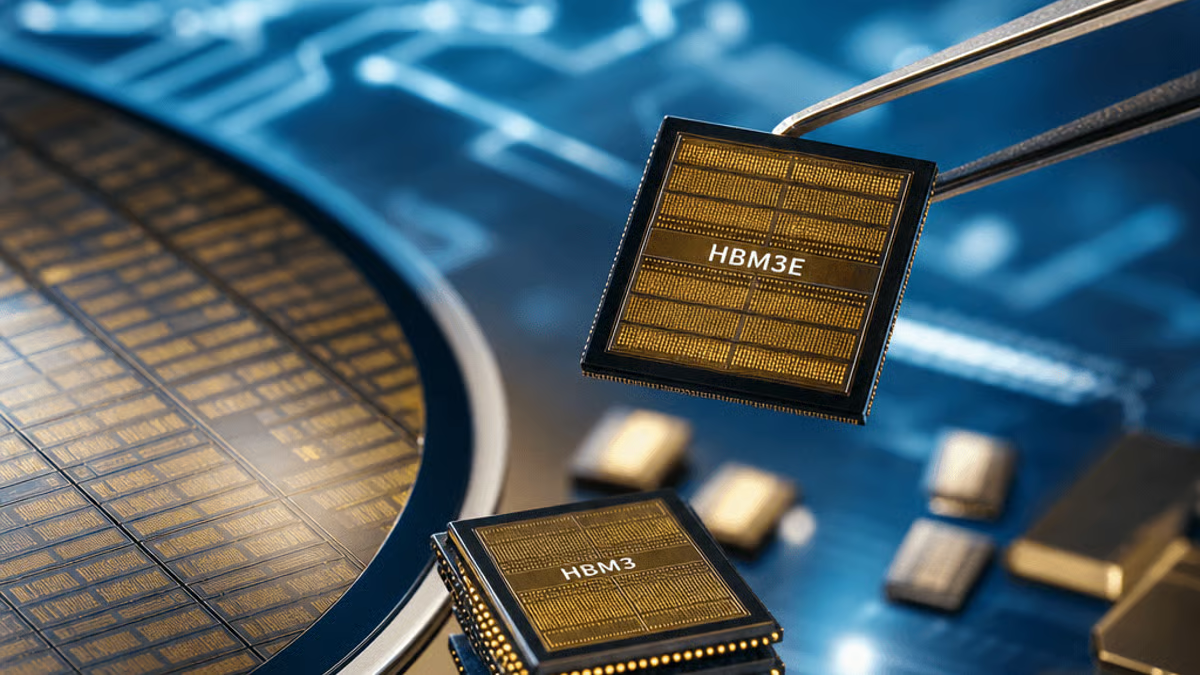
Samsung just posted one of the most dramatic earnings reversals in tech history. The South Korean semiconductor giant’s profits skyrocketed 1,800% as the AI chip boom collides with severe supply constraints, sending memory chip prices soaring. The explosive growth signals how deeply the AI infrastructure race is reshaping the global semiconductor landscape, with Nvidia, Microsoft, and Google locked in a bidding war for scarce chip capacity.
Samsung just delivered a masterclass in how to ride the AI wave. The company’s semiconductor division posted an 1,800% profit increase, a stunning reversal that underscores how the artificial intelligence boom has fundamentally rewritten the rules of the chip industry. It’s not just growth – it’s a complete transformation of the business model, driven by insatiable demand for high-bandwidth memory and advanced logic chips that power AI training and inference workloads.
The numbers tell a story of severe market imbalance. Demand for semiconductors continues to drastically outstrip available supply, creating a seller’s market that Samsung has exploited with precision. Memory chip prices have climbed steadily over the past year as Microsoft, Google, Amazon, and Meta race to build out AI infrastructure. Each company needs massive quantities of high-bandwidth memory, or HBM, to feed the data-hungry AI models that have become central to their competitive strategies.
Samsung’s windfall comes at a moment when the entire semiconductor supply chain is stretched thin. Manufacturing capacity for advanced chips remains constrained despite years of investment. The company has ramped up production of HBM3 and HBM3E memory, critical components in Nvidia’s H100 and upcoming B100 AI accelerators. But even with Samsung, SK Hynix, and Micron running flat-out, they can’t keep pace with orders.
The profit explosion mirrors the trajectory of Samsung’s chief rival. SK Hynix recently announced plans for a US IPO, riding its own AI-driven earnings surge. The South Korean memory chip maker has emerged as Nvidia’s preferred HBM supplier, a relationship that’s translated into record revenues. Samsung’s results suggest it’s closing that gap, winning back market share in the premium AI chip segment after initially lagging in HBM3 production yields.
What’s driving this unprecedented demand? The answer lies in the architecture of modern AI systems. Training a frontier language model like OpenAI’s GPT-4 or Google’s Gemini requires thousands of AI accelerators working in parallel, each needing ultra-fast memory to avoid bottlenecks. Inference – actually running these models for users – also demands massive chip arrays as companies scale to hundreds of millions of queries daily. Enterprise adoption of AI has only accelerated this cycle, with businesses across industries building private AI infrastructure.
The supply crunch isn’t easing anytime soon. Building new semiconductor fabs takes three to five years and costs upwards of $20 billion per facility. Samsung has committed over $230 billion to expand its foundry and memory operations through 2030, but those investments won’t meaningfully impact supply until late 2026 at the earliest. Meanwhile, AI companies keep raising their chip orders. Microsoft reportedly locked in multi-year supply agreements worth billions, while Meta announced plans to deploy over 600,000 H100 equivalents by year-end.
Pricing power has shifted decisively to chip makers. Samsung can command premium prices for its most advanced HBM chips, with some industry analysts estimating HBM3E sells for 5-7 times the price per gigabyte compared to standard DRAM. That pricing advantage flows straight to operating margins, explaining the explosive profit growth. The company’s semiconductor division, which struggled through a brutal downturn in 2023, has become a cash generation machine.
But the boom carries risks. History shows semiconductor cycles can turn quickly when supply finally catches up with demand. The 2022-2023 memory crash, which saw chip prices crater and Samsung report its first quarterly loss in 14 years, remains a recent memory. The difference this time, industry insiders argue, is that AI represents structural demand growth, not a cyclical spike. Companies aren’t just refreshing hardware – they’re building entirely new computing paradigms that require orders of magnitude more silicon.
Competitive dynamics are also shifting. Nvidia maintains a stranglehold on AI accelerators with roughly 90% market share, but challengers are emerging. AMD is gaining traction with its Instinct MI300 series, while Google and Amazon have developed custom AI chips to reduce dependence on Nvidia. Samsung’s foundry business could benefit from this diversification, as chip designers look for alternatives to TSMC, which manufactures most of Nvidia’s GPUs.
The geopolitical dimension adds another layer of complexity. US export controls on advanced chips to China have fragmented the global market, creating regional supply imbalances. Samsung, with fabs in South Korea and increasing US presence, has positioned itself to serve Western customers locked out of Chinese manufacturing. The company broke ground on a new Texas fab that will produce advanced logic chips, though memory production remains concentrated in Asia.
What comes next depends largely on whether AI’s growth trajectory continues at its current blistering pace. If enterprise adoption maintains momentum and new AI applications drive consumer demand, chip makers could sustain elevated pricing and margins for years. But if the AI hype cycle cools or efficiency improvements reduce chip requirements per workload, the industry could face another painful adjustment. For now, Samsung is riding high, banking profits while the AI gold rush continues.
Samsung’s explosive profit growth isn’t just a win for one company – it’s a signal that the AI infrastructure build-out has entered a new phase of intensity. With supply constraints expected to persist through 2027 and hyperscalers showing no signs of slowing their chip purchases, the semiconductor industry faces a rare period of sustained pricing power. The question now is whether Samsung and its rivals can execute on massive capacity expansions without triggering the next supply glut. For investors, customers, and competitors alike, the stakes have never been higher in the chip wars.










Leave a Reply