
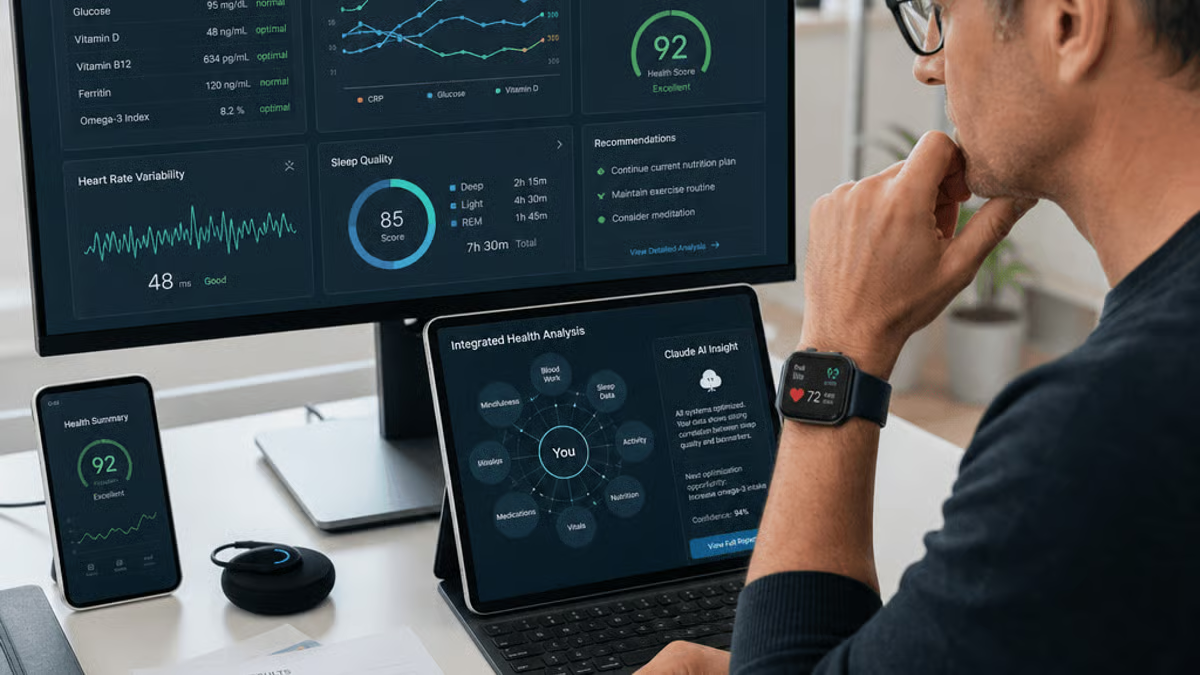
When Connor Christou got his cancer diagnosis, the Keragon founder didn’t just follow doctor’s orders – he turned his treatment into an AI experiment. Christou fed every piece of his health data into Anthropic’s Claude, creating a real-time analysis system that tracked blood work, scan results, wearable device metrics, and daily journal entries. The move highlights how startup founders are becoming early adopters of AI-powered healthcare, using tools like Claude to make sense of complex medical data that even doctors struggle to synthesize quickly.
Connor Christou wasn’t supposed to be the one who got sick. As CEO of Keragon, a workflow automation startup, Christou was known around the office as the fittest person in the room – the guy who optimized everything from his sleep schedule to his macros. So when doctors delivered his cancer diagnosis, his first instinct wasn’t panic. It was data collection.
Within days of starting treatment, Christou built what he calls his “health intelligence system” around Claude, Anthropic’s AI assistant. Every blood test, every scan result, every metric from his wearable devices got uploaded into conversations with the AI. He kept detailed journal entries about symptoms, energy levels, and side effects. Then he’d ask Claude to find patterns, flag anomalies, and suggest questions to bring to his oncologist.
“I realized my doctors were looking at snapshots,” Christou told TechCrunch. “They’d see my bloodwork from Tuesday, but they wouldn’t know that I felt terrible on Wednesday or that my sleep score tanked on Thursday. Claude could see all of it at once.”
The approach reveals something bigger than one founder’s health crisis. It’s a preview of how AI is shifting from corporate use cases into the most intimate corners of people’s lives. While companies like Google and Microsoft pitch AI for enterprise productivity, founders like Christou are stress-testing these tools in life-or-death scenarios.
Christou’s setup wasn’t sophisticated from a technical standpoint – he simply copied lab results into Claude’s interface and uploaded photos of scan reports. But the AI’s ability to maintain context across weeks of data, remember previous conversations, and surface connections between disparate metrics gave him something traditional healthcare systems don’t provide: continuity.
“My oncologist would spend maybe 15 minutes with me every two weeks,” Christou explained. “Claude spent hours analyzing everything between those appointments.” He’s careful to note that he never used the AI to make treatment decisions – that stayed firmly with his medical team. But Claude became his prep tool, helping him formulate better questions and advocate for himself when something felt off.
The healthcare AI market is exploding, with McKinsey projecting the technology could unlock $1 trillion in value. But most attention focuses on clinical applications – AI reading X-rays, predicting patient deterioration, or streamlining administrative work. Christou’s DIY approach shows another path: patients taking AI tools built for general purposes and repurposing them for medical self-advocacy.
Anthropic hasn’t positioned Claude specifically for healthcare use, though the company emphasizes the model’s ability to handle nuanced, context-heavy conversations. The company’s focus on AI safety and reliability makes it a natural choice for sensitive applications, but using it for medical data analysis sits in a regulatory gray zone. Christou wasn’t violating any rules – he was simply using a consumer AI tool to organize his own health information.
Other founders are watching. Since Christou started sharing his experience on social media, he’s heard from dozens of startup executives running similar experiments. Some use OpenAI’s ChatGPT, others prefer Claude or Google’s Gemini. The common thread is frustration with healthcare’s fragmented data systems and rushed appointments.
The trend raises obvious questions about accuracy and liability. AI models can hallucinate, misinterpret medical terminology, or miss crucial context that trained physicians would catch. But Christou argues the risk calculus is different than critics assume. “I’m not asking Claude to diagnose me,” he said. “I’m asking it to help me understand what my doctors are telling me and to spot patterns in my own data. That’s not replacing medical judgment – it’s augmenting patient engagement.”
His oncologist initially seemed skeptical when Christou mentioned his AI assistant. But over time, the doctor came to appreciate that Christou arrived at appointments with organized questions and clear observations about symptom patterns. “I think she realized I wasn’t some conspiracy theorist trying to override her expertise,” Christou laughed. “I was just a patient trying really hard to get better.”
The experiment also highlights gaps in healthcare technology. Despite billions invested in electronic health records and patient portals, most people still can’t easily aggregate their own medical data. Wearable devices from Apple, Samsung, and others collect vast amounts of health metrics, but that information rarely flows into clinical decision-making. Christou had to manually bridge these disconnected systems using an AI chatbot.
Now in remission, Christou still maintains his health intelligence system. He’s scaled back the intensity, but he continues feeding data into Claude and reviewing the patterns monthly. The experience changed how he thinks about Keragon’s product too. “If AI can help me coordinate my own healthcare data, imagine what it could do for actual care coordination workflows,” he noted.
The story also reveals how AI adoption happens in practice – not through careful enterprise rollouts, but through individuals facing urgent problems and grabbing whatever tools work. Anthropic didn’t market Claude for cancer patients. Christou just needed help, and Claude was there.
Christou’s story isn’t just about one founder’s ingenuity during a health crisis. It’s a signal of how AI is escaping the confines of enterprise software and productivity tools to become something more personal and essential. As models like Claude get better at maintaining context and handling sensitive information, more people will use them for high-stakes personal decisions. Healthcare systems aren’t ready for this shift – they’re still figuring out how to integrate their own AI tools, let alone respond to patients who show up with insights from consumer chatbots. But ready or not, the future Christou is pioneering is already here. People facing serious diagnoses won’t wait for permission to use every tool available, and AI assistants are proving surprisingly capable partners in the fight.





Leave a Reply