
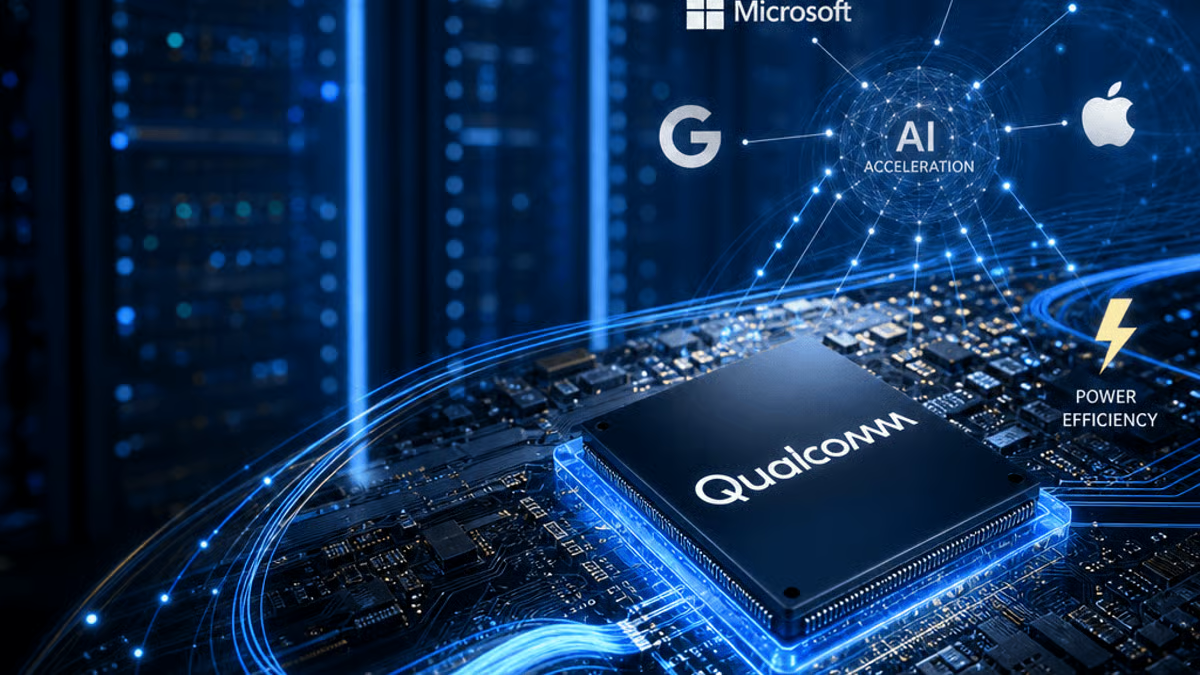
Qualcomm just fired a shot across the data center world. The chipmaker unveiled its first AI-optimized data center CPU and landed Meta as its debut customer – a dramatic expansion beyond the smartphone chips that still generate two-thirds of its revenue. The move puts Qualcomm on a collision course with Intel, AMD, and Nvidia in the red-hot infrastructure market powering AI workloads.
Qualcomm is making its most aggressive bet yet to break free from smartphone dependency. The San Diego chipmaker announced Wednesday it’s entering the AI data center processor market with a new CPU architecture and secured Meta as its first marquee customer – a validation that could reshape the infrastructure powering generative AI.
The timing isn’t accidental. Data center chips have become the industry’s hottest commodity as companies race to build out AI infrastructure. Nvidia has captured most of the attention with its GPU accelerators, but the market for CPUs handling general computing and AI inference remains massive – and dominated by Intel and AMD.
Qualcomm‘s entry comes as the company faces mounting pressure to diversify. Smartphones generated roughly two-thirds of product revenue in its most recent quarter, according to the company’s latest financial disclosures. But that market has matured, with global shipments largely flat. The data center represents a growth engine that could rival or exceed its mobile business over time.
Landing Meta as the inaugural customer is a coup. The social media giant operates some of the world’s largest data center footprints and has been aggressively building AI infrastructure to power its recommendation algorithms, content moderation, and emerging generative AI products. Meta’s willingness to adopt Qualcomm’s unproven data center silicon signals confidence in the architecture – and validates Qualcomm’s design decisions.
But the challenge ahead is steep. Intel has dominated data center CPUs for decades, though its market share has eroded as AMD‘s EPYC processors gained traction with hyperscalers. Meanwhile, cloud giants like Amazon and Google have designed custom ARM-based chips for their own infrastructure, cutting into traditional CPU suppliers.
Qualcomm brings deep expertise in power-efficient chip design from its mobile heritage – a critical advantage as data centers grapple with energy costs and sustainability pressures. The company’s Snapdragon processors pioneered advanced power management and AI acceleration in smartphones, capabilities that translate directly to data center workloads focused on inference rather than training.
The Meta deal also represents a strategic hedge for the social platform. Diversifying silicon suppliers reduces dependence on Intel and AMD while potentially securing better economics and custom optimizations. For AI inference – running models to generate responses rather than training them – Qualcomm’s approach could deliver better performance per watt than traditional server chips.
Industry watchers will be scrutinizing technical specs and benchmarks when Qualcomm reveals more details. The company hasn’t disclosed clock speeds, core counts, or performance metrics yet. But the mere fact that Meta committed to deployment suggests Qualcomm’s silicon cleared rigorous internal testing.
The announcement also pressures Nvidia, whose data center revenue has exploded on AI accelerator demand. While Nvidia’s GPUs dominate AI training, the inference market remains more fragmented – and Qualcomm’s CPU could complement or compete with Nvidia’s offerings depending on workload requirements.
For Qualcomm CEO Cristiano Amon, the data center push represents the culmination of years positioning the company beyond smartphones. The firm has invested heavily in automotive chips, IoT processors, and PC CPUs based on ARM architecture. Data centers represent the largest prize – a market projected to exceed $50 billion annually as AI deployment accelerates.
The Meta partnership will serve as a crucial proof point as Qualcomm courts other hyperscalers and cloud providers. Success could trigger a wave of deployments across Microsoft Azure, Amazon Web Services, and Google Cloud. Failure would leave Qualcomm struggling to gain traction in a market with high switching costs and entrenched incumbents.
Qualcomm’s data center gambit with Meta as anchor customer marks a defining moment for the chipmaker’s diversification strategy. If the silicon delivers on performance and efficiency promises, it could crack open a market worth tens of billions and reduce the company’s reliance on stagnating smartphone sales. But the road ahead is brutal – competing against Intel and AMD’s entrenched positions while proving its architecture can handle AI workloads at the scale Meta and other hyperscalers demand. The next 12 months will reveal whether Qualcomm can translate mobile chip dominance into data center credibility, or if this becomes an expensive lesson in how hard it is to challenge incumbents in enterprise infrastructure.









Leave a Reply