
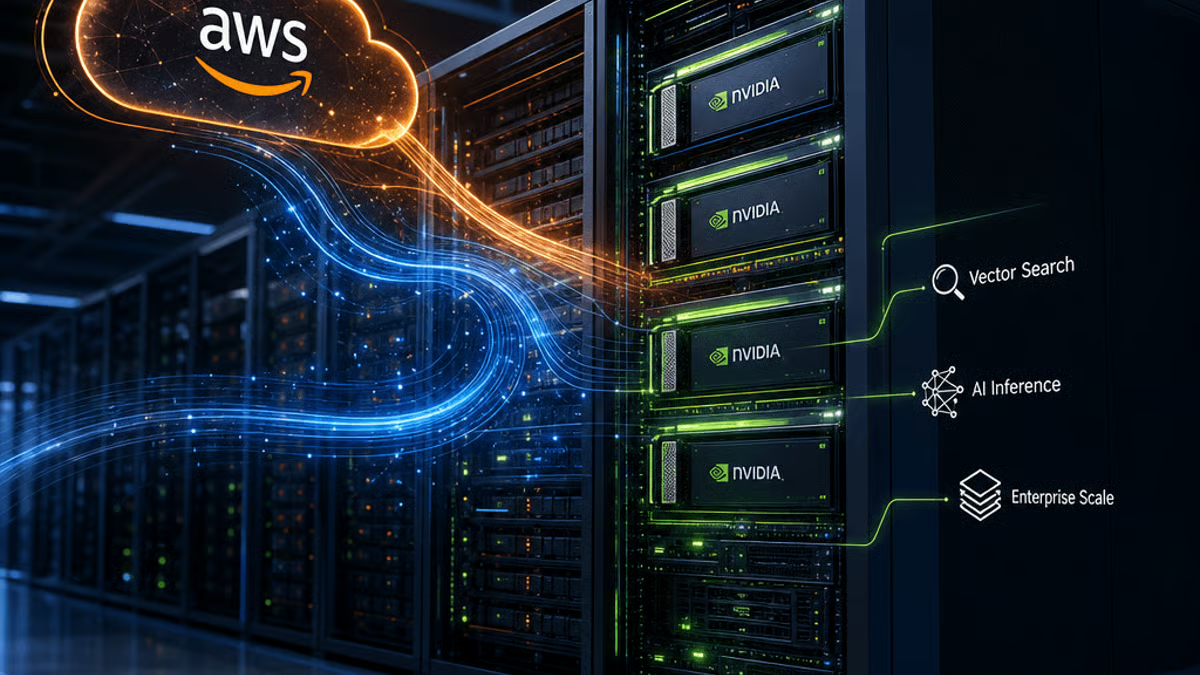
Nvidia and Amazon Web Services just rolled out a major infrastructure partnership designed to help enterprises finally move AI from prototype to production at scale. The collaboration brings Nvidia’s GPU horsepower directly into AWS’s OpenSearch and EC2 services, tackling the biggest headaches companies face when deploying AI: latency, cost, and operational complexity. For businesses struggling to operationalize their AI investments, this could be the bridge between experimentation and real-world deployment.
Nvidia and Amazon Web Services are betting that most companies don’t have an AI innovation problem – they have an AI deployment problem. The two tech giants just announced a sweeping infrastructure collaboration aimed squarely at enterprises stuck between impressive prototypes and production-ready systems that actually scale.
The partnership integrates Nvidia’s AI infrastructure directly into Amazon OpenSearch and Amazon EC2, addressing what the companies call the four horsemen of AI production: latency bottlenecks, sluggish vector search, poor GPU economics, and infrastructure that collapses under its own complexity as it grows.
It’s a practical acknowledgment of where enterprise AI actually stands in 2026. Despite the hype cycle around generative AI and large language models, most companies are still figuring out how to move beyond proof-of-concept demos. Building AI systems that can handle production traffic without melting down or eating the entire IT budget remains surprisingly hard.
The technical integration isn’t superficial. Nvidia’s GPU architecture is now baked directly into AWS’s search and compute infrastructure, which means enterprises can tap into accelerated inference and vector search without rebuilding their entire stack. For companies already invested in AWS, that’s a significant friction reducer.
Vector search gets particular attention in this partnership, and for good reason. As companies build retrieval-augmented generation systems and semantic search tools, vector database performance becomes critical. Slow vector search means slow AI responses, which means users bail. Nvidia’s acceleration tech promises to speed that up considerably within the OpenSearch environment.
The GPU price-performance angle matters more than it sounds. Training models gets all the attention, but inference – actually running AI models in production – is where costs quietly explode. Companies discovering their cool chatbot costs $0.50 per query at scale tend to panic. Better GPU economics on EC2 instances could make the difference between an AI project getting budget approval or getting killed.
What’s particularly interesting is the infrastructure scalability piece. One of the dirty secrets of enterprise AI is that systems that work great with 100 users often faceplant at 10,000 users, not because the model fails but because the infrastructure can’t scale without becoming impossibly complex to manage. The Nvidia-AWS collaboration specifically targets operational complexity, suggesting both companies have heard the same horror stories from enterprise customers.
This isn’t Nvidia’s first rodeo with cloud providers – they’ve got similar partnerships across the industry. But the depth of AWS integration and the specific focus on production bottlenecks suggests this goes beyond the usual co-marketing arrangement. Both companies clearly see enterprise AI infrastructure as a massive market opportunity, and neither wants to cede ground.
For AWS, deeper Nvidia integration strengthens its position against Microsoft Azure and Google Cloud, both of which are pushing hard on AI infrastructure. For Nvidia, getting its tech embedded in the world’s largest cloud platform ensures it remains the default choice for enterprise AI workloads even as competition from AMD and custom silicon heats up.
The timing aligns with a broader shift in enterprise AI spending. Companies are moving from “let’s experiment” to “let’s deploy,” which means infrastructure that actually works at scale suddenly matters more than flashy demos. The partnership appears designed to capture that transition moment.
What remains to be seen is whether this infrastructure push translates to faster enterprise AI adoption or just makes expensive AI projects slightly less expensive. The technology constraints are real, but so are organizational, regulatory, and data quality challenges that no amount of GPU acceleration can solve.
The Nvidia-AWS partnership signals that enterprise AI is entering a new phase where infrastructure matters as much as algorithms. Companies that have been waiting for production-ready AI platforms now have fewer excuses, but they’ll also discover that technology is only part of the deployment puzzle. The real test comes when enterprises try to move their AI projects from pilot to production at scale – and whether this infrastructure collaboration actually delivers on its promise to make that journey less painful. For now, both companies are making a clear bet that the next chapter of AI growth happens in the enterprise, and they’re building the roads to get there.











Leave a Reply