
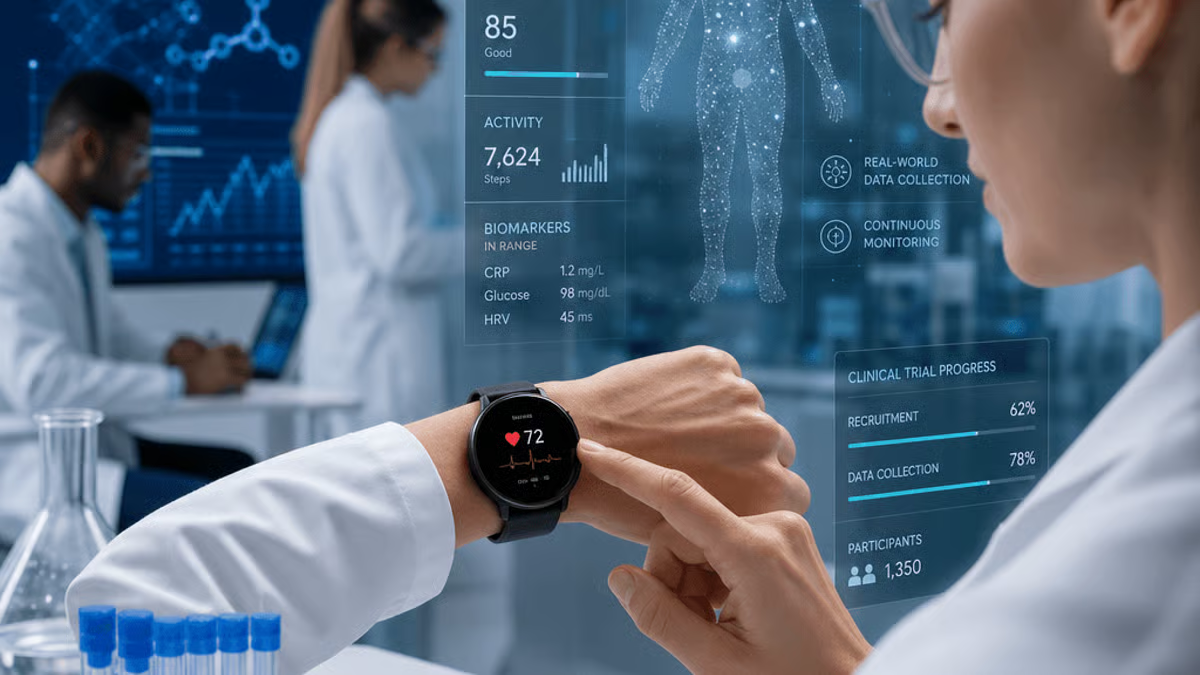
Samsung just made a major play to turn your Galaxy Watch into a clinical research tool. The company’s linking up with Alcedis, a digital-first clinical research organization, to translate continuous health data from wearables into actual evidence that pharmaceutical companies and researchers can use in clinical trials. It’s a bet that the future of medical research happens on your wrist, not just in sterile lab settings.
Samsung is making a serious push into clinical research, and it’s bringing the Galaxy Watch along for the ride. The electronics giant announced it’s teaming up with Alcedis, a clinical research organization that specializes in data-driven trials, to bridge a gap that’s been frustrating pharmaceutical companies and researchers for years: how do you turn all that health data from consumer wearables into something scientifically meaningful?
The problem isn’t new. Wearables have gotten really good at tracking heart rate, sleep patterns, and activity levels. They’re cheap, people actually wear them, and they capture continuous data in real-world environments. But pharma companies running clinical trials have struggled to translate those streams of biometric signals into the kind of validated evidence that regulators and scientists trust. It’s one thing to know someone’s resting heart rate dipped at 2am. It’s another to prove that data point matters for evaluating a new cardiac medication.
Samsung’s answer is an integrated research platform that combines its latest biosensor tech with what it calls “clinically validated measurements.” That includes bioelectrical impedance analysis (BIA) for body composition, electrodermal activity (EDA) for stress response, and Software as a Medical Device features like obstructive sleep apnea and atrial fibrillation detection. These aren’t just consumer wellness features – they’re measurements that have gone through validation processes to meet medical-grade standards.
“The future of clinical research is increasingly collaborative and brings together technology, scientific expertise and research partners to generate a deeper understanding of human health,” Jongmin Choi, Head of Health R&D Group at Samsung’s Mobile eXperience Business, said in a statement. “Through our collaboration with Alcedis, Samsung is unlocking new opportunities for biomarker development, digital endpoint innovation and evidence generation throughout the research lifecycle.”
Here’s how it works in practice. Samsung’s research platform starts with Galaxy Watch devices that can continuously collect physiological data from consenting participants. The setup gives researchers fine-grained control over which biosensors to activate, how frequently to collect data, and how to access both participant-level and device-level insights. It’s designed for faster study setup compared to traditional clinical trial infrastructure, which often requires custom hardware and months of configuration.
The Alcedis partnership handles the other critical piece – actually running the studies. While Samsung provides the wearable technology and research infrastructure, Alcedis leads study execution and participant engagement. That division of labor makes sense given that clinical trials involve a lot more than just collecting data. You need regulatory compliance, participant recruitment, data management systems, and scientific expertise to design studies that actually answer the questions researchers care about.
“The future of clinical research depends on our ability to capture meaningful health data beyond traditional clinical settings,” Hanno Härtlein, CEO of Alcedis, noted. “Our collaboration with Samsung brings together complementary strengths and scalable infrastructure to help advance endpoints and biomarker development, to accelerate evidence generation and support the development of more patient-centric healthcare innovations.”
The timing reflects a broader shift happening across healthcare and pharmaceutical research. Traditional clinical trials require participants to show up at research centers for periodic assessments – maybe once a month or once a quarter. That approach misses a ton of data about what happens in between those visits, and it’s expensive to maintain dedicated research sites. Wearables flip that model by capturing continuous data while people go about their normal lives.
Apple has been building similar capabilities with ResearchKit and more recently with research partnerships around its Apple Watch. The competition signals that both companies see digital health research as a strategic growth area. For Samsung, it’s a way to differentiate Galaxy Watch beyond consumer fitness tracking and potentially open up enterprise revenue from pharmaceutical companies and research institutions.
The platform’s emphasis on validated biomarkers matters because that’s been the sticking point for adoption. A pharma company testing a new diabetes treatment needs to prove their intervention works using endpoints that regulators will accept. Raw step counts or heart rate variability might correlate with health outcomes, but they need to be translated into clinically meaningful measurements. Samsung’s work developing those validated digital endpoints could speed up trial timelines and reduce costs – potentially by millions of dollars per study.
There are still questions about how widely this approach will get adopted. Not every patient owns a Galaxy Watch, which could create selection bias in study populations. Data privacy and security remain critical concerns when you’re dealing with protected health information collected continuously. And the scientific community will need to see published results from actual trials using this platform before fully embracing wearable-based endpoints as equivalent to traditional clinical assessments.
But the infrastructure is clearly falling into place. As healthcare shifts toward more connected, data-driven models, the line between consumer health monitoring and medical-grade research is blurring fast.
Samsung’s partnership with Alcedis is a clear signal that consumer wearables are evolving into serious clinical research tools. By combining Galaxy Watch’s advanced biosensors with validated measurement methodologies and research infrastructure, Samsung is positioning itself as a key player in the shift toward continuous, real-world health data collection. The success of this approach will depend on whether pharmaceutical companies and regulators embrace wearable-based endpoints as reliable alternatives to traditional clinical assessments. If Samsung and Alcedis can prove their platform generates scientifically rigorous evidence, it could fundamentally change how clinical trials are designed and executed – making them faster, cheaper, and more reflective of how patients actually live. For now, the infrastructure is in place. The real test comes when the first wave of clinical trial results starts rolling in.







Leave a Reply