
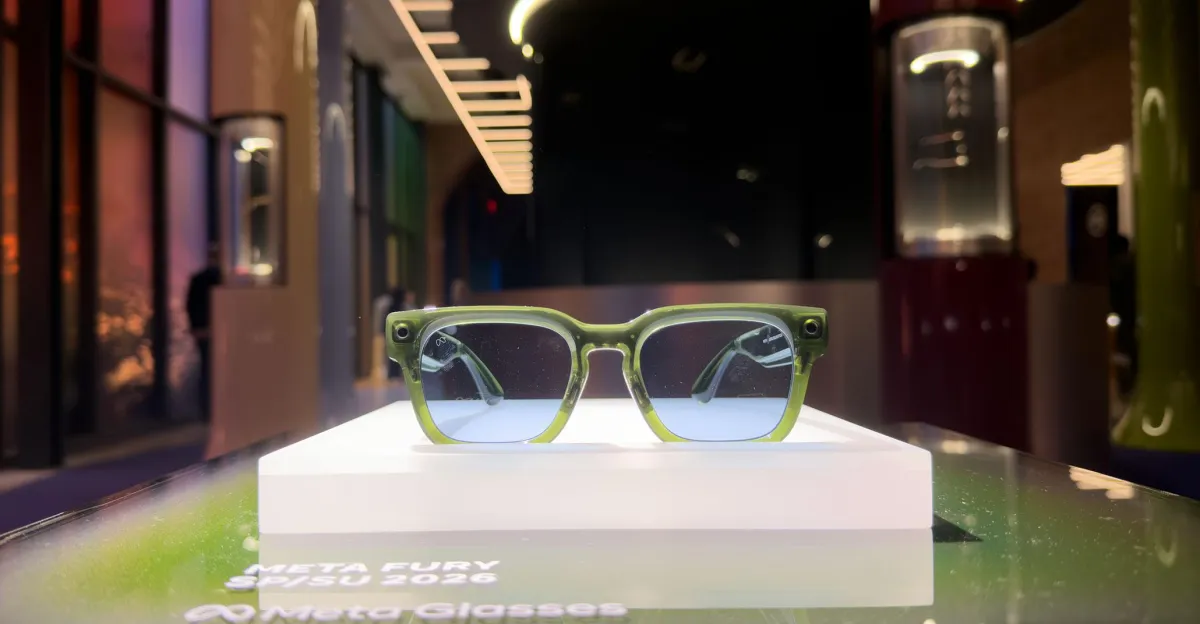
For the past three years, “Meta” and “Ray-Ban” have been synonymous in the smart glasses space. Not anymore. Yesterday, I slipped on several pairs of Meta Glasses — no Ray-Bans — in three different styles and seven colors. One style, I was told several times by various enthusiastic Meta spokespeople, is a collaboration with socialite and reality TV star Kylie Jenner.
Meta could’ve struck out on its own from the get-go, but teaming up with EssilorLuxottica and the Ray-Ban brand was a savvy move in entering the smart glasses space. Previous smart glasses looked straight out of a sci-fi flick, or were just dorky enough to be unappealing. Ray-Ban lending its iconic silhouettes, name recognition, and cultural cachet helped give Meta’s glasses an air of legitimacy. The fact that these smart glasses truly looked like ordinary glasses you wouldn’t be ashamed of wearing was a simple but inspired design choice. However, the glasses’ biggest hurdle may be their attachment to Meta and its history of privacy scandals. In recent weeks, both The New York Times and Wired have reported that the company is actively building a facial recognition feature for its smart glasses.
A conspiracy theorist might wonder if removing the Ray-Ban branding is an attempt by EssilorLuxottica to distance itself from Meta. Not quite. If you peer at the inside temple of the new Meta Fury, Meta Adventurer, and Meta Glasses by Kylie, they all have EssilorLuxottica’s name stamped on the inside. (Albeit in tiny font that’s hard to read in dim lighting.) EssilorLuxottica helped with designing these glasses, as well as the nuts and bolts that go into making and eventually shipping them. According to Meta executives, there’s one big reason for dropping Ray-Ban: price. The Meta Glasses start at $299, which is about $80 cheaper than the starting price for the Ray-Ban Meta Gen 2.
“We just feel like we need to have a pair of glasses at a lower price point, and we were trying to figure out what could work there. [EssilorLuxottica] do have glasses at brands that are at lower price points, but they’re not really that well known, so there wasn’t an obvious fit there,” adds Alex Himel, Meta’s vice president of wearables.


As far as style and specs, the Meta Glasses aren’t that different from Ray-Bans. The internal specs are the same as the recently released Ray-Ban Meta Optics Styles, with slightly longer battery life. The Adventurer models have thinner rims, while the Fury models hew a bit closer to the Meta Ray-Ban Display with a bolder, chunkier frame. You could describe the Adventurer as square, and the Fury as even more square. The Kylie glasses sport a more unique design with a distinct Y2K flavor that I’m told is meant to be worn lower on your nose. On me, it gives off a sort of “unamused Gen Z librarian” vibe. At my hands-on, I’m told many times that there is a little gem in the upper corner of the left lens for a sparkle of personality. Looking at the Kylie glasses, I suspect Google, Samsung, and Gentle Monster might not be terribly pleased.
As a lifelong glasses wearer, the more exciting thing is the adjustable nose pads and temple tips. The nose pads can be pressed and clicked into three separate positions, while the temple tips have a wire that allows you to bend them for a better fit. Like the Display and the Optics Styles, the Meta Glasses also have overextension hinges, which allow for a more comfortable fit for wider faces. Another plus: The glasses support a wide range of prescriptions, spanning -12 to +2.25. (Though you’ll have to go to an optician for prescriptions stronger than -6.)
Regardless of what you think of Meta, on paper, these are all strategic moves that make these glasses appeal to a wider audience. Provided that people are willing to look past Meta’s reputation.
While playing around with the Meta Glasses, it was hard not to notice that the camera appears smaller than in previous Ray-Ban glasses. Technically, Himel tells me, that’s not new to these Meta Glasses. It was actually introduced back in March with the prescription-optimized Optics Styles. Even so, the backlash from the facial recognition feature and glassholes using Meta’s glasses to harass women is at the top of many journalists’ minds at this particular hands-on event.
“We know that there’s tampering today, and there are a handful of ways that people are doing it,” Himel says, noting that Meta has seen an increasing number of bad actors misusing its products as they become more popular. “If people aren’t comfortable with you wearing the glasses, not only do we personally think that’s bad, but we wouldn’t have a business anymore. You should see some updates from us really soon, where we’re looking to address it directly.”


Himel didn’t divulge what those privacy updates will be, but added that Meta is aggressively discussing internally how best to approach the privacy problem — as well as how to set an example for the space going forward.
“In general, we would like to get a place where there’s a uniform way of handling things,” he says. To Himel, it’d be a bad experience for people shelling out money for Meta’s products, only to find that the glasses are banned in public spaces or in certain scenarios — which is starting to become a reality. The challenge isn’t just privacy, either. As Meta leans into AI as a killer use case for these glasses, the company also has to contend with how different states and countries are approaching AI regulation.
“If there are different rules in different states or places you go, that just becomes hard for people. It’s hard for us too, because then we can’t build one thing,” says Himel. “We’re trying to be part of these conversations and try to steer them to a place where, ideally, [policies] are consistent and we think we can get to a reasonable place where people get a lot of value and also feel comfortable.”
That all sounds swell, but Meta has to deliver here — publicly, swiftly, and in a way that shows it’s truly committed to being a leader in shaping good privacy policies and etiquette in this space. A first step would be to be stricter about its security and privacy measures. Himel points to the early days of the smartphone as an example of technology that initially caused great societal concerns that were eventually figured out. While true, there’s one major flaw in that example. Smartphones had obvious “killer” use cases that made privacy tradeoffs seem worth it. Smart glasses are still figuring that one out.
Speaking of “killer use cases,” Meta is quadrupling down on AI. The new Meta Glasses will all launch with Muse Spark, the first model out of Meta’s Superintelligence Labs. (It’ll also be arriving on older Ray-Ban and Oakley glasses in the US and Canada via a software update.) Supposedly, that means more helpful glasses.
At my hands-on, I was told that Meta AI would now be less stiff. I’d be able to talk to it more naturally and get smarter responses. The AI now supports 14 more languages, including Arabic, Japanese, Mandarin, Hindi, and Korean. Pedestrian turn-by-turn navigation is also coming to Meta’s displayless glasses. Later this month, there’ll be a new “dynamic photo” feature that automatically takes multiple frames and then recommends the best one.

I didn’t get to try all of these features, but I did get a few live demos. Live Mandarin translations were pretty smooth, though I did experience a smidge of latency, likely due to all the cross-talk in the demo space. Ongoing conversations were a tad smoother, though Meta AI is still a chatty Cathy. Supposedly, the AI will be better at recommendations. In a room with a tray full of trinkets, Meta AI — in Kylie Jenner’s voice — responded to a prompt for “recommendations” by asking for more context about the types of colors, vibes, and mood I was going for. When I responded with a “cute purple keychain charm,” Meta-as-Kylie suggested I think about charms shaped as grapes or perhaps a lavender donut, and that those could easily be found on Etsy or Instagram. A bit generic, but better answers than what I got when I first tested asking Meta AI for recommendations last year. I also asked Meta AI to estimate the caloric content for a plate of canapés. Meta-as-Kylie gave me a rough estimate of 280 calories, but admitted it wasn’t sure about one prosciutto and fig concoction.
Ultimately, it was a slightly better version of what I’ve tried before. I’ll have to give it a more thorough test in everyday life, though I remain skeptical about whether Muse Spark (or Gemini, or any AI model really) is smart and convenient enough now to override the public’s privacy concerns regarding this tech. Nevertheless, these are affordable, well-made smart glasses, in the widest available array of colors, styles, prescriptions, and fits. But, as I’ve said before, hardware hasn’t been Meta’s problem for some time now.
Photography by Victoria Song / The Verge










Leave a Reply