
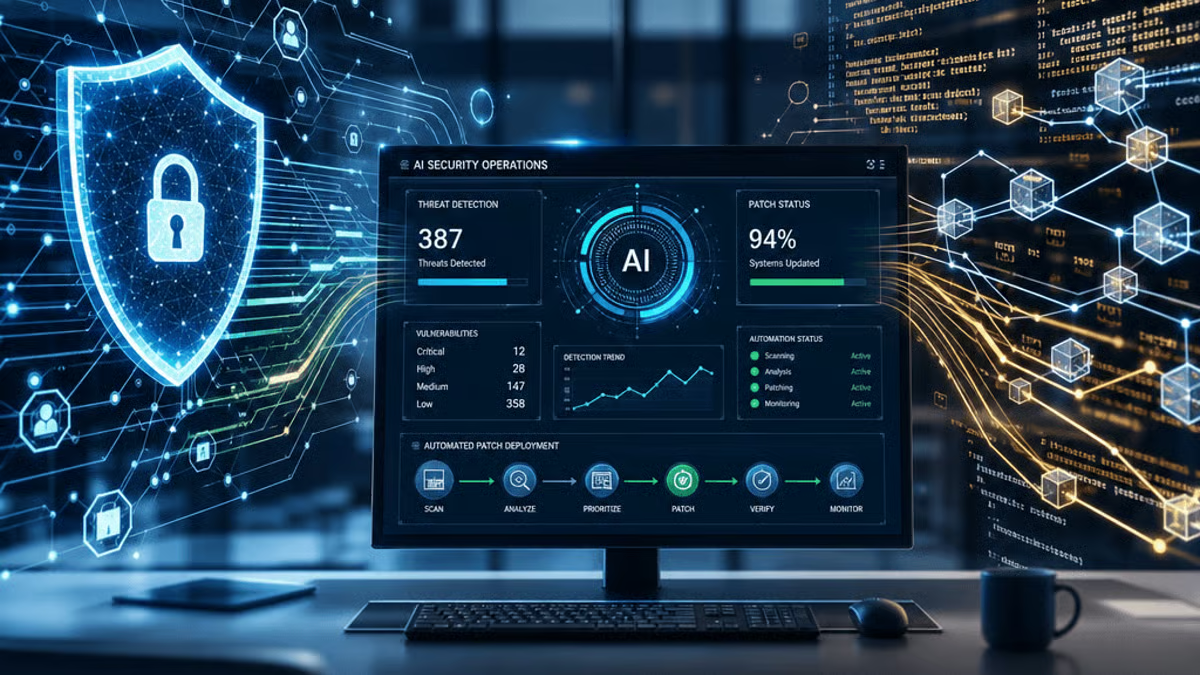
OpenAI just fired a major shot across the bow in the AI security wars. The company unveiled GPT-5.5-Cyber, a specialized model built for cybersecurity work, alongside “Patch the Plant” – an ambitious initiative to automatically fix vulnerabilities in open source software. The move comes as Anthropic gains ground with its own security-focused Mythos system, turning AI safety from a talking point into a competitive battleground where code-level capabilities matter more than corporate promises.
OpenAI is making its biggest play yet in the cybersecurity space, and the timing couldn’t be more pointed. The company just unveiled GPT-5.5-Cyber, an enhanced version of its flagship model specifically trained to hunt down software vulnerabilities, write security patches, and reason through complex attack vectors. But the real headline is “Patch the Plant” – an initiative that sounds almost too ambitious to be real.
Here’s what OpenAI is promising: the system will automatically scan open source repositories, identify security bugs, generate fixes, and submit pull requests to maintainers. It’s essentially positioning AI as an automated security researcher that works 24/7 across the entire open source ecosystem. According to Wired’s reporting, this comes “amid concerns about AI models’ cybersecurity capabilities” – a diplomatic way of saying the industry’s been skeptical about whether these systems can actually do more than generate fancy-sounding security theater.
The competitive angle here is impossible to ignore. Anthropic has been quietly building momentum with Mythos, its own security-focused AI system that’s gained traction with government contractors and enterprise security teams. Where OpenAI has historically led with raw capability and scale, Anthropic carved out a niche by positioning itself as the “safer” choice – constitutional AI, red teaming, all the buzzwords that make compliance officers happy.
Now OpenAI is essentially saying: fine, you want safety? We’ll give you something better – actual utility. GPT-5.5-Cyber isn’t just about detecting threats in theory; it’s about writing production code that fixes them. That’s a fundamentally different value proposition than the cautious, let’s-think-about-the-implications approach that’s dominated AI safety discourse.
The “Patch the Plant” name itself is worth unpacking. It’s a riff on “bug bounty” programs, but instead of paying humans to find vulnerabilities, OpenAI is deploying AI to do it at scale. The “plant” presumably refers to the broader software ecosystem – the infrastructure everyone depends on but few actively maintain. Linux kernel modules, Python libraries, npm packages – the unglamorous plumbing of modern software that’s held together by volunteer maintainers and hope.
If this actually works, the implications are massive. Open source security has been a perpetual crisis for years. The 2021 Log4j vulnerability exposed how fragile the entire system is – a logging library maintained by volunteers nearly broke half the internet. Major companies depend on code written by unpaid developers who don’t have resources for security audits. OpenAI’s pitch is that AI can finally scale security review to match the pace of software development.
But there’s a catch, and it’s a big one: can GPT-5.5-Cyber actually write secure code? AI models are great at generating plausible-looking patches, but security isn’t about plausibility – it’s about correctness under adversarial conditions. One bad automated patch could introduce vulnerabilities worse than the original bug. Maintainers are already overwhelmed; now they’ll need to review AI-generated pull requests too.
The OpenAI versus Anthropic dynamic is also revealing something bigger about how the AI industry is maturing. Early competition was about benchmark scores and demo videos. Now it’s about specific enterprise use cases where wrong answers have real consequences. Cybersecurity is one of those rare applications where you can actually measure AI performance objectively – did it find the vulnerability? Does the patch work? Does it introduce new problems?
For enterprise buyers, this creates an interesting decision point. Anthropic’s Mythos offers safety through caution and interpretability – you can understand why it makes certain decisions. OpenAI’s GPT-5.5-Cyber offers safety through aggressive automation – fix bugs faster than attackers can exploit them. Different philosophies, different risk profiles.
The open source community’s reaction will be crucial. Maintainers have mixed feelings about AI-generated contributions already. Some see it as helpful automation; others worry it’ll flood projects with low-quality noise. OpenAI will need to prove that “Patch the Plant” actually reduces maintainer burden rather than just shifting it from finding bugs to reviewing AI patches.
There’s also the question of access and economics. Will this be a free public service, or another enterprise upsell? If OpenAI charges for GPT-5.5-Cyber while positioning it as critical infrastructure security, that’s going to create tension. Open source exists because of shared resources; turning AI security into a paid product could backfire.
What’s clear is that AI companies are moving past the “trust us, we’re careful” phase into the “watch us actually do useful things” phase. That’s healthy for the industry, even if individual implementations are messy. Cybersecurity is a perfect testing ground because success and failure are unambiguous – either the code is more secure, or it isn’t.
The launch of GPT-5.5-Cyber and “Patch the Plant” marks a pivotal shift in how AI companies are competing – less about safety promises, more about measurable security outcomes. Whether OpenAI can actually deliver on the ambitious goal of automatically patching open source vulnerabilities at scale remains to be seen, but the move forces Anthropic and others to prove their systems can do more than talk about safety. For enterprises and open source maintainers, this is the beginning of a new chapter where AI security tools will be judged by their code contributions, not their conference presentations. The industry’s about to find out if AI can actually make software more secure, or if this is just another layer of complexity on top of an already fragile system.






Leave a Reply