
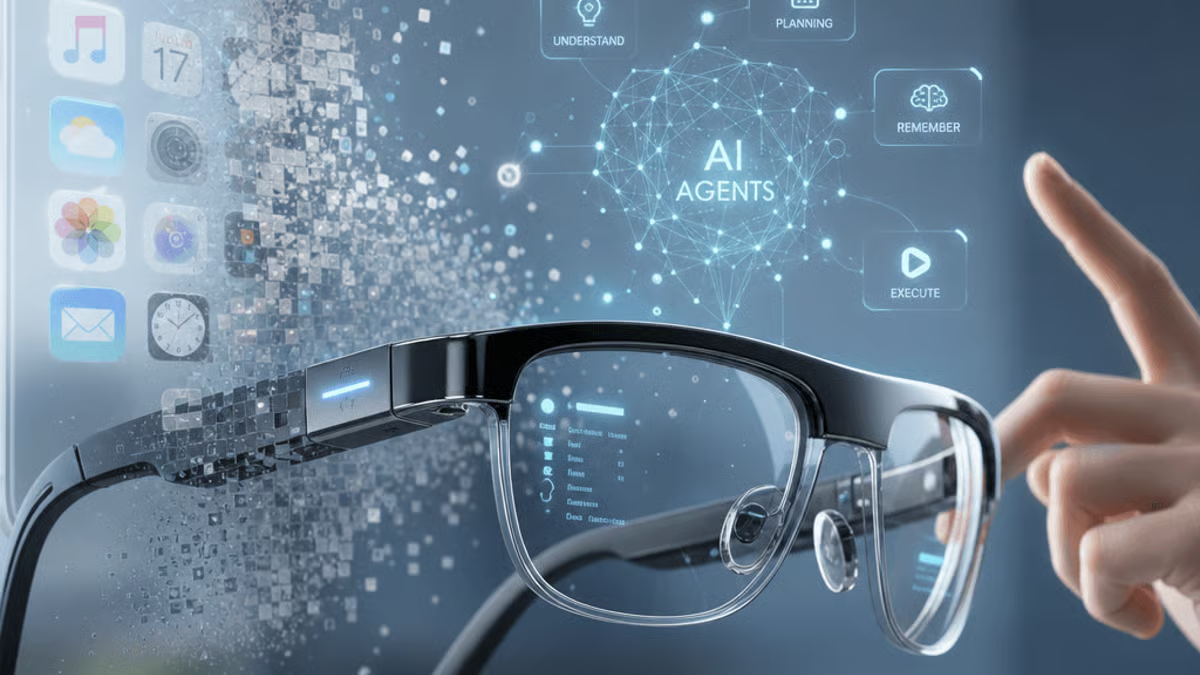
The app era is ending, according to Qualcomm’s CEO. Cristiano Amon just declared that AI agents will replace traditional apps as the chip giant races to power 40 new AI devices hitting the market. In a bold prediction that echoes the shift from desktop to mobile, Amon is betting big on smart glasses as the next smartphone-scale platform, positioning Qualcomm at the center of what could be computing’s next revolution.
Qualcomm just fired a shot across the bow of the entire app economy. CEO Cristiano Amon told CNBC that AI agents will fundamentally replace the apps we’ve relied on for the past 15 years, and the company is already positioning itself to power this seismic shift with 40 new AI devices in its pipeline.
The timing isn’t coincidental. As Apple, Meta, and Google scramble to embed AI into existing hardware, Qualcomm is making a different bet entirely. Amon believes the future isn’t about bolting AI onto smartphones but about purpose-built devices where AI agents handle tasks autonomously, without users tapping through endless app interfaces.
“We’re looking at smart glasses that could eventually become as big as the smartphone,” Amon revealed, doubling down on wearable computing at a moment when most competitors remain focused on traditional form factors. It’s a calculated gamble that mirrors the early smartphone era when Nokia dominated but Apple saw a different future.
The 40-device pipeline represents Qualcomm’s most aggressive push into AI hardware yet. While the company didn’t break down specific device categories, the smart glasses emphasis suggests a mix of wearables, AI-enabled laptops, and potentially automotive systems where agents can process requests locally without cloud latency. This aligns with Qualcomm’s recent focus on edge AI processing, where the Snapdragon platform handles complex AI workloads directly on devices.
What makes Amon’s agent prediction compelling is the infrastructure already falling into place. OpenAI recently expanded its API capabilities for autonomous agents, Microsoft is building Copilot agents into Windows, and Google is rumored to be developing agent-first interfaces for Android. Qualcomm’s silicon could become the hardware foundation these software platforms need to run efficiently.
The smart glasses angle is particularly interesting given Meta‘s Ray-Ban collaboration and Apple‘s long-rumored Vision products. But while those companies control both hardware and software ecosystems, Qualcomm is positioning itself as the arms dealer, supplying chips to any manufacturer willing to build AI-first wearables. It’s the Android strategy applied to the emerging AI device category.
Amon’s app replacement thesis hinges on a fundamental UX shift. Instead of opening a rideshare app, checking prices, and confirming a driver, an AI agent simply books the ride based on your calendar, location, and preferences. Instead of manually ordering groceries through an app interface, the agent monitors your pantry and restocks automatically. The apps don’t disappear but they become invisible background services that agents orchestrate.
That vision requires serious processing power at the edge. Cloud-based AI introduces latency and privacy concerns that make real-time agent interactions clunky. Qualcomm’s bet is that its Snapdragon chips can deliver the compute performance needed for agents to feel instantaneous and personal, all while keeping data on-device.
The semiconductor industry is watching closely. Nvidia dominates data center AI chips, but the edge AI market remains fragmented. If Qualcomm successfully powers the first wave of mass-market AI agents devices, it could claim a strategic position that rivals have struggled to match in mobile.
Critics will point out that platform predictions often fail spectacularly. Remember when blockchain was supposed to replace everything? But Amon isn’t betting on speculative technology. AI agents already exist in limited forms through voice assistants and chatbots. The question isn’t if they’ll improve but whether they’ll migrate from screens to ambient devices like smart glasses.
The 40-device figure also signals manufacturer confidence. Device makers don’t commit to Qualcomm chips unless they see market demand. That pipeline suggests companies from consumer electronics to automotive are placing bets that AI devices represent a genuine category, not just a tech industry fever dream.
Amon’s agent-first vision sets up a collision between Qualcomm’s hardware ambitions and the platform giants who control today’s app ecosystems. If AI agents truly replace apps, Apple and Google lose their app store leverage while chipmakers like Qualcomm gain influence. The 40-device pipeline will test whether manufacturers and consumers are ready to move beyond the smartphone-app paradigm that’s defined computing for a generation. Smart glasses might sound niche today, but so did touchscreen phones in 2006.










Leave a Reply