
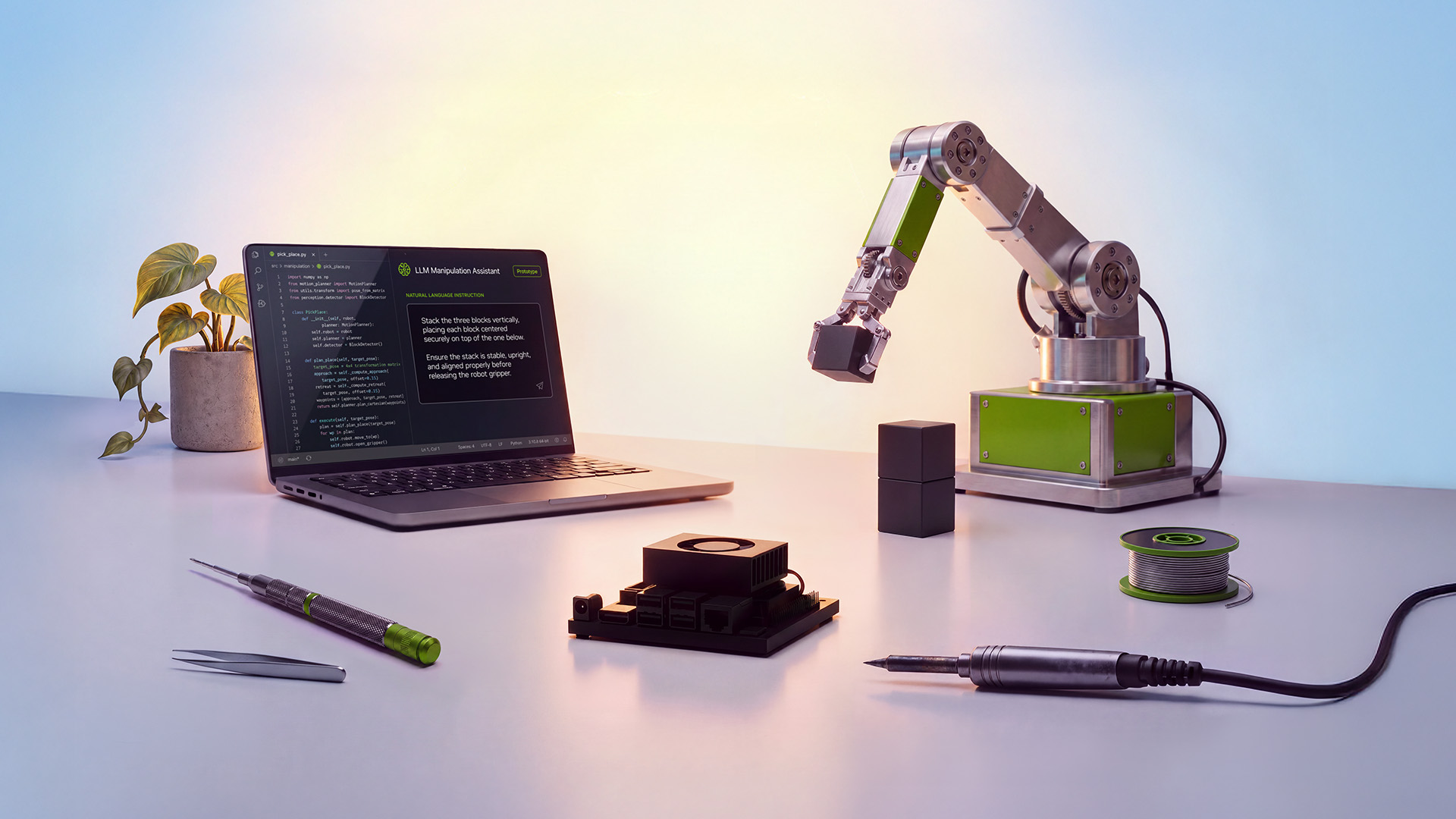
NVIDIA has unveiled the Jetson Orin Nano 2, an edge robotics computer aimed at bringing physical AI to drones, robots, and vision systems. The company is positioning the new board as an entry-level option for developers who want generative AI models running directly on a machine instead of inside a data centre.
NVIDIA’s argument for the launch rests on a change in how well small and medium AI models now perform. The company says models of this size have reached the accuracy that only the largest frontier models achieved a year earlier.
Deepu Talla, VP of Robotics and Edge AI at NVIDIA, said: “The Jetson Orin Nano 2 computer puts that breakthrough within reach of millions of developers, delivering the performance and energy efficiency needed for real-time reasoning at the edge.”
Achieving that level of accuracy from small and medium AI models lets compact edge hardware interpret language and images and act on that information in real-time. Robots, delivery drones, inspection drones, and vision AI systems all depend on hardware that can run those workloads without drawing much power.
NVIDIA Jetson Orin Nano 2 compute specs and power draw
Jetson Orin Nano 2 carries 78 trillion operations per second of AI compute, 8GB of memory, and an eight-core Arm CPU. NVIDIA built the board to deliver a jump in AI and video-processing performance while keeping cost and power draw low.
The new board reaches twice the inference performance of the existing Jetson Orin Nano Super. NVIDIA attributes that gain to improved Tensor Cores and higher memory bandwidth, packed inside the same compact form factor as its predecessor. Running in 15-watt mode, Jetson Orin Nano 2 uses 40 percent less power than the Orin Nano Super while matching its performance level.
Jetson Orin Nano 2 runs on NVIDIA’s open software stack alongside Jetson agent skills and the wider Jetson AI ecosystem. NVIDIA says the board is built to run large language models and vision language models optimised for memory-efficient inference at the edge. The company names its own Cosmos and Nemotron models as examples, alongside Gemma 4 and Qwen 3, as models developers can deploy on the hardware.
Early partners test physical AI applications
Cognex, Doosan Bobcat, and Matic sit among the first companies NVIDIA names as adopting and exploring Jetson Orin Nano 2. NVIDIA says more than three million developers already build on its robotics stack. The company expects partners – including the aforementioned partners – to bring edge AI into home robots, vision AI systems, delivery and inspection drones, carrier boards, hardware systems, and reference designs.
Wing, the drone delivery subsidiary of Alphabet, already runs Jetson Orin Nano Super and NVIDIA’s software stack across its delivery drone fleet. The company plans to evaluate Jetson Orin Nano 2 to push further into real-time AI perception and reasoning, with the aim of making deliveries from local businesses to residential yards faster and safer.
Dinuka Abeywardena, Head of Perception at Wing, commented: “Drone delivery depends on AI that can enable fast, reliable understanding of the real world. Wing is exploring Jetson Orin Nano 2 to give us a path to more responsive, energy-efficient drones that can help make deliveries quicker and more dependable for customers.”
Wing’s existing drone fleet runs on the Jetson Orin Nano Super, a separate product from the new board. There’s currently no public timeline for Wing to move from evaluation to production use of Jetson Orin Nano 2 on delivery flights.
Matic Robots, a consumer robotics company, is adopting Jetson Orin Nano 2 for its home cleaning robots. NVIDIA says the board will let Matic add conversational AI, gesture detection, precision mapping and semantic understanding of the home, alongside autonomous cleaning behaviour.
Navneet Dalal, Cofounder and Chief Executive of Matic Robots, explained: “Home robots need to understand people, map spaces precisely, understand the layout of objects and spaces, and clean autonomously in dynamic and constantly changing environments.
“With Jetson Orin Nano 2, Matic can run state-of-the-art AI models at the edge in a compact home robotics platform built for real-time perception, interaction, and navigation.”
Carrier boards and reference designs
NVIDIA also named a large roster of Jetson hardware partners building around the new board.
AAEON, ADLINK, Advantech, and Aetina sit among the manufacturers building carrier boards and hardware systems for it. Antmicro, Aptiv,
Auvidea and AVerMedia join a further group working on customised AI software and reference designs, alongside Chuanglebo, Connect Tech, ForeCR, and JWIPC.
Neurealm, Plink, Realtimes, RidgeRun, RS, Seeed Studio, Tauro Tech, Twowin, TZTEK, and YUAN complete the list of partners NVIDIA says are working to help customers reach the market faster.
“Frontier intelligence has reached the edge. Frontier models that used to run inside data centers last year can now run in real time on entry-level Jetson systems,” said Talla. “With Jetson Orin Nano 2, robots and edge systems can run leading language and vision models locally and in real-time, opening up applications that weren’t possible before.”
Learn more about physical AI during the Physical AI Expo held in Amsterdam, London, and North America.
See also: XPENG IRON humanoid robot draws record physical AI funding

Want to learn more about AI and big data from industry leaders? Check out AI & Big Data Expo taking place in Amsterdam, California, and London. The comprehensive event is part of TechEx and is co-located with other leading technology events including the Cyber Security & Cloud Expo. Click here for more information.
AI News is powered by TechForge Media. Explore other upcoming enterprise technology events and webinars here.







Leave a Reply