
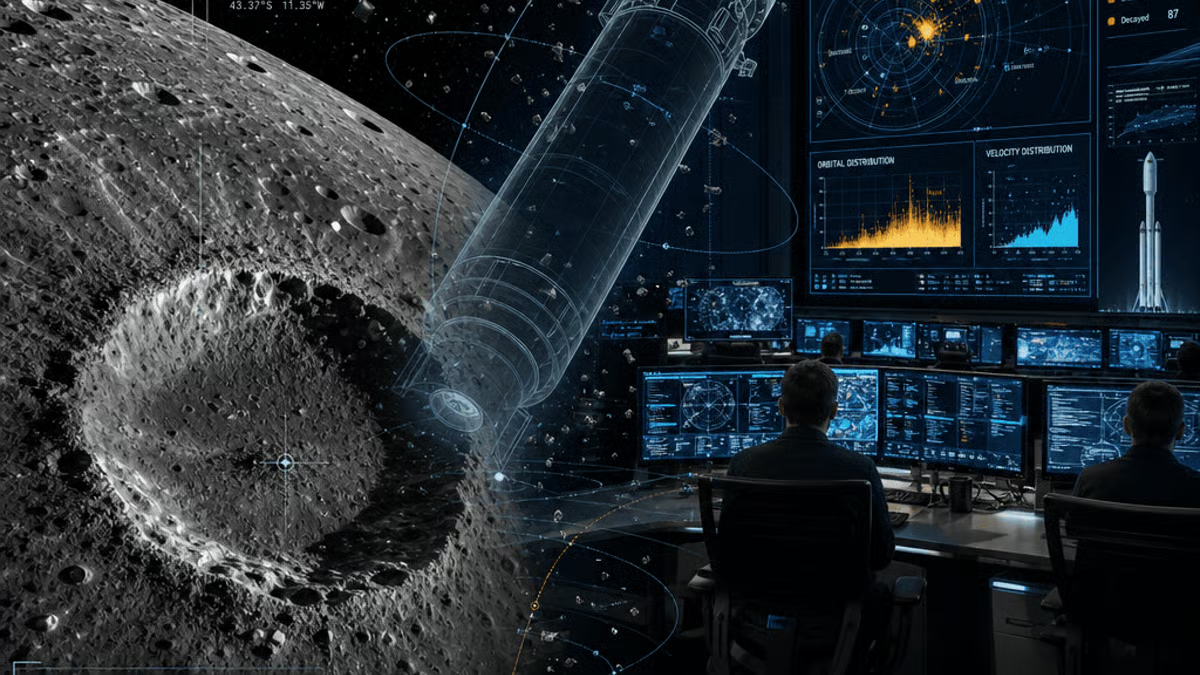
A SpaceX Falcon 9 rocket stage just became the latest piece of hardware to crash into the Moon, and somehow, nobody managed to capture the moment it happened. Scientists confirmed the impact through detected signals from the lunar surface, marking an unexpected addition to humanity’s growing collection of space debris on Earth’s closest neighbor. Orbital imaging systems are now racing to photograph the fresh crater, which could appear within days.
SpaceX just added an unplanned entry to the Moon’s impact record. A spent Falcon 9 upper stage slammed into the lunar surface sometime recently, and in a twist that’s equal parts fascinating and concerning, not a single camera or telescope caught the moment of impact.
Scientists confirmed the collision through signal detection rather than direct observation, according to Wired. The rocket stage, which had been tumbling through space after completing its mission, finally met its end on the Moon’s far side—a region notoriously difficult to monitor in real-time from Earth.
The lack of visual documentation isn’t just bad luck. It reveals how challenging it remains to track the thousands of pieces of space hardware drifting beyond Earth orbit, even when we know roughly where they’re headed. Amateur astronomers and professional observatories alike apparently missed the show, despite advance predictions about the rocket’s trajectory.
Lunar orbiters now hold the key to understanding what happened. NASA’s Lunar Reconnaissance Orbiter and other spacecraft circling the Moon are expected to capture the first images of the impact crater within days. These photos will help scientists calculate the rocket stage’s velocity at impact and assess the size of the debris field.
This isn’t SpaceX’s first encounter with uncontrolled space debris concerns. The company’s rapidly expanding Starlink constellation has drawn scrutiny from astronomers worried about both collision risks and light pollution. But a rocket stage hitting the Moon carries different implications—it’s a reminder that cislunar space, the region between Earth and the Moon, is becoming increasingly crowded.
The Falcon 9 upper stage likely spent years in what’s called a chaotic orbit, influenced by both Earth’s and the Moon’s gravity, before finally succumbing to lunar gravity. These “zombie” rocket stages represent a growing tracking challenge as commercial space activity accelerates. SpaceX alone launched 96 times in 2024, leaving dozens of upper stages in various orbits.
What makes this incident particularly noteworthy is the detection method. Scientists apparently picked up signals—possibly seismic data from instruments left on the Moon during the Apollo era, or electromagnetic signatures—that confirmed impact without needing visual proof. The Apollo Passive Seismic Experiments stopped transmitting in 1977, but newer instruments from various lunar missions could have captured the event.
The coming days will bring answers. When orbital imaging confirms the crash site, scientists will gain valuable data about how rocket impacts affect the lunar surface. Previous deliberate crashes, like those of spent Apollo Saturn rocket stages, created seismic waves that helped researchers understand the Moon’s internal structure. This accidental impact might offer similar scientific value.
For SpaceX, the incident underscores questions about long-term debris management as the company pushes toward its Mars ambitions. If we can’t consistently track and photograph a multi-ton rocket stage hitting our closest celestial neighbor, monitoring hardware traveling to Mars presents exponentially greater challenges.
The invisible Moon crash serves as a wake-up call for the space industry. As companies like SpaceX accelerate launch cadences and push deeper into cislunar space, the ability to track and manage defunct hardware becomes critical infrastructure, not just a nice-to-have. When orbital imaging confirms the crater in the coming days, it’ll mark more than just another impact—it’s a visible reminder that space traffic management needs to evolve as fast as the rockets themselves. The question isn’t whether more hardware will eventually drift into uncontrolled orbits, but whether we’ll build the tracking systems to see it coming.











Leave a Reply