
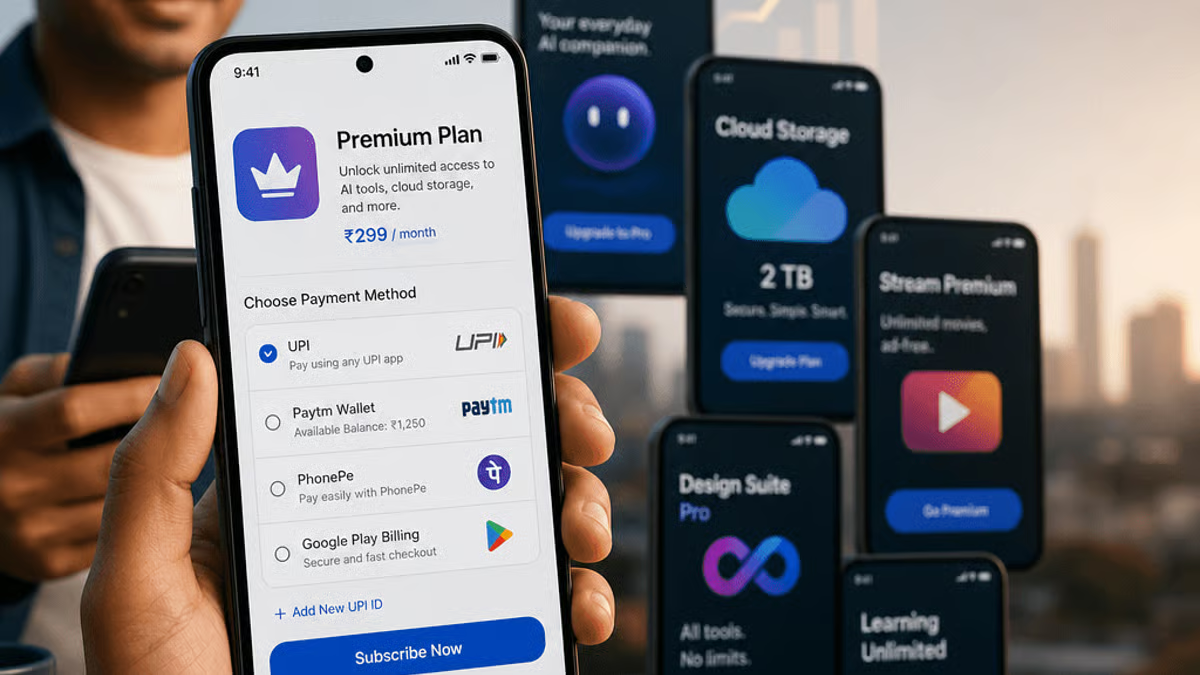
India’s app economy just crossed a watershed moment. The market generated a record $345 million in Q2 2026, signaling a fundamental shift in how the world’s most populous nation consumes digital services. For years, India was synonymous with free app downloads and ad-supported models. Now, users are opening their wallets for premium AI subscriptions like ChatGPT Plus, Claude Pro, and Google One, reshaping the economics for developers eyeing the subcontinent’s 700 million smartphone users.
India’s app economy is finally paying off – literally. The market just notched $345 million in Q2 2026 revenue, shattering previous records and upending the conventional wisdom that Indian users won’t pay for apps. The surge marks a turning point for a market that app developers have long viewed as high-volume but low-revenue territory.
The catalyst? AI is changing spending habits. OpenAI’s ChatGPT Plus, Anthropic’s Claude Pro, and Google One subscriptions are converting free users into paying customers at rates that would’ve seemed impossible just two years ago. Indian professionals and students are shelling out for AI assistants that help with everything from coding to content creation, willing to pay $20 monthly for tools that tangibly boost productivity.
This represents a seismic shift in consumer behavior. India has historically been the land of free apps and aggressive price sensitivity. The country leads global app downloads year after year, but conversion to paid subscriptions languished in the low single digits. Developers adapted by building ad-supported models or treating India as a user-acquisition market rather than a revenue driver.
But the numbers tell a different story now. The $345 million quarterly haul suggests Indian consumers are maturing in their digital consumption patterns. Rising disposable incomes, better payment infrastructure through UPI (Unified Payments Interface), and a growing class of knowledge workers who see software as essential tooling are converging to unlock monetization at scale.
Google One has been particularly aggressive in India, bundling cloud storage with VPN services and photo editing features at localized price points. The company reportedly crossed 10 million paid subscribers in India earlier this year, a milestone that took years longer in other emerging markets. The success has prompted Google to test India-specific pricing tiers and family plans that acknowledge local purchasing power while still generating meaningful revenue.
The AI subscription boom is only part of the equation. Entertainment apps, productivity tools, and health-and-fitness platforms are also seeing conversion upticks. Indian users are increasingly comfortable with recurring payments for services that deliver consistent value, especially when integrated with local payment methods that reduce friction.
For global app developers, India’s monetization inflection point carries huge implications. The market offers scale that rivals China but with fewer regulatory barriers and English-language advantages. A consumer base that’s willing to pay – even modestly – transforms the unit economics of customer acquisition. Suddenly, the cost of acquiring an Indian user starts penciling out against lifetime value projections.
The shift also validates localized pricing strategies. OpenAI and Anthropic have experimented with regional pricing that makes ChatGPT Plus and Claude Pro more accessible without racing to the bottom. Early data suggests conversion rates justify the lower price points when multiplied across India’s massive user base.
Investors are taking notice. Indian app developers who can demonstrate strong monetization metrics are commanding higher valuations in funding rounds. The narrative has flipped from ‘we have millions of users’ to ‘we’re generating millions in recurring revenue’ – a pitch that resonates far better with growth-stage investors looking for path to profitability.
But challenges remain. Payment infrastructure, while vastly improved through UPI, still faces hiccups with international subscription billing. Credit card penetration remains relatively low compared to developed markets, though digital wallets and UPI are filling the gap. App developers also have to navigate price sensitivity carefully – push too hard on pricing and users abandon subscriptions quickly.
The Q2 milestone also raises questions about sustainability. Can growth rates hold as the novelty of AI assistants wears off? Will users maintain subscriptions during economic downturns, or are these services still discretionary spending vulnerable to the first budget cuts? The next few quarters will test whether India’s app monetization surge represents a permanent behavioral shift or a temporary AI-hype bubble.
What’s certain is that India’s app economy has entered a new chapter. The market is no longer just about download volume and DAU metrics – it’s about revenue per user and subscription retention. Developers who cracked the code on Indian monetization early are seeing returns that justify years of patient market cultivation. Those who dismissed India as unprofitable are scrambling to reassess their strategies before they miss the window entirely.
India’s $345 million Q2 app revenue isn’t just a number – it’s a signal that the world’s largest internet market is finally monetizing at scale. The combination of AI-driven subscriptions, improved payment infrastructure, and changing consumer attitudes is unlocking revenue streams developers once thought impossible. For companies like OpenAI, Anthropic, and Google, India represents the next frontier of growth beyond saturated Western markets. The question now isn’t whether Indian users will pay for apps, but how quickly developers can capture this emerging willingness to spend before competition intensifies. The app economy gold rush in India has officially begun.









Leave a Reply