

South Korea just threw down a trillion-dollar gauntlet in the global semiconductor wars. The government unveiled a sweeping national investment plan targeting chips and AI infrastructure, directly challenging Taiwan’s foundry dominance, China’s state-backed chip ambitions, and Japan’s resurgent semiconductor push. The announcement signals Seoul’s determination to secure its position as a critical node in the AI supply chain, with Samsung and SK Hynix expected to anchor the strategy.
South Korea just made the largest single bet in its industrial history. The government’s $1 trillion chip and AI investment plan represents an existential play to maintain relevance in a semiconductor landscape being reshaped by geopolitical fractures and AI demand.
The announcement comes as Samsung and SK Hynix face mounting pressure from all sides. Taiwan’s TSMC continues to dominate advanced logic manufacturing, China’s pouring state resources into achieving chip independence, and Japan’s reclaimed its position as a critical materials and equipment supplier. Seoul’s watching its regional neighbors build fortress semiconductor ecosystems while South Korea’s chipmakers grapple with cyclical memory market downturns and mounting capital expenditure requirements.
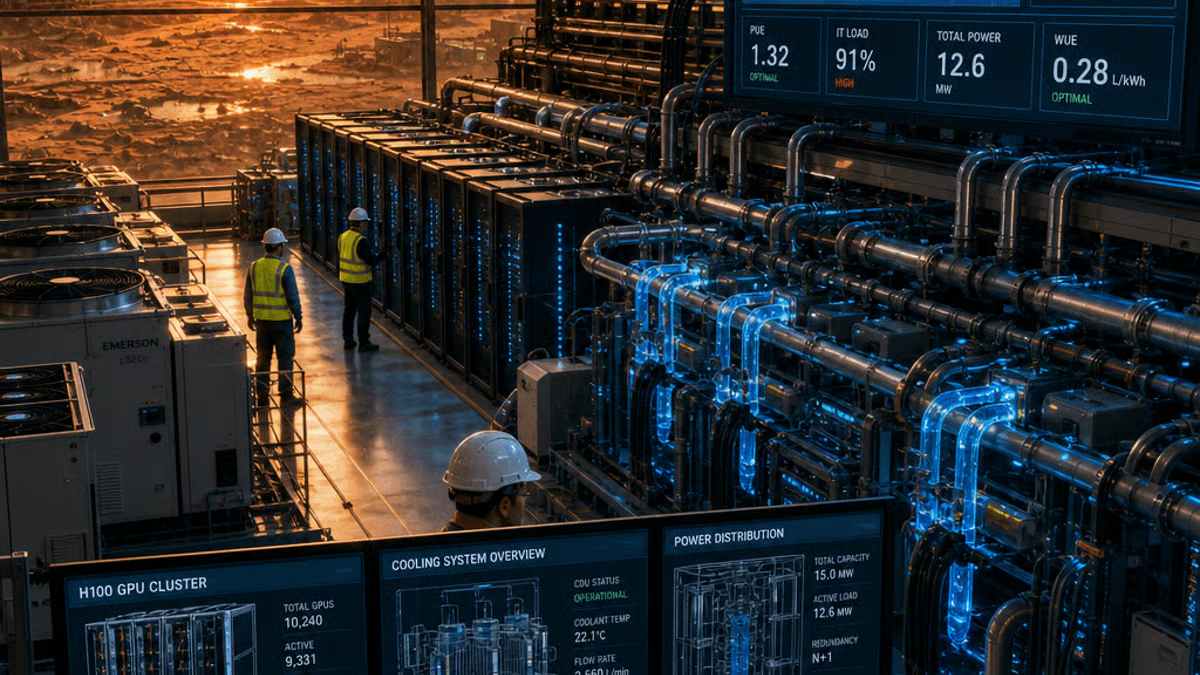
According to BBC News, the plan specifically targets both traditional semiconductor manufacturing capacity and AI-focused infrastructure. That dual focus reflects the industry’s evolution – it’s no longer enough to just make chips. Nations need integrated ecosystems spanning advanced packaging, high-bandwidth memory, and AI training infrastructure.
The timing reveals South Korea’s strategic anxiety. Taiwan’s positioned itself as the indispensable node for cutting-edge logic chips through TSMC’s technological lead. China’s throwing hundreds of billions at achieving self-sufficiency despite U.S. export controls. Japan’s leveraging its materials monopoly and partnerships with TSMC to rebuild domestic capacity. South Korea risks being squeezed between Taiwan’s foundry dominance and China’s massive market, even as Samsung struggles to close the gap with TSMC in advanced process nodes.
The $1 trillion figure suggests this isn’t just industrial policy – it’s national security strategy. Modern AI systems run on high-bandwidth memory, where SK Hynix and Samsung maintain strong positions. But that advantage means nothing if customers can’t get the logic chips to pair with Korean memory, or if geopolitical tensions disrupt supply chains. Seoul’s betting it can build a more integrated domestic semiconductor stack before those vulnerabilities become critical.
What makes this different from previous chip investment announcements is the explicit AI framing. Every major economy now views semiconductor capacity through the lens of AI competitiveness. The U.S. CHIPS Act, Europe’s semiconductor ambitions, China’s Made in China 2025 goals – they all recognize that whoever controls advanced chip production shapes the AI future. South Korea’s joining that race with the deepest pockets yet.
The plan likely includes everything from fab construction subsidies to R&D funding for next-generation chip architectures, advanced packaging facilities, and AI data center infrastructure. South Korea’s already home to some of the world’s most advanced semiconductor manufacturing, but expanding that requires solving talent shortages, securing equipment supply chains dominated by ASML and other foreign providers, and maintaining technological parity as Moore’s Law economics become brutal.
For Samsung specifically, this represents potential validation of its foundry ambitions. The company’s poured resources into challenging TSMC but struggled with yields and customer wins. A trillion-dollar national backing could accelerate that roadmap, though money alone won’t solve the technical execution challenges that have plagued Samsung’s foundry operations.
SK Hynix faces different math. The company dominates high-bandwidth memory critical for AI accelerators, but that market’s concentration creates risk. If customers diversify suppliers or if China’s memory manufacturers achieve quality parity, SK Hynix’s position weakens. National investment could fund next-generation memory architectures and tighter integration with domestic logic chip production.
The regional chip race now features four heavyweight contenders, each with distinct advantages. Taiwan’s got TSMC’s technological lead and manufacturing expertise. China’s got market scale and state resources. Japan’s got materials control and equipment partnerships. South Korea’s betting its memory dominance and manufacturing prowess, backed by unprecedented capital, can secure its position.
What’s unclear is how much of the $1 trillion represents new government spending versus private investment the government’s coordinating. South Korea’s historically favored the latter approach, with chaebols like Samsung making massive capital commitments while the government provides infrastructure, tax incentives, and regulatory support. Either way, the scale signals Seoul views semiconductor leadership as non-negotiable for its economic future.
South Korea’s trillion-dollar chip bet isn’t just industrial policy – it’s a recognition that semiconductor leadership now determines national power in an AI-driven world. As Taiwan, China, and Japan each build fortress chip ecosystems with distinct strategic advantages, Seoul’s mobilizing its manufacturing prowess and memory market dominance to secure a seat at the table. Whether Samsung and SK Hynix can execute on that scale of investment while solving persistent technical challenges will shape not just South Korea’s economic future, but the global balance of semiconductor power. The chip wars just entered their most capital-intensive phase yet, and every nation’s calculating whether they can afford to compete – or afford not to.








Leave a Reply