
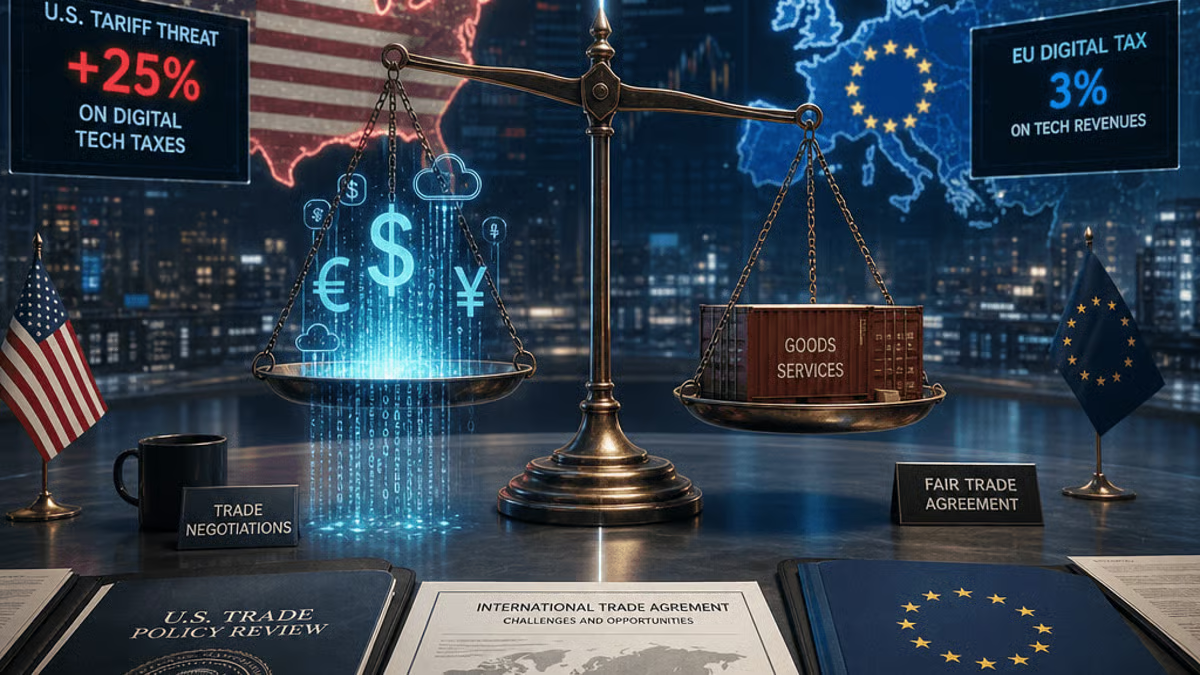
President Donald Trump just fired a warning shot that could reshape how American tech giants operate abroad. In a Truth Social post, he threatened 100% tariffs on any country imposing digital services taxes on US companies – a move that puts Google, Amazon, Apple, Microsoft, and Meta squarely in the crosshairs of an escalating international tax battle. The declaration, posted to Truth Social, promises to override existing trade agreements and marks the most aggressive stance yet on the digital tax dispute that’s simmered between the US and Europe for years.
The Trump administration just turned up the heat on international tech taxation in a way that could fundamentally alter how American companies do business overseas. President Trump’s declaration that he’ll impose 100% tariffs on nations implementing digital services taxes targets a pressure point that’s been building for years between the US and its trading partners.
“This TARIFF will supersede Trade Deals made with the Country, whether implemented, signed, or not,” Trump wrote in his Truth Social post, making clear that no existing agreement would shield countries from retaliation. The language leaves zero room for interpretation – this isn’t a negotiating position, it’s a hard line.
The timing couldn’t be more significant for Big Tech. Google, Amazon, Apple, Microsoft, and Meta have been navigating a patchwork of digital services taxes across Europe and beyond for years. France kicked off the trend in 2019 with a 3% tax on digital revenues, followed by the UK, Italy, Spain, and Austria. These taxes specifically target companies that generate revenue from digital services in a country without maintaining a significant physical presence there – a model that describes virtually every major American tech platform.
The European approach has long frustrated US tech executives and policymakers who view these taxes as discriminatory. While framed as closing loopholes that let digital giants avoid local taxes, critics argue they unfairly single out American companies that happen to dominate the digital economy. Google alone faces digital tax obligations in over a dozen countries, adding complexity and cost to its international operations.
Trump’s threat puts European allies in an impossible position. The digital services taxes generate meaningful revenue – France’s version alone brought in over €400 million in its first year. But 100% tariffs on exports to the US would devastate industries far beyond tech. Germany’s auto sector, French luxury goods, Italian fashion – all could face crippling duties if their governments don’t back down.
What makes this particularly volatile is the superseding clause. The US has spent decades negotiating intricate trade frameworks with Europe and other partners. Trump’s assertion that tariffs would override these agreements suggests a willingness to tear up the rulebook entirely. That creates uncertainty not just for tech companies, but for any business operating across borders.
For Amazon and Apple, which run massive logistics and retail operations in Europe, the calculus gets even messier. Do foreign governments risk tariff retaliation to collect digital taxes? Or do they cave to US pressure and find other ways to tax the digital economy? Either way, the regulatory environment just became far less predictable.
The threat also arrives as the OECD has been working toward a global framework for taxing digital services – a multilateral solution that would replace the current hodgepodge of national taxes. Trump’s unilateral approach could torpedo those negotiations before they gain traction, leaving companies to navigate an even more fragmented landscape.
Industry observers note the irony that American tech giants may end up caught in the middle of a fight ostensibly waged on their behalf. Meta and Microsoft have both publicly supported international tax reform efforts, recognizing that a predictable global framework beats a chaotic patchwork. A tariff war that destabilizes trade relationships could harm their European operations more than the taxes themselves.
The immediate market impact remains unclear, but the policy uncertainty is already palpable. Tech companies planning European expansion now face a wildcard variable – will their home country’s trade policy suddenly make their products uncompetitive? Will retaliatory measures from Europe create new barriers?
“This is exactly the kind of unpredictability that makes long-term planning impossible,” one tech industry lobbyist told reporters, speaking on background given the sensitivity. “Companies need stable rules to invest and grow. This creates the opposite.”
Trump’s tariff threat transforms digital services taxation from a policy debate into a potential trade war, with American tech giants stuck in the middle. Whether this pressure forces Europe and other regions to abandon their digital taxes or triggers a broader breakdown in trade relationships remains to be seen. What’s certain is that Google, Amazon, Apple, Microsoft, and Meta now face heightened regulatory uncertainty in their largest international markets. For companies that thrive on predictable rules and long-term planning, that uncertainty may prove costlier than the taxes themselves. The next few weeks will reveal whether this is a negotiating tactic or the opening salvo in a fundamental restructuring of how digital commerce is taxed globally.











Leave a Reply