
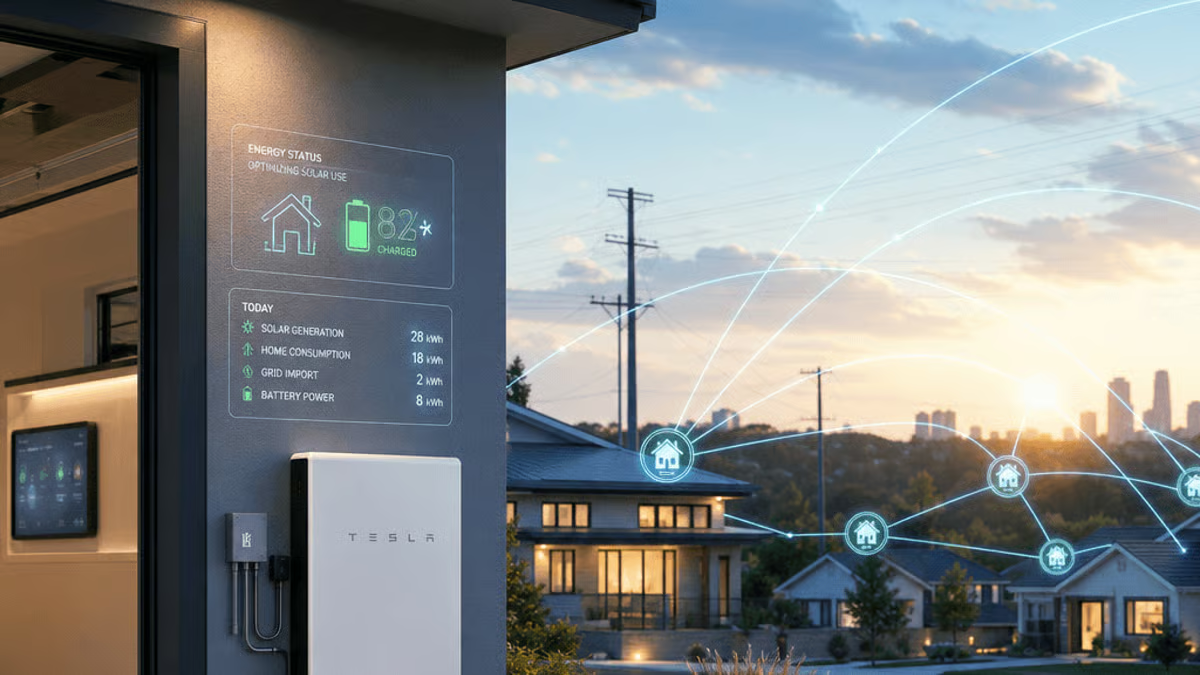
Base Power just found a clever workaround to one of the energy industry’s biggest headaches. The a16z-backed startup is sidestepping PJM’s notorious interconnection queue – where projects wait years for grid access – by installing batteries directly in people’s homes. In exchange for backup power, homeowners become nodes in a distributed energy network that can sell electricity back to the grid when it’s needed most. It’s a model that could reshape how we think about grid infrastructure.
Base Power is taking a fundamentally different approach to grid-scale energy storage, and it’s one that could sidestep the infrastructure bottlenecks choking the renewable energy transition. The startup, backed by Andreessen Horowitz, is placing batteries in residential homes across the PJM Interconnection territory, creating a distributed network that can supply electricity to the grid without waiting in the infamous interconnection queue.
The PJM queue problem has become legendary in energy circles. Projects routinely wait five to seven years for approval to connect to the grid, creating a massive backlog that’s stalling billions in clean energy investments. By going residential, Base Power effectively turns each home into a micro-power plant that’s already connected to the grid, eliminating the need for new transmission infrastructure or regulatory approvals that plague utility-scale projects.
Here’s how it works: Base Power installs battery systems in participating homes at little to no upfront cost to homeowners. In return, residents get backup power during outages, while Base Power aggregates the batteries into a virtual power plant that can discharge electricity to the grid during peak demand periods. The company then sells that capacity to utilities and grid operators who desperately need it, especially during heat waves and cold snaps when demand spikes.
The timing couldn’t be better. PJM, which coordinates electricity delivery across 13 states and Washington D.C., has been struggling with reliability concerns as coal plants retire faster than new resources come online. Grid operators are increasingly turning to battery storage as a solution, but the interconnection queue has created a catch-22 where the very resources needed to stabilize the grid can’t get connected in time.
Base Power’s distributed model also offers something utility-scale batteries can’t: resilience through geographic diversity. Instead of one massive battery farm that could fail or get knocked offline, the company’s network spreads risk across hundreds or thousands of residential installations. If one neighborhood goes down, the rest of the network keeps humming.
The economics work because electricity prices in PJM can swing wildly. During peak demand, wholesale prices can spike from $30 per megawatt-hour to $300 or higher. Base Power can charge home batteries when electricity is cheap, then discharge during these price spikes, pocketing the difference while providing critical grid stability services.
Andreessen Horowitz’s involvement signals that Silicon Valley sees residential energy storage as more than just a climate play. It’s a data and software opportunity disguised as hardware. Managing thousands of distributed batteries requires sophisticated algorithms to predict demand, optimize charging cycles, and coordinate discharge across the network. That’s the kind of technical challenge that gets venture investors excited.
The model also addresses one of the biggest barriers to residential solar and battery adoption: cost. By monetizing the grid services these batteries can provide, Base Power can subsidize or eliminate the upfront investment homeowners would normally face. It’s similar to how early solar companies like SunRun and Sungevity offered power purchase agreements that required no money down.
But the approach isn’t without challenges. Base Power needs to reach significant scale before it can meaningfully impact grid reliability. A few dozen or even a few hundred home batteries won’t move the needle for a grid that serves millions. The company will need thousands of installations to create a virtual power plant that utilities take seriously.
There’s also the question of homeowner adoption. People need to trust that Base Power won’t drain their batteries when they need backup power, and that the system will actually work during an outage. The company will need to build that trust through transparent communication about when and how it accesses battery capacity.
Regulatory uncertainty looms as well. While residential batteries don’t face the same interconnection hurdles as utility-scale projects, they’re entering a gray area where rules around aggregated distributed energy resources are still being written. PJM and state regulators will need to figure out how to properly value and compensate these virtual power plants.
Despite these hurdles, Base Power’s approach represents a genuine innovation in how we think about grid infrastructure. Instead of building massive central stations, what if the grid of the future is actually millions of small resources coordinated by software? It’s a vision that aligns with broader trends toward decentralization in everything from computing to finance.
Base Power’s bet on residential batteries as a grid solution is the kind of lateral thinking the energy transition needs. By treating homes as infrastructure rather than just consumers, the company is finding liquidity in a market choked by regulatory bottlenecks. Whether it can scale fast enough to matter remains to be seen, but the model proves there’s more than one way to build the grid of the future. For homeowners, it’s free backup power. For the grid, it’s desperately needed flexibility. And for Base Power, it’s a path to market that doesn’t require waiting half a decade in a queue.











Leave a Reply